Breast cancer in younger women is more common—and more aggressive—than current screening guidelines suggest. Stable trends across 11 years show a need for earlier, personalized risk evaluation. A review of data from seven outpatient centers in the New York region shows that 20 to 24% of all breast cancers detected over an 11-year period occurred […]
The deal, unveiled by the companies on Monday, comes as Nvidia has carried out a range of investments, such as those in OpenAI and Anthropic, to try to cement its dominance in the artificial intelligence market.
The Synopsys deal is about shifting the work of several high-tech industries that are just starting to adopt AI away from central processing units used in the past and toward the graphics processing unit chips sold by Nvidia.
Synopsys software is widely used in designing everything from computer chips to jet engines. Engineers use its tools to simulate those designs virtually in computers before committing to expensive prototype manufacturing.
Those simulations can take weeks, but could be sped up to a few hours using Nvidia’s chips, the CEOs of the two companies said during a press conference.
“The order of magnitude speed-up is going to unlock opportunities that have never been possible before,” Nvidia CEO Jensen Huang said in announcing the deal.
Synopsys and Nvidia are customers of one another. Nvidia’s flurry of investments has raised concerns that it is paying customers to buy its chips.
Synopsys CEO Sassine Ghazi said the Nvidia cash will give Synopsys “optionality” as it adapts its software for Nvidia chips.
“There is no intention or commitment to use that $2 billion to purchase Nvidia GPUs,” Ghazi said during the press conference. “This is something that we do on a normal course of business.”
Both CEOs said the deal is non-exclusive, and Ghazi said Synopsys is open to working with other chipmakers.
“If an AMD or an Intel or whichever customer wanting to capture a similar opportunity (approaches Synopsys), it’s not exclusive. We’re willing and happy to work with them,” Ghazi said.
Synopsys shares were up nearly 5%, while Nvidia was up 1.4%.
The world’s most valuable company has invested billions of dollars this year in companies linked to the booming AI industry, ranging from deals allowing as much as a $100 billion investment in ChatGPT parent OpenAI to a $5 billion stake in Intel.
Nvidia bought Synopsys’s common stock at $414.79 per share, the companies said on Monday, representing a discount of about 0.8% to the stock’s last closing price on Friday.
Synopsys also counts AMD as a customer, while Nvidia works with the electronic design automation firm’s rival Cadence Design. Shares of Cadence, which unveiled its own partnerships with Nvidia earlier this year, were about flat.
A TOR-targeting cancer drug unexpectedly extends yeast lifespan through a newly discovered metabolic feedback loop. Researchers at Queen Mary University of London’s School of Biological and Behavioural Sciences have found that the new TOR inhibitor rapalink-1 can extend the chronological lifespan of simple fission yeast, which they used as a model organism. The study, published […]
FILE PHOTO: OpenAI CEO Sam Altman told employees he was declaring a “code red” to improve ChatGPT and is planning to delay other initiatives, such as advertising.
| Photo Credit: Reuters
OpenAI CEO Sam Altman told employees he was declaring a “code red” to improve ChatGPT and is planning to delay other initiatives, such as advertising, The Information reported on Monday, citing an internal memo.
OpenAI hasn’t publicly acknowledged it is working on selling ads, but it is testing different types of ads, including those related to online shopping, the report said, citing a person with knowledge of its plans.
Most were loyal supporters of U.S. President Donald Trump, who carried their home of Montour County by 20 percentage points in the 2024 election. But they bristled at Washington’s push to fast-track artificial intelligence infrastructure, which has driven data-centre growth in rural areas around the U.S. where land is cheap.
On a recent November evening, residents in this county of 18,000 people stepped to the microphone, questioning Talen Energy officials about how their planned data centre might raise residents’ utility bills, reduce working farmland, and strain local water and natural resources.
“Say no to rezoning, so water keeps flowing and crops keep growing,” two women sang in a riff on Woody Guthrie’s folk song “This Land Is Your Land.”
Political leaders across the U.S. are urging a rapid expansion of data-centre capacity and new power production to keep the country competitive in AI. Trump, a Republican, is promoting the build-out as an economic and national security priority and has directed his administration to bypass environmental rules and permitting that give local communities a voice. In Pennsylvania, Democratic Governor Josh Shapiro and Republican Senator Dave McCormick are courting developers with incentives and infrastructure upgrades to attract investment in the fast-growing industry.
Some communities welcome the economic boost. But the backlash in Montour County, nestled in central Pennsylvania, reflects a growing coalition of farmers, environmentalists and homeowners who have united across partisan lines to resist data-centre expansion.
A report by Data Center Watch earlier this year found that about $64 billion worth of data centre projects have been blocked or delayed amid local pushback in states including Texas, Oregon and Tennessee. Critics in Pennsylvania worry that their region could turn into northern Virginia’s “data center alley,” with its vast, sprawling complexes.
If successful, the pushback threatens to slow efforts by the administration and the tech industry to build AI infrastructure fast enough to keep pace with global rivals. Political strategists say anger over the projects also could add to the problems Republicans face as they grapple with affordability worries going into the 2026 midterm elections.
“It’s an issue that can be exploited by whoever’s out of power,” said Chris Borick, a political science professor at Muhlenberg College in Allentown, Pennsylvania.
The politics of AI infrastructure, he added, remain unsettled: “The industry’s still evolving, and politicians are figuring out where to stand. It’s like social media — everyone rushed in before understanding the consequences.”
Talen Energy is requesting to rezone roughly 1,300 acres in Montour County from agricultural to industrial use, the first step toward building a large data centre that would include 12 to 15 buildings. The site would sit in the shadow of the company’s 1,528-megawatt natural-gas-fired power plant, tucked among farmland and dirt roads used heavily by the region’s Amish community.
Talen Energy has said the project would take 350 acres of farmland supporting soybeans, corn and livestock. Residents worry that losing this land would weaken the local farm economy, including a nearby plant that processes soybeans for regional food and feed.
Montour County Commissioner Rebecca Dressler, a Republican, said the concerns are rooted less in ideology than in preserving the region’s character. “Small-town character defines our community,” Dressler said. “People aren’t anti-development – they just want growth that fits who we are.”
At its recent November meeting, the county planning commission recommended against approving the rezoning by a 6-1 vote; a decision that drew thunderous applause. The issue now goes to Dressler and the other two county commissioners for a final decision in mid-December.
Rather than blaming Trump, residents are pointing their fingers at the billion-dollar companies behind the data-centre boom; firms they say have the money to snap up farmland, reshape rural landscapes and leave locals to absorb the higher utility costs.
“I think it’s a society that has forgotten about the small person – the people who live here, the farmers who are struggling with the economy,” said Theresa McCollum, a 70-year-old Trump supporter.
In a place that prides itself on local control, the shift in power to Washington does not sit well.
“Stay out. We wouldn’t even be having this conversation without federal involvement,” said Craig High, 39, also a Trump supporter. “Both (political) parties are pushing data centers and giving regulatory relief — water permits, permitting, all of it.”
Pennsylvania utilities project a sharp rise in electricity demand from data centres by the end of the decade – enough to power several million additional homes, according to data from PJM Interconnection, the region’s grid operator.
Electricity prices in Pennsylvania increased by about 15% in the past year – roughly double the national average, according to federal data. That surge is already rippling through the regional grid. Capacity prices, which help determine what power plants are paid to ensure supply during peak demand, have spiked in recent auctions, and utilities have begun raising rates to cover growing infrastructure needs.
Analysts warn that customers’ bills could climb significantly in the years ahead.
For many families, the strain is already visible. Overdue utility balances have risen far faster than inflation since 2022, and Pennsylvania ranks among the states with the highest levels of household energy debt, according to the Century Foundation, a progressive research organization.
Those pocketbook pressures are starting to reshape politics in some parts of the United States. Earlier this year, Alicia Johnson became one of two Democrats elected to Georgia’s utility board since 2007 after her campaign highlighted frustration over rising power bills and unchecked growth of data centres. She said the issues in her campaign were a preview of what states like Pennsylvania may face in next year’s U.S. midterm elections. Power prices have surged in Georgia in recent years, in large part because of massive cost overruns at the new Vogtle nuclear plant.
“Data centers and utility costs were the top two issues on the ballot, and people are angry,” Johnson said. “They don’t want data centers without guardrails, and they don’t want to be the ones paying for them. This is going to be part of the national affordability debate in 2026.”
Ginny Marcille-Kerslake, an organizer with Food and Water Watch, an environmental nonprofit group, has spent months mobilizing opposition to data centres in places like Montour County. She predicted a political reckoning next year.
“Communities – red, blue, and everything in between – are united in opposition,” she said, referring to so-called red areas dominated by Republicans and blue areas controlled by Democrats. “At a time when we’re so divided, this issue is bringing people together.”
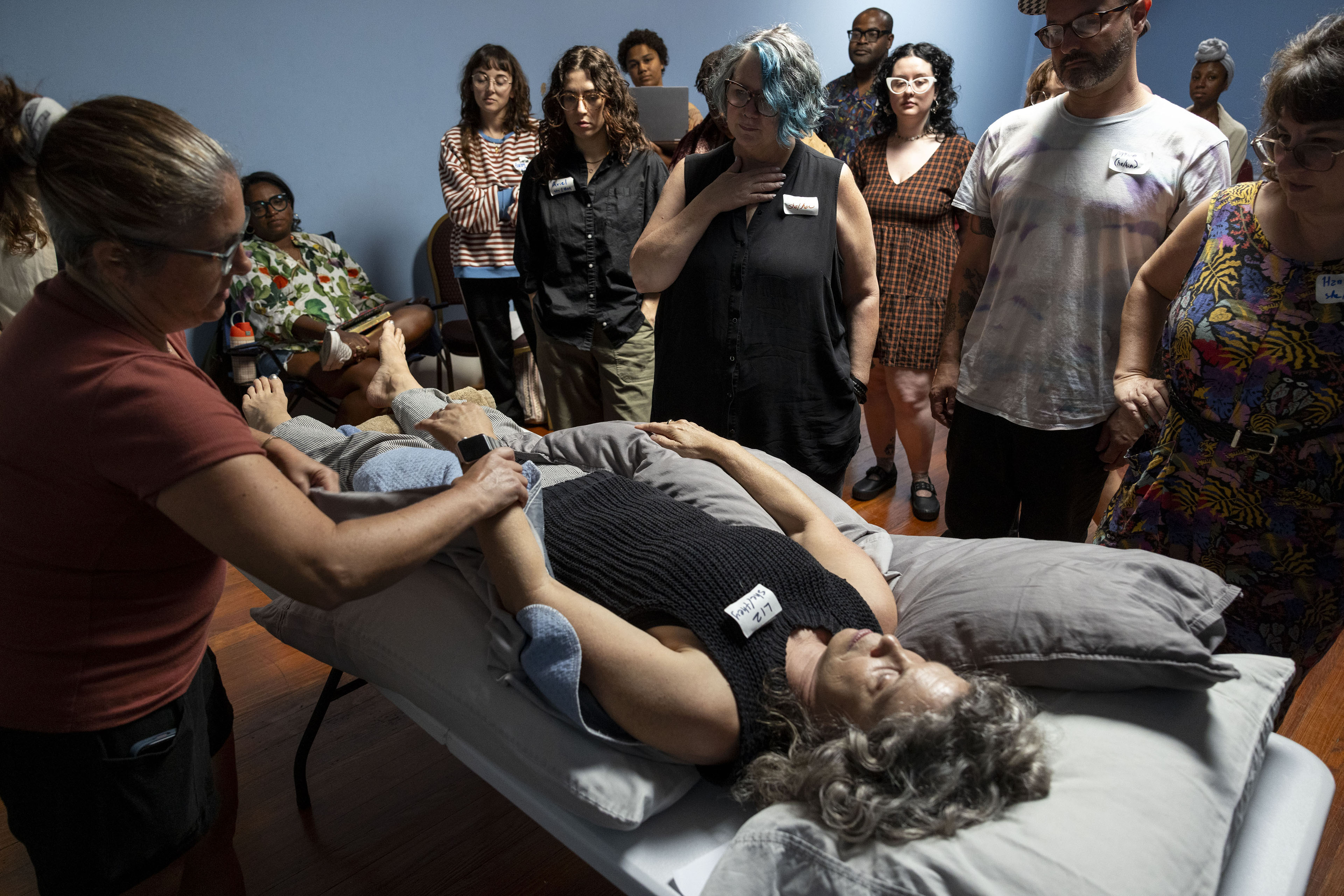
Liz Dunnebacke no se está muriendo, pero durante un reciente taller sobre cuidados al final de la vida en Nueva Orleans, fingió que sí.
Acostada e inmóvil sobre una mesa plegable que hacía las veces de cama, Dunnebacke se quejaba de dolor en las piernas. La enfermera Ana Kanellos, enrollando dos pequeñas toallas blancas, mostró cómo elevarle los tobillos para aliviarle el dolor.
“¿Las piernas de mamá siempre están hinchadas? Entonces, levántaselas”, dijo Kanellos.
Unas 20 personas, residentes de Nueva Orleans, escuchaban con atención, interesadas en aprender más sobre cómo cuidar a seres queridos en casa cuando se acercan al final de sus vidas.
Alix Vargas, una de las asistentes, dijo que antes le aterraba la idea de morir. Pero hace unos tres años, la muerte de una prima muy cercana la impulse a participar en talleres grupales de escritura, lo que la ayudó a enfrentar su duelo y superar ese miedo. “Siento un fuerte llamado hacia este trabajo”, dijo. “Definitivamente es un conocimiento que quería adquirir y ampliar mi mente en ese sentido. Y además, es algo que todos vamos a experimentar en nuestras vidas”.
El taller la hizo pensar en una vecina cuya madre tiene demencia. “Inmediatamente pensé: ‘Ok, hay alguien en mi entorno cercano que está viviendo esto’”, recordó Vargas. “‘Esto es una forma práctica de poner en acción la ayuda mutua’”.
La demanda de atención médica en casa, incluyendo los cuidados paliativos domiciliarios, se ha disparado desde el inicio de la pandemia de covid, al igual que el número de personas que cuidan a familiares.
Según una encuesta de 2024 realizada por AARP y la Alianza Nacional de Cuidadores (National Alliance for Caregiving), se calcula que 63 millones de personas en el país —casi una cuarta parte de los adultos— brindaron cuidados a otra persona con una condición médica o discapacidad, por lo general otro adulto, el año anterior.
En los últimos 10 años, unas 20 millones de personas más han asumido este rol de cuidadoras.
Se estima que casi 1 de cada 5 personas en Estados Unidos tendrá 65 años o más para 2030, por lo que expertos en salud pronostican que la necesidad de cuidadores en el hogar seguirá creciendo.
Hay numerosos recursos en línea sobre cuidados al final de la vida, pero la capacitación práctica para preparar a personas cuidadoras no es tan accesible, y puede ser costosa. Aun así, familiares sin entrenamiento están asumiendo tareas de enfermería y atención médica.
Durante su campaña presidencial de 2024, Donald Trump prometió más apoyo para las personas cuidadoras, incluyendo un nuevo crédito fiscal para quienes cuidan a familiares. Respaldó un proyecto de ley que fue reintroducido en el Congreso este año y que permitiría otorgar créditos fiscales de hasta $5.000 a cuidadores familiares, pero la legislación no ha avanzado.
Mientras tanto, los recortes a Medicaid previstos en la ley republicana conocida como One Big Beautiful Bill Act, que el presidente Trump firmó en julio, podrían llevar a que algunos estados reconsideren su participación en programas opcionales de Medicaid, como el que ayuda a cubrir los cuidados paliativos en casa. Esto podría hacer que morir en casa sea aún menos accesible para familias de bajos ingresos, según investigadores y defensores.
Activistas como Osha Towers tratan de ayudar a los cuidadores a navegar esta incertidumbre. Towers lidera el trabajo comunitario en LGBTQ+ en Compasión y Opciones (Compassion & Choices), una organización nacional que busca mejorar los cuidados, la preparación y la educación sobre el final de la vida. “Es sin duda algo muy aterrador, pero lo que sí sabemos que podemos hacer ahora es simplemente estar presentes para cada persona, y asegurarnos de que sepan qué necesitan para estar preparadas”, afirmó Towers.
La enfermera voluntaria Ana Kanellos demuestra técnicas de cuidado en el hogar durante el taller de Wake de septiembre en el Healing Center de Nueva Orleans. Wake es una organización sin fines de lucro que ofrece educación y recursos para el cuidado de personas hacia el final de la vida.(Christiana Botic/Verite News and CatchLight Local/Report for America)
En Nueva Orleans, una organización sin fines de lucro llamada Wake, que se enfoca en apoyar a familiares que brindan cuidados al final de la vida y en el momento de la muerte, es una de las que busca llenar ese vacío de conocimiento.
Wake organizó el taller gratuito de tres días en septiembre donde Dunnebacke, fundadora del grupo, simuló ser una paciente moribunda. Estos talleres buscan preparar a las personas para saber qué esperar cuando un ser querido está muriendo y cómo cuidarlo, incluso sin ayuda profesional costosa. Los cuidados domiciliarios a tiempo completo son poco comunes. “No se necesita ninguna formación especial para hacer este trabajo”, señaló Dunnebacke. “Solo se necesitan algunas habilidades y apoyos para poder hacerlo”.
En cierto modo, la evolución de los cuidados al final de la vida en Estados Unidos en el último siglo han vuelto a cómo era en el pasado. No fue sino hasta la década de 1960 que la mayoría de las personas comenzaron a morir en hospitales, residencias de mayores e instituciones de cuidados paliativos, en lugar de en casa.
Aunque estas instituciones pueden ofrecer atención médica avanzada inmediata y cuidados paliativos, a menudo carecen de la conexión humana que proporciona el cuidado en el hogar, según Laurie Dietrich, gerente de programas de Wake.
Ahora, más personas quieren morir en sus casas, rodeadas de su familia, pero con el apoyo y la tecnología que ofrecen las instalaciones médicas modernas.
En la última década, las doulas del final de la vida o matronas de la muerte —personas que brindan apoyo no médico y emocional a las personas moribundas y sus seres queridos— se han vuelto más populares como una forma de acompañar en ese proceso y llenar ese vacío.
Douglas Simpson, director ejecutivo de la Asociación Internacional de Doulas del Final de la Vida (International End of Life Doula Association), dijo que su organización reconoce la falta de recursos sobre cuidados durante la muerte, por lo que está capacitando a doulas para que actúen como educadoras comunitarias. Espera que estas doulas sean especialmente útiles en comunidades rurales y que promuevan conversaciones sobre la muerte. “Se trata de lograr que las personas se sienta más abiertas y cómodas para hablar sobre la muerte y reflexionar sobre su propia mortalidad”, dijo Simpson.
La capacitación como doula de la muerte varía según la organización, pero el grupo de Simpson se enfoca en enseñar sobre el proceso de morir, cómo respetar la autonomía de la persona que está muriendo y cómo las doulas deben cuidar de sí mismas mientras cuidan de otros.
Algunas personas que participaron en el taller de Wake ya habían recibido algún tipo de formación como doula de la muerte. Después de que la madre de Nicole Washington fue asesinada en 2023, ella consideró convertirse en doula. Pero pensó que la capacitación, que puede costar entre $800 y $3.000, era demasiado clínica e impersonal, en contraste con el enfoque comunitario de Wake. “Me siento con mucha energía, muy animada”, aseguró Washington. “Y también es muy reconfortante compartir con personas que están familiarizadas con la muerte y el duelo”
Susan Nelson, de Ochsner Health, quien ha trabajado como geriatra por 25 años, dijo que se necesitan más programas especializados como el de Wake para capacitar y preparar a las personas cuidadoras. “Aprender habilidades para cuidar a otros suele ser, lamentablemente, una experiencia de prueba y error”, añadió Nelson.
Kanellos (izq.) demuestra técnicas de cuidado en el hogar en Dunnebacke. “No se necesita ninguna formación especial para realizar este trabajo”, dice Dunnebacke. “Solo se necesitan algunas habilidades y apoyo para lograrlo”.(Christiana Botic/Verite News and CatchLight Local/Report for America)
Compasión y Opciones también busca educar a personas cuidadoras. Towers explicó que la formación de la organización abarca desde la planificación anticipada hasta actuar como representante de atención médica y brindar cuidados durante la etapa final. “En este país nos hemos alejado de los cuidados al final de la vida de una forma en la que antes no lo hacíamos”, dijo Towers.
Towers señaló que este movimiento para cuidar a las personas en casa y brindarles apoyo comunitario tiene sus raíces en la epidemia de VIH/sida, cuando algunos médicos se negaban a atender a personas con VIH. Amistades, especialmente dentro de la comunidad lesbiana, comenzaron a organizar la entrega de alimentos, visitas, vigilias al pie de la cama e incluso círculos de contacto, donde los pacientes recibían gestos de consuelo como tomarse de las manos para aliviar el dolor y la sensación de aislamiento.
“Me gusta verlo como un modelo de lo que podemos volver a hacer hoy: priorizar el cuidado comunitario”, dijo Towers.
Este artículo se produjjo en colaboración con Verité News. La reportera de Verité News, Christiana Botic, colaboró con este informe.
The Sanchar Saathi app integrates other tools the DoT has launched in the past, such as a feature to check the “genuineness” of the IMEI number assigned to a device, and to block a stolen phone by barring telecom operators from working on a blacklisted IMEI.
| Photo Credit: Reuters
The government’s mandate on Monday (December 1, 2025) for smartphone makers to pre-install the Sanchar Saathi app sparked backlash from the Opposition and from digital rights activists. Leader of the Opposition in the Rajya Sabha Mallikarjun Kharge wrote on X, formerly Twitter, that “unilateral directions to preload this app without taking into confidence various stakeholders and citizens is akin to dictatorship,” and that the app was “yet another addition to the long list of attempts by the BJP to strangulate the voice of the people”.
Rajya Sabha MP Priyanka Chaturvedi from the Shiv Sena (UBT), reacting to Communications Minister Jyotiraditya Scindia’s assurance on Tuesday (December 2, 2025) that the app can be deleted if users wished, said, “When you say ‘mandated’ in your notification, when you are asking every mobile manufacturer to preload a government app, it then comes preloaded on every phone. So it is absolutely ridiculous [to say] that you can voluntarily download or delete the app.”
CPI(M) leader and Rajya Sabha MP John Brittas wrote in a letter to Communications Minister Jyotiraditya Scindia that “compulsory pre-installation, even if deletion is later permitted, undermines the very principle of informed consent and transforms the mobile phone into a potential instrument of continuous digital supervision”.
Sanchar Saathi is an app that the Department of Telecommunications (DoT) launched initially as a website in 2023 to allow users to flag fraudulent phone calls. The app also integrates other tools the DoT has launched in the past, such as a feature to check the “genuineness” of the International Mobile Equipment Identity (IMEI) number assigned to a device, and to block a stolen phone by barring telecom operators from working on a blacklisted IMEI.
Watch: Opposition slams govt. over mandatory Sanchar Saathi App
Mandating the app to be installed, as the DoT did in an order to phone makers on Monday (December 1, 2025), would likely mean that users wouldn’t be able to uninstall it, as is the case for private apps pre-installed on many smartphone brands’ devices. The DoT did not officially announce the move until after news reports came out describing the move.
Some worried about the potential for a pre-installed app like this to be used as a carrier for malware and spyware. Anand Venkatanarayanan, co-founder of DeepStrat, a policy and cybersecurity consultancy, said on X that a “Regulator as a Malware operator is quite a thing in India,” as “[o]nce you get root in OS layer by a govt app, an Over the air update is all it takes to “get more permissions”.” Root access refers to privileged access in an operating system, which pre-installed apps usually have; such access allows apps to add to what they have access to without prompting users to accept additional permissions.
Why India is forcing Sanchar Saathi app on new phones? | The Hindu Explains
Why India is forcing Sanchar Saathi app on new phones? | The Hindu Explains
| Video Credit:
The Hindu
Last week, the DoT ordered WhatsApp and other platforms like it to restrict users to devices containing the SIM card they used to register. That order also ordered WhatsApp web and similar secondary access mechanisms to be logged out every six hours. Both directions were issued under the Telecom Cyber Security Rules, 2024, which were amended in November to allow the DoT to target a wide range of firms which use mobile numbers to identify users, going beyond its usual remit of telecom operators.
FILE PHOTO: Zoho CEO Sridhar Vembu has responded to Y Combinator President Garry Tan’s jab that the SaaS company’s business could be seized by vibe coded apps.
| Photo Credit: KSL
Zoho CEO Sridhar Vembu has responded to Y Combinator President Garry Tan’s jab that the SaaS company’s business could be easily seized by vibe coded apps, saying that Zoho’s business was still seeing “rapid customer growth exceeding 50%.”
On the social media platform X on December 2, Mr. Tan had pointed to an article on Mr. Vembu’s suspicions around the hype of vibe coding.
“Zoho’s business would be first to be competed away by people building their own custom software built by people using Replit, Emergent and Taskade. Why pay $30/seat/month for over bundled SaaS when soon even non-tech ops ppl can vibe-code a custom solution in a weekend?” Mr. Tan had tweeted.
In turn, Mr. Vembu questioned why legitimate vibe coded email or spreadsheet or accounting apps weren’t already being used instead.
“My own personal R&D project is to enable huge gains in programmer productivity by combining compiler technology with AI. Our goal is to enable a quantum leap in programmer productivity while being able to provide security, privacy and compliance guarantees. Without those guarantees, vibe coding just piles up tech debt faster and faster until the whole thing collapses,” he went on.
Mr. Vembu then took a shot at Mr. Tan, claiming that for people like him, tech debt is to be “pawned off on unsuspecting acquirers.” He bet that Zoho would surpass vibe coding companies.
Multiple users agreed with Mr. Vembu’s sentiment, saying Zoho’s offerings were valuable and available at an affordable price for smaller businesses.
Generative AI-powered vibe coding startups have grown exponentially since the trend took off sometime ago with players like Cursor, Replit, Bolt driving popularity, and new entrants like Emergent, Composio and TableSprint now joining the segment.
A decade-long study links polyphenol-rich diets to slower increases in cardiovascular risk. People who often eat foods and drinks high in polyphenols, such as tea, coffee, berries, cocoa, nuts, whole grains and olive oil, may support better heart health over the long term. A research team from King’s College London reported that individuals who followed […]
Union Minister Jyotiraditya M. Scindia (right) speaks outside Parliament on November 2, 2025. Picture: Screenshot from video posted on X/@ANI
Communications Minister Jyotiraditya Scindia defended the Department of Telecommunications (DoT)’s directions to phone makers to mandatorily pre-install the Sanchar Saathi app on devices sold from March 2026 onwards.
“There is no snooping or call monitoring,” Mr. Scindia said on Tuesday (December 2, 2025) in remarks outside Parliament. “If you don’t want the app, don’t activate it. If you do want it on your phone, keep it. If you want to delete it, delete it.”
“The way your phone has many pre-installed apps like Google Maps— you can delete Google Maps if you don’t want it, so you can delete this also,” Mr. Scindia said. “Obviously you can delete it. There is no problem. This is a matter of customer protection. It is not mandatory. If you don’t want to register, and don’t want to use the app, don’t use it; don’t register, and it will lay dormant.”
Google’s pre-installed apps on many phone brands cannot be uninstalled; they can, however, be disabled. Apps bundled in with a phone may also enjoy elevated permissions access by default, even if the variant distributed on application marketplaces like Google Play and Apple’s App Store seek individual permissions on an ad hoc basis.
Mr. Scindia added that to protect people from fraud or theft, it was the government’s “responsibility” to have the app distributed to all users. “If you don’t register, it will stay inactive.”
“In one year, in 2024 alone, our country had ₹22,800 crore of frauds,” Mr. Scindia said. “On one hand, the Opposition complains about increasing fraud. On the other, when we give the Sanchar Saathi to the common citizens, they cry Pegasus,” Mr. Scindia said, referring to the Israeli-developed spyware acquired by the Intelligence Bureau, and allegedly used on Opposition leaders, activists and journalists in India.
“Those who don’t want to see the truth cannot be shown the truth,” Mr. Scindia said.
Watch: Opposition slams govt. over mandatory Sanchar Saathi App