Home Blog Page 170

They Need a Ventilator To Stay Alive. Getting One Can Be a Nightmare.

0


On vacation in Mexico last year, Michael DiPlacido passed out twice while scuba diving and again in his hotel. Back in St. Louis, doctors diagnosed him with amyotrophic lateral sclerosis, or ALS, an incurable disease that often requires mechanical ventilation.

When his son Adam DiPlacido tried to find a permanent place to care for his father, who now needed a ventilator to breathe through a tracheostomy tube, he discovered none of Missouri’s nearly 500 nursing homes could take him.

“I never thought it would be easy, but I never thought it would be this hard,” Adam said.

A KFF Health News investigation found widespread flaws and gaps in care for some of the country’s most debilitated people: those who cannot breathe on their own.

Spinal cord injuries, strokes, chronic obstructive pulmonary disease, and neurological diseases such as multiple sclerosis have left tens of thousands of Americans permanently dependent on ventilators. The barriers these patients face offer a stark example of how the United States’ disjointed health care system makes dealing with severe illness so much harder.

The investigation found patients are frequently stymied in efforts to get their insurers to provide appropriate home ventilators. They can end up spending hundreds of thousands of dollars for private nurses to make sure they don’t die overnight. Those who need to be in a nursing home or other health facility sometimes must move to another state, far from their families.

“There are not a lot of institutions that can manage these people,” said Jonathon Schwartz, acting chief medical officer for the Spaulding Rehabilitation Network in Boston.

Only 347 of the nation’s roughly 14,750 nursing homes have specialized units dedicated to people on ventilators, a KFF Health News analysis of federal data shows. Fifteen states, including Missouri, have no nursing homes with a specialized unit for ventilator care.

While nursing homes can care for residents on ventilators on their regular floors, in practice few do. From April through June, fewer than 10% of nursing homes had long-stay residents breathing with the assistance of invasive mechanical ventilators, which deliver air through a tube down the airway or via a tracheostomy, the analysis found. Fewer than 15% of nursing homes had short-stay patients on ventilators.

Many patients in nursing homes can be weaned off ventilators, but those who can’t because of their condition often spend years in hospitals, which are not designed for residency. Innovative alternatives to traditional nursing homes exist in some areas of the country, but they haven’t been widely replicated and now are at risk from steep reductions in Medicaid enacted by President Donald Trump and the Republican-controlled Congress.

“It could create a terrible scenario,” said Gene Gantt, a respiratory care consultant to states and insurers.

Many people permanently on ventilators prefer to live at home as long as they can. But care there can be perilous and pricey. Some state health programs pay for ventilator care for low-income patients, but getting enrolled can take months amid bureaucratic hurdles and waitlists.

Some insurers balk at providing advanced home ventilators — which sound alerts for collapsed lungs, airway leaks, or malfunctions and can cost more than $10,000 — until patients have lost much of their ability to breathe.

“Feeling you’re suffocating is a horrific feeling, and that feeling can go on for months and months” as ALS patients decline while sparring with insurers, said Tyler Rehbein, an assistant professor of neurology at the University of Rochester who treats ALS patients.

Tyler Rehbein, an assistant professor of neurology at the University of Rochester who treats ALS patients, says he often battles insurers to get them to cover battery-powered ventilators, which are portable, unlike basic respiratory devices. (Lauren Petracca for KFF Health News)

‘Out of Money’

David Goldstein’s first symptom of ALS was a limp that appeared in the fall of 2022. It took six months for doctors to diagnose him with the neuromuscular disorder, also known as Lou Gehrig’s Disease. ALS afflicts about 34,000 Americans, destroying the nerve cells in the brain and spinal cord that control muscles, including those for breathing. It eventually results in complete paralysis, while most people remain mentally alert. Patients usually end up on ventilators if they do not die first, and respiratory failure is the most common cause of death.

Now 69 and on a ventilator, David cannot move anything except his eyes and mouth, said his ex-wife, Janis Goldstein, who has power of attorney. He requires someone around all the time in his Houston apartment to feed and bathe him, give him medication, and remove mucus blocking his airway. The settings on the ventilator require frequent monitoring and adjustments.

In spring of 2023, David got on the waiting list for Texas’ Medicaid home health program for disabled adults. More than a year later, Texas authorized 12 hours of home care a day. Still, Janis said, the state’s designated administrator sometimes has trouble getting workers for those shifts, and she and her ex-husband must pay for nurses to cover the rest of the day or night.

She said they have spent around a half-million dollars, largely on nurses and aides. They raised much of it through online campaigns and a fundraiser headlined by the country singer Larry Gatlin.

“The point that we’re at now, with the 24-hour help, is we’re pretty much out of money,” Janis said.

She is planning to move David into one of the few nursing homes in the region that take patients on ventilators, she said, but is concerned it will be difficult to arrange for someone to stay with David overnight in his room. She fears that if David’s position shifts even half an inch, he won’t be able to call for help through the machine that tracks his eye movements.

“I don’t know that he’ll be able to handle the stress and the anxiety of knowing that he could suffocate, even in a facility, because he doesn’t have someone by his side,” she said.
A ventilator sits on a gurney in a hospital exam room
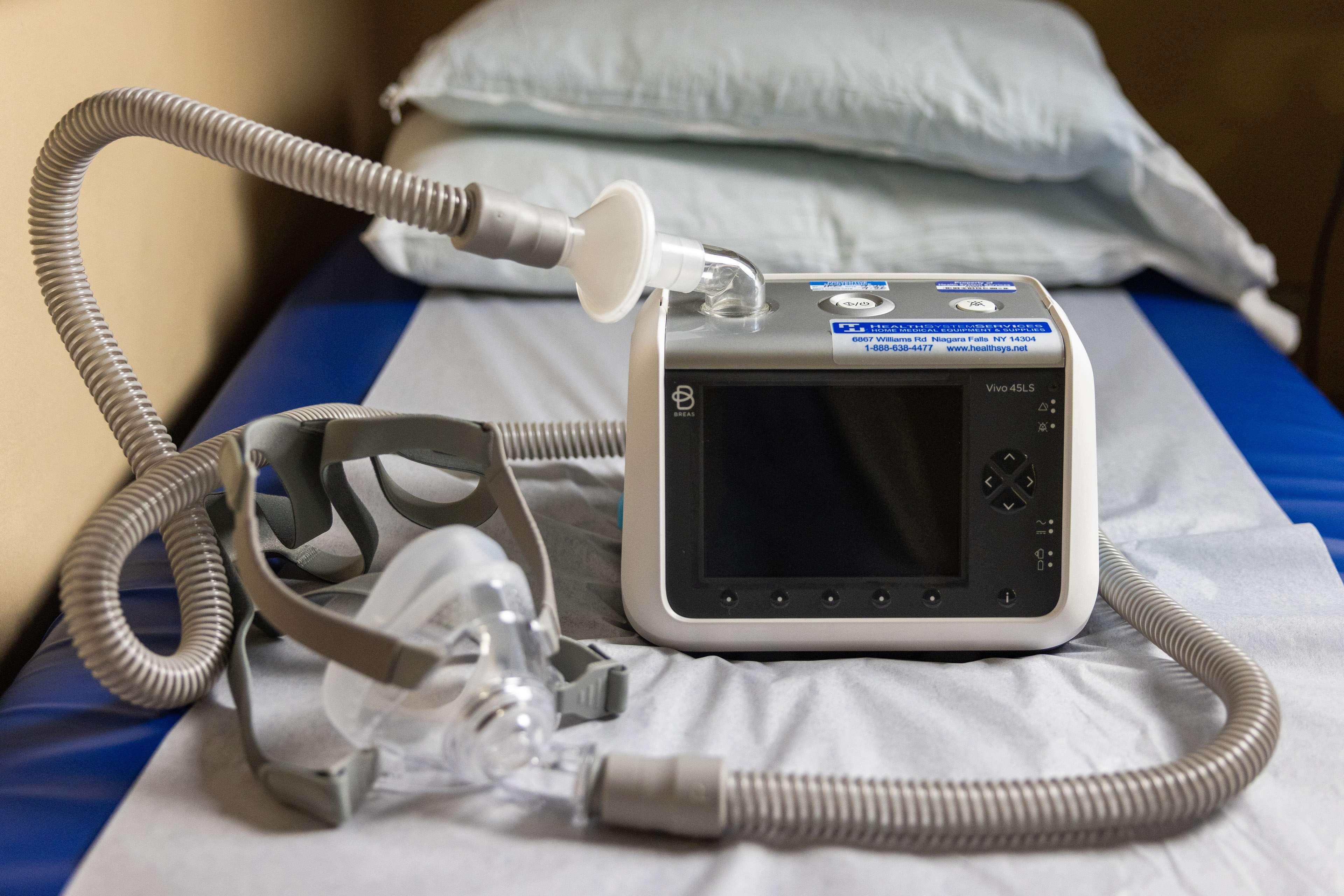
Home mechanical ventilators have portable power sources and backup batteries, as well as alarms that detect airway blockages, leaks, and device malfunctions. Physicians who treat ALS patients say insurers are often reluctant to provide them.(Lauren Petracca for KFF Health News)

Ventilator Deserts

When Michael DiPlacido’s son Adam spent weeks searching for a facility in Missouri that could take care of a patient on a ventilator with a trach tube, the only one that was even a possibility told him it couldn’t accept new patients, because its lone respiratory therapist had quit.

“It’s incredible to me there is not one single place in Missouri that can take a patient like my father,” Adam said.

Looking outside the state, Michael decided to move to a nursing home north of Chicago, about five hours by car from St. Louis. After three months, he left the facility because it was so far away from his family, Adam said.

Adam helped his father move into a long-term care hospital in suburban St. Louis for six weeks. But Michael’s insurer would not pay for hospital-level acute care, so Adam said Michael had to pay more than $47,000 out-of-pocket. Next, Adam helped him move to another Illinois nursing home, about an hour away, that his son had originally rejected because of online reviews, including a Medicare warning that abuse had occurred. Finding it deficient, Michael left after a week.

Adam found a private nursing home company that would care for Michael in his home, at a cost of $960 a day. “After 323 days, my father has finally made it back home,” Adam said in an email in September.

But with his health rapidly deteriorating, Michael was admitted to a hospice facility in October. He died later that month at 75.

A man stands with his hands on a large, yellow metal tube
Iron lungs, the precursor to today’s mechanical ventilators, were developed to treat polio patients suffering from respiratory paralysis. These two iron lungs for adults, built by the J.H. Emerson Co. in the 1930s, are part of a collection owned by Gene Gantt, a Tennessee respiratory care consultant.(Donna Gantt)

Gantt, the respiratory care consultant, said that fewer than half of state Medicaid programs provide adequate reimbursement rates for ventilator patients. He said most state Medicaid payment formulas do not measure outcomes or reward nursing homes financially if they provide better care, such as weaning a patient off the ventilator or preventing infections. He said he has seen nursing homes accept patients with trach tubes even when nurses lack proper training, or when the facility doesn’t employ respiratory therapists.

“For the large part, these patients are stuck in bed,” Gantt said. “We should try to get them the best quality of life.”

David Gifford, the chief medical officer for the American Health Care Association, a nursing home trade group, said equipping a nursing home with ventilators and getting state approval is expensive, and outside of urban areas, many markets lack enough local patients who need ventilators to make it financially worthwhile.

“It’s not as simple as saying we’re going to pay more and have more respiratory therapists,” Gifford said. “This is a group that needs highly specialized care. You’re not going to have it everywhere.”

Flagging Breaths

Derek McManus’ weakening right hand and occasional twitching was the first sign something was wrong. In October 2023, doctors diagnosed Derek, a corporate executive who lives in Painted Post, New York, with ALS.

By August 2024, Derek’s lungs were operating at 78% of capacity, his medical records show. Because ALS progresses so quickly, doctors often prescribe advanced home mechanical ventilators. These machines deliver high-pressure air through a mask (called non-invasive) or a tube down the airway or via a tracheostomy (called invasive). They can calibrate themselves based on a patient’s breathing and have alarms that detect leaks, airway blockages, and device malfunctions. They can run on portable power sources and backup batteries in case of a power failure. The machines can allow people to talk or eat.
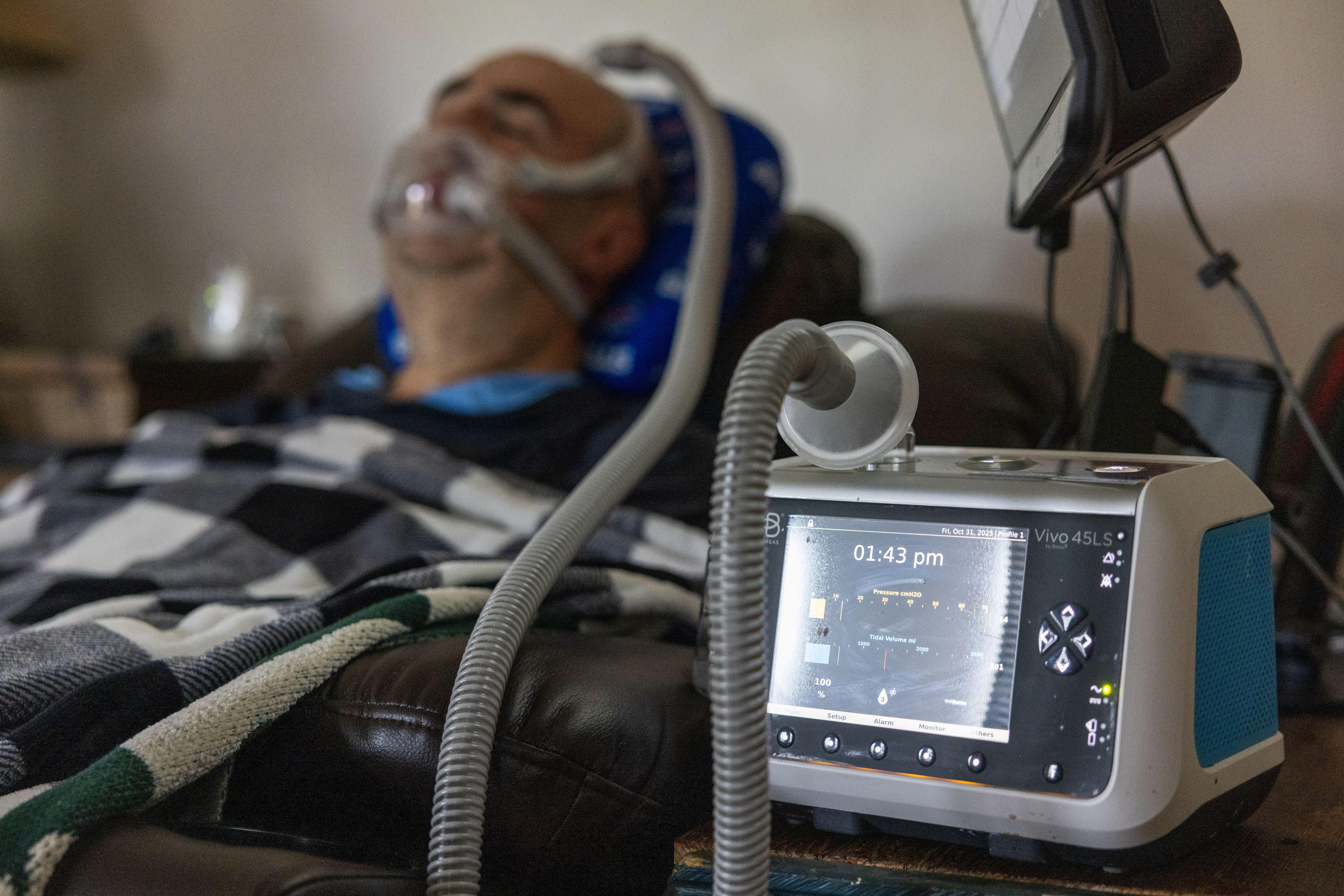
A ventilator machine is in the foreground, while a man wearing a ventilator mask is in the background
Derek McManus’ insurer refused to provide an advanced medical ventilator. Each machine can cost insurers more than $10,000. An independent appeals reviewer ordered the insurer to provide one.(Lauren Petracca for KFF Health News)

But some insurers have what physicians call “fail first” policies that won’t pay for ventilators unless the patient has already tried a respiratory assist device without success (as defined by the company). These simpler machines, the kind sleep apnea patients use, are not as effective in removing carbon dioxide as ventilators and lack safety features. Commonly known by the acronyms BiPAP or CPAP, they can cost $1,000 or more and need to be plugged into an electrical socket.

“It seems to be an expectation of insurance companies they should live the rest of their life attached to a wall outlet,” said Rehbein, the University of Rochester neurologist.

In November 2024, Derek’s insurer denied his physician’s request for a ventilator, writing that “you have not failed treatment” with the simpler device, according to the insurer’s letter, provided by his wife, Lesley McManus. By April, Derek’s breathing capacity had dropped to 60% of normal. Lesley said she worried he would suffocate overnight if his basic device stopped working, since it had no safety alert. “He couldn’t take the mask off, because he can’t move his hands,” she said.

The insurer denied a second request for a ventilator, reiterating that Derek had not shown the simpler machine hadn’t worked, according to another insurance letter. Derek, who is 56, appealed to an independent medical reviewer, who overturned the insurer’s decision and ordered it to provide a ventilator, according to a copy of the ruling. The doctor wrote that the machine’s alarm system and capacity to automatically clear away airway secretion by simulating a cough were “vital for patient safety” and would help protect Derek from developing pneumonia.

“This multi-faceted approach to respiratory care is essential for improving gas exchange, reducing the work of breathing, and ultimately enhancing the patient’s quality of life and extending survival,” the decision said.

Derek said that since he got the new machine, he’s breathing easier, literally and emotionally. “If I’m not breathing right, it will give it an alert, and it will let us know if I don’t have the mask on properly,” he said.

The McManus family requested KFF Health News not publish their insurer’s name, out of fear of repercussions.
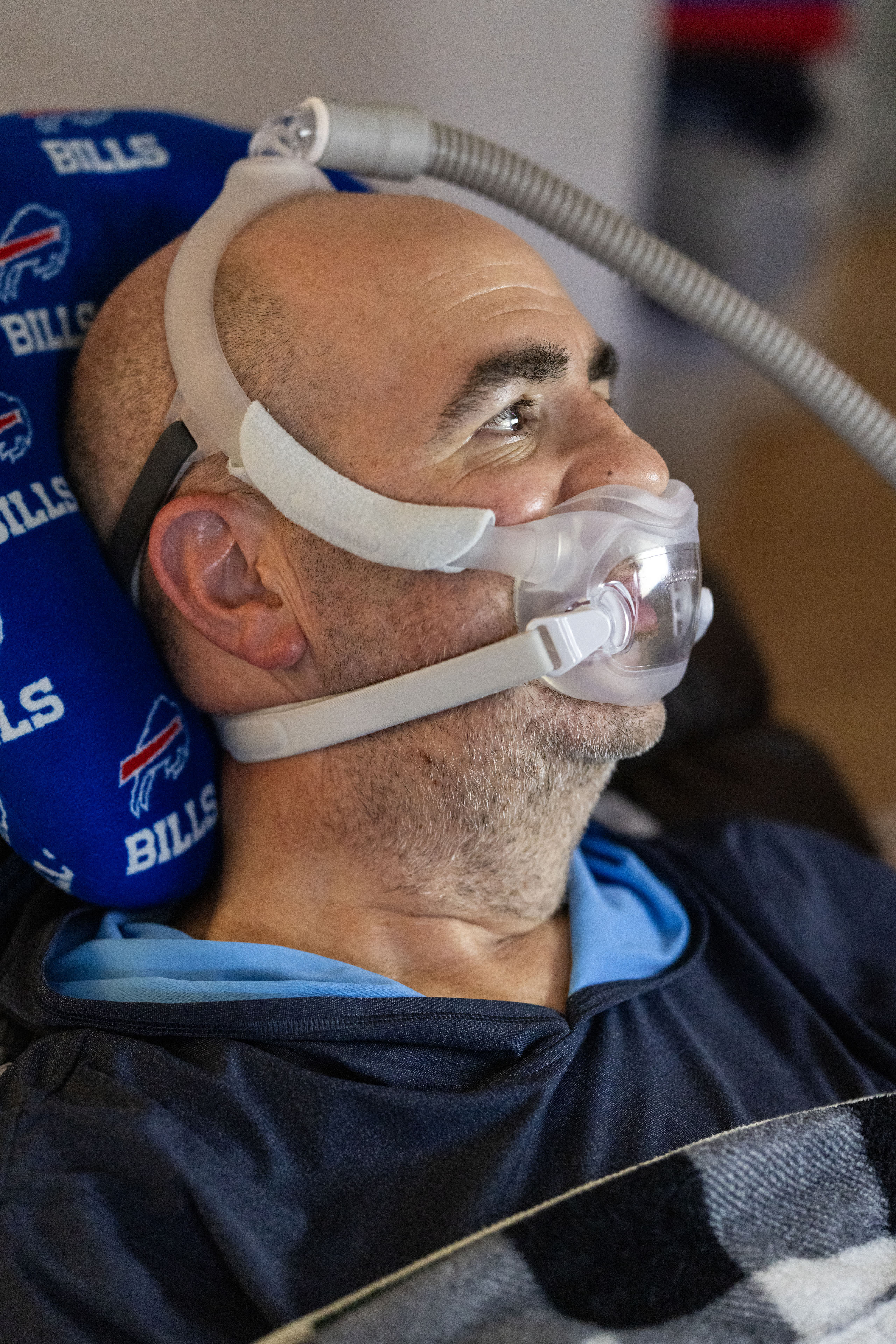
A man leans back on a Buffalo Bills pillow while wearing a breathing mask
Derek McManus says his new ventilator has made things easier for him physically and emotionally.(Lauren Petracca for KFF Health News)

Insurance Rules

John Hansen-Flaschen, a pulmonologist who founded Penn Medicine’s program for home assisted ventilation, said some patients give up when an insurer denies their requests and don’t file appeals. “These are some of the most vulnerable people there are, and they don’t have energy to do this,” he said.

Doctors who treat patients with neuromuscular disorders said the most resistance to providing ventilators comes from some private Medicare Advantage plans, but they said it also has been an issue with some commercial policies.

Insurers dispute that they refuse ventilators for patients who need them. The written policy of Excellus BlueCross BlueShield, which Rehbein said was one of the companies that covers his patients, requires simpler breathing machines to have failed before patients can get the more sophisticated ventilator. After a KFF Health News inquiry, Excellus clarified its policy with a footnote saying it does consider mechanical ventilators as first-line therapy for certain situations, such as ALS, on a case-by-case basis.

UnitedHealthcare confirmed that some of its policies require that a less complex device be tried initially and found ineffective before a ventilator can be authorized. Aetna’s policy doesn’t mandate a stepped process and says it considers mechanical ventilators based on the severity of the condition and “where interruption or failure of respiratory support would lead to death,” with other patients eligible only for the simpler devices. Humana and Cigna did not respond to requests to provide their policies.

Chris Bond, a spokesperson for AHIP, the health insurance industry’s trade organization, said, “Health plans work to connect patients with safe, clinically appropriate care and welcome opportunities to work with policymakers and stakeholders across the health care system to continually improve access and precisely address any coverage-related issues.”

Melanie Lendnal, senior vice president for policy and advocacy at the ALS Association, said, “I haven’t met one person yet living with ALS, or a family member, who has not had to fight — really fight — to get a non-invasive ventilator.”

A Model in Massachusetts

In 2019, David Marion, a 36-year-old plumber, was hanging out with friends in Lowell, Massachusetts, when he tripped on the sidewalk and fractured his neck. The injury rendered him quadriplegic and paralyzed his abdominal and diaphragm muscles, requiring him to use a ventilator. Surgeons performed a tracheotomy, and over the next year and a half, Marion lived in two long-term acute care hospitals. “I didn’t get out of bed” at the second hospital, Marion, now 43, said in an interview.

His mother, Denise Valliere, who lives in New Hampshire, said she grew desperate trying to find a permanent home for him that was close enough that she could visit. “Some of those nursing homes are pretty sad places,” she said.

At the end of 2020, Marion’s luck turned. He was accepted by the Leonard Florence Center for Living in Chelsea, Massachusetts, which has created an alternative to the institutional life most nursing homes can offer people on ventilators. The center follows the Green House philosophy, with small residences each serving 10 people, with private bedrooms, a common living room, and outdoor space. Residents set their own schedules, including when and what to eat. The center has 10 residences in its building; six are dedicated to people dependent on ventilators, including those with ALS or MS.

The center’s respiratory therapists helped Marion get to the point where he didn’t need a feeding tube and didn’t require his ventilator for portions of the day. The center provided a portable ventilator attached to his wheelchair and a computer tablet that Marion operates with his mouth. It allows him to summon the elevator, open doors, go outside, and adjust his bed, window shades, temperature, and television settings. Other residents who can’t use their hands or mouths can operate the devices through a camera that captures eye movement.

“This gives back independence to people who never thought they’d have independence again,” said Barry Berman, the chief executive officer of Chelsea Jewish Lifecare, the nonprofit that owns the Leonard Florence Center. “There are alternatives. It doesn’t have to be the way that it is.”

A screenshot of the PEAC system with icons for controlling
Residents at the Leonard Florence Center for Living in Chelsea, Massachusetts, are given computer tablets they can operate with their mouths or eye movements to open doors, call elevators, and adjust the lights, shades, temperature, and TV in their rooms. This is a screen they see to select options. (Steve Saling)

Most of the residents’ stays are paid for by Medicaid, which together with Medicare provides the bulk of the center’s revenue. Its finances are bolstered by the nonprofit’s endowment, something most nursing homes lack. Berman said that since the center opened in 2010, he has hosted dozens of visitors interested in replicating its model elsewhere in the country, but no one has.

Some states have licensed facilities that aren’t nursing homes to care for people on ventilators. In California, some people on ventilators live in “congregate living health facilities,” which are residential houses that provide 24-hour skilled nursing for the terminally ill, people who are catastrophically or severely disabled, or people who are mentally alert but physically disabled.

Patients often must pay privately because Medicaid managed care programs don’t include these facilities as a benefit, said Mariam Voskanyan, who is president of the state association representing congregate living facilities and owns one in Los Angeles. California’s Medi-Cal program is authorized to pay these kinds of facilities through its Home and Community-Based Alternatives waiver, but the program is at capacity and there is a waitlist of more than 5,000 people.

Researchers expect states will be under pressure to reduce or eliminate programs like these to make up for nearly $900 billion in coming Medicaid reductions, since the federal government does not require states to cover respiratory care for people on ventilators or nursing home alternatives.

Valliere, Marion’s mother, said she was baffled that there were not more places like Leonard Florence. “How can we be so behind in that kind of care and those kinds of facilities if we’re the best country in the world,” she asked. “Why is this?”

Source link

Fat Stem Cells Heal Broken Spines in a Breakthrough Study

0

Fat tissue stem cells have shown a remarkable ability to heal spinal fractures and restore bone strength in rats. The discovery could pave the way for safer, less invasive treatments for osteoporosis and other bone diseases. Fat-Derived Stem Cells Tested for Spinal Fracture Repair A research group at Osaka Metropolitan University has explored the use […]

Source link

Medicaid Work Rules Exempt the ‘Medically Frail.’ Deciding Who Qualifies Is Tricky.

0

Eliza Brader worries she soon will need to prove she’s working to continue receiving Medicaid health coverage. She doesn’t think she should have to.

The 27-year-old resident of Bloomington, Indiana, has a pacemaker and a painful joint disease. She also has fused vertebrae in her neck from a spinal injury, preventing her from turning her head.

Indiana’s Medicaid agency currently considers Brader “medically frail,” giving her access to an expanded set of benefits, such as physical therapy.

New federal rules will require more than 18 million Medicaid enrollees nationwide to show they’re working, volunteering, or going to school for 80 hours a month starting in 2027 to keep their coverage. Brader is exempt as long as she’s deemed medically frail.

But lacking sufficient federal guidance, states are wrestling with how to define medical frailty — a consequential decision that could cut Medicaid coverage for many people, said state officials, consumer advocates, and health policy researchers.

“It’s terrifying,” Brader said. “I already have fought so hard to get my health care.”

‘Incredibly High’ Stakes

President Donald Trump’s One Big Beautiful Bill Act slashes nearly $1 trillion from Medicaid over the next decade, with much of the savings projected to come from no longer covering those who don’t qualify under the new work rules. Those spending cuts help offset the costs of GOP priorities, such as extra border security and tax cuts that mainly benefit the wealthy.

Conservative lawmakers have argued that Medicaid, the government health insurance program for people with low incomes or with disabilities, has grown too large and expensive, especially in the wake of its expansion to more low-income adults under the Affordable Care Act. They also say that requiring participants to work is common sense.

The work rules in Trump’s tax-and-spending law offer exemptions for several groups who might struggle to meet them, including people deemed “medically frail.” The law spells out certain “medically frail” conditions such as blindness, disability, and substance use disorder. But it does not list many others.

Instead, the law exempts those with a “serious or complex medical condition,” a term whose interpretation could vary by state.

State officials say they need more clarity to ensure that people who cannot work for health reasons retain rightful access to Medicaid. They also worry that, even with a clear definition, people will face the onerous task of having to regularly vouch for being medically frail, which is a challenge without reliable access to medical care.

“The stakes are incredibly high,” said Kinda Serafi, a partner at consulting firm Manatt Health.

The new work requirements will affect Medicaid recipients in 42 states and Washington, D.C. Eight states — Alabama, Florida, Kansas, Mississippi, South Carolina, Tennessee, Texas, and Wyoming — did not expand their Medicaid programs to cover additional low-income adults, so they won’t have to implement the work rules.

The Medicaid work rules are expected to be the largest driver of health insurance coverage losses over the next decade, according to the nonpartisan Congressional Budget Office.

Forty-four percent of all adults covered by states’ expanded Medicaid programs have at least one chronic health condition, according to KFF.

A Challenge for States

State Medicaid agencies are scrambling to implement the rules with little direction from the U.S. Department of Health and Human Services, which has yet to issue specific guidance. Federal officials will clarify the “medically frail” definition next year, said Andrew Nixon, an agency spokesperson.

Ultimately, states will have to decide who is unhealthy enough to be exempt from work rules. And it won’t be easy for state workers and their computer systems to track.

Every year, state eligibility systems screen millions of applicants to check if they qualify for Medicaid and other government programs. Now, these same systems must screen applicants and existing enrollees to determine whether they meet the new work rules.

Jessica Kahn, a partner at consulting firm McKinsey & Co., has urged states to start planning how to adapt eligibility systems to verify work status. States can do a “tremendous amount” of work without direction from the federal government, said Kahn, a former federal Medicaid systems official, who spoke during a recent Medicaid advisory panel hearing. “Time is a-wasting already.”

State Medicaid directors are pondering the challenge.

“Medical frailty gets so complex,” Emma Sandoe, Oregon’s Medicaid director, said during a recent panel discussion. Conditions that can keep people from working, such as mental health disorders, can be hard to prove, she said.

A state might try to use data pulled from a person’s health records, for instance, to determine medical frailty. But information from a patient’s chart may not paint a clear picture of someone’s health, especially if they lack regular access to medical care.

It’s a tall order for eligibility systems that historically have not had to scrape medical records to screen applicants, said Serafi of Manatt Health.

“That is an incredibly new thing that eligibility enrollment systems are just not fluent in at all,” Serafi said.

Lobbying groups for the private health insurance companies that help run Medicaid in many states also have urged federal regulators to clearly define medical frailty so it can be applied uniformly.

In a Nov. 3 letter to federal officials, the Medicaid Health Plans of America and the Association for Community Affiliated Plans advocated for allowing enrollees to qualify for the exemption by saying on their applications that they have conditions that make them medically frail. Successfully implementing exemptions for the medically frail will be “crucial” given the “severe health risks of coverage loss for these populations,” the groups said.

Some state officials worry about unintended consequences of the work rules for people with chronic conditions.

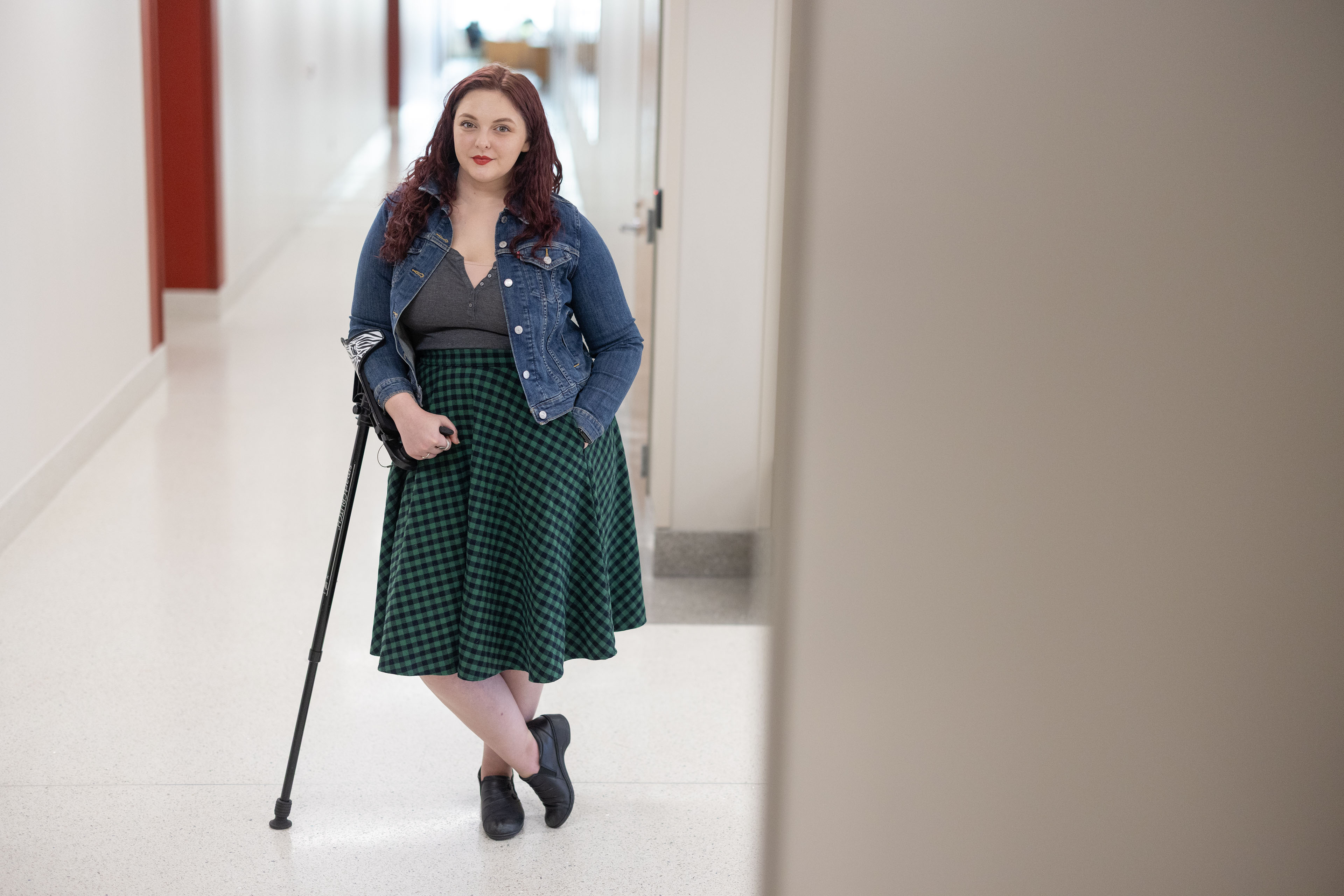
A portrait of a young woman leaning on a cane.
Brader worries the additional red tape will cause her to lose her Medicaid coverage. “It’s terrifying,” she says. “I already have fought so hard to get my health care.”(Chris Bergin for KFF Health News)

Jennifer Strohecker, who recently resigned as Utah’s Medicaid director, reiterated the high stakes, especially for those with diabetes on Medicaid. They may be very healthy and functional with insulin, but if they fail to complete the work requirements, that may change, Strohecker said during a recent Medicaid advisory hearing.

Whether someone is deemed medically frail already depends heavily on where they live.

For example, in Arkansas, people indicate on their Medicaid applications that they’re disabled, blind, or need help with daily living activities.

Approximately 6% of the roughly 221,000 people enrolled in Arkansas’ Medicaid expansion program are deemed medically frail, according to Gavin Lesnick, a spokesperson for the Arkansas Department of Human Services.

In West Virginia, the state accepts a medical frailty designation when an applicant self-reports it.

The burden of proof is higher in North Dakota. Applicants there must answer a questionnaire about their health and submit additional documentation, which may include medical chart notes and treatment plans. More than half of applicants were denied last year, according to Health and Human Services Department spokesperson Mindy Michaels.

Indiana’s Family and Social Services Administration, which runs its Medicaid program, declined an interview and said it could not comment on individual cases, like Brader’s.

Brader worries the additional red tape will cause her to lose Medicaid again. She said she was temporarily kicked off the program in 2019 for failing to meet the state’s work rules when Indiana said her work-study job didn’t count as employment.

“Anytime I have tried to receive help from the state of Indiana, it has been a bureaucratic nightmare,” she said.

As states await federal guidance, Kristi Putnam, a senior fellow at the conservative Cicero Institute and former secretary of the Arkansas Department of Human Services, which oversees the state Medicaid program, said even if a state creates an extensive list of qualifying “medically frail” conditions, the line must be drawn somewhere.

“You can’t possibly create a policy for exemptions that will catch everything,” she said.


Source link

New Work Requirement Adds Red Tape to Missouri’s Snarled Food Aid System

0

WARRENTON, Mo. — Distributing food stamps soon could get even harder for Missouri’s food aid system, which a federal judge has already called “broken and inaccessible.”

States depend heavily on federal funds to operate their food stamp programs, which help feed about 42 million people nationwide. But a new federal law has restructured the nation’s food assistance, requiring more people to work to qualify for aid and shifting more of the program’s cost onto states over the next decade. Meanwhile, many Americans are struggling to afford groceries, and state governments are straining to help them.

More than a year ago, for example, a federal judge ruled that Missouri’s food aid system was “overwhelmed,” had wrongly denied assistance to applicants, and had caused many to go hungry as a “direct result of the system’s inadequacy.” The judge, Douglas Harpool, ordered the state to fix the problems.

Despite the court order, not much has changed, according to a KFF Health News analysis of state performance metrics.

Missouri’s ongoing problems foreshadow the trouble that lies ahead for state food aid programs nationwide. Food assistance advocates have said Missouri is just one example of a nationwide problem in which strained state systems struggle to deliver timely aid. For example, low-income people in Alaska have faced chronic backlogs while the state has spent years trying to fix the problem.

Last year, then-U.S. Agriculture Secretary Tom Vilsack sent letters to 44 governors urging swifter application processing and greater accuracy in determining benefits.

The administrative snarls come on top of concerns about funding during the recent federal government shutdown. The Trump administration refused to use emergency funds to keep the food aid program running, and food benefits lapsed for millions of people, including in Missouri, on Nov. 1 as the shutdown dragged into its fifth week. Two federal judges ordered the Trump administration to tap emergency funds for the program.

The shutdown ended Nov. 12, and Missouri said its SNAP recipients began receiving their full benefits three days later. Meanwhile, as Thanksgiving approached, benefit delays were still being reported in some states.

Even after the shutdown, states will have to do more with fewer resources. Republicans’ One Big Beautiful Bill Act slashes billions in federal funding to the food aid program and pushes more of the administrative and financial burden to states.

The bill President Donald Trump signed in July axes $187 billion over the next decade from the Supplemental Nutrition Assistance Program, commonly referred to as food stamps, or SNAP. That represents a 20% cut, according to the Congressional Budget Office.

One of the most significant and immediate changes requires more people to work to qualify for aid. The change will cause at least 2.4 million Americans to lose aid, according to an analysis from the bipartisan Congressional Research Service. The analysis predicts many people will lose their benefits because the work requirements will make applying more difficult.

Expanding work requirements will harm some of the nation’s most vulnerable people, said Ed Bolen, who leads food aid strategies at the left-leaning Center on Budget and Policy Priorities.

But the conservative Foundation for Government Accountability, a group that has worked to advance similar policies in states, says the requirement is necessary to preserve assistance for the “truly needy.”

Undisputed’ Strains in Missouri

Some Missourians were already struggling before Trump signed the bill.

Kelly Thweatt, 64, said she received a notice in the mail that her food benefits had been cut back. She didn’t understand why, because her income hadn’t changed, she said recently outside a SNAP office 60 miles west of St. Louis.

After she pays for her spot at a mobile home park in Warrenton, she said, she’s left with about $300 each month from Social Security. The roughly $300 in SNAP benefits she had received every month kept her afloat.

Thweatt will be subject to the new federal work requirement because she’s not yet 65.

More than 150,000 Missourians are at risk of losing some amount of food aid because of the new work requirement, which went into effect Nov. 1.

For Thweatt, finding a job may prove difficult. She’s been out of the workforce for nearly 20 years.

Food aid provides a lifeline to more than 650,000 Missourians — that’s more than eight sold-out crowds at Arrowhead Stadium in Kansas City, where the NFL’s Chiefs play. The program helps feed 20% of Missouri’s children every month, according to the Missouri Foundation for Health, a nonprofit philanthropic organization. (The foundation provides financial support to KFF Health News.)

The recent federal changes will require more seniors, parents, veterans, homeless people, and former foster care youths to clear additional administrative hurdles to get food aid, according to the U.S. Department of Agriculture.

Patrick McKelvey, executive director of the Gateway Food Pantry in Arnold, Missouri, unloads a recent grocery delivery.(Samantha Liss/KFF Health News)

For years, thousands of Missourians have struggled to tap into food assistance, largely because applicants must complete an interview, over the phone or in person. But many Missourians can’t get through to a state staffer.

Applicants have spent hours waiting on hold or in line outside state offices, according to a lawsuit filed in 2022 in federal court. At times, so many people have been waiting on hold that the phone system started hanging up on people, the lawsuit says.

Some Missouri SNAP offices are staffed by only a single employee, according to Harpool’s May 2024 order, adding to the strain.

In a statement provided to KFF Health News, the Missouri Department of Social Services said that because demand varies by location, it may be appropriate to have a single staffer in some places.

In Warrenton, makeshift phone booths line the walls of the food aid office. People sit at a cubicle with a desk and use a phone to complete interviews with officials elsewhere. A sign sitting on the floor asks applicants to “please be patient with our progress” as the state works on technology improvements.

According to Harpool’s order, the “evidence is undisputed” that Missouri’s food aid system has “unacceptable wait times” and that thousands of calls “cannot be completed.” These problems put Missourians at risk of losing aid “each and every time” they apply for food benefits, the judge wrote. To stay in the program, most households need to periodically submit documents and complete interviews.

A KFF Health News analysis of Missouri SNAP reports showed the same problems persist more than a year later. In the 16 months after the judge’s order, nearly half of all the applications that were denied were rejected at least partly because no interview was completed, according to data the state submitted to the court as part of the order. That indicates the state’s system is failing the most vulnerable, the judge has said.

In an order released in May of this year, Harpool found that Missouri failed to show significant improvement and that its performance deteriorated by some measures. The state hadn’t documented adding a single staffer or investing any additional resources to process applications faster, Harpool wrote.

Missouri’s Department of Social Services said the state legislature has provided money to hire temporary workers in other areas, freeing up staff to process SNAP applications.

To complete the required interviews for food aid, the agency said, it makes multiple attempts to reach applicants once an application is received.

Katie Deabler, an attorney with National Center for Law and Economic Justice who represented Missourians in the case, said, “These are your neighbors, these are your kids’ classmates who are going hungry when the system doesn’t work.”

Trouble Ahead

Roughly 68% of the state’s food aid recipients are children, adults over 60, or people with a disability, according to the Missouri Foundation for Health. Many who can work already do.

Christine Woody, the food security policy manager with Empower Missouri, an organization working to eradicate poverty in the state, said Missouri lacks the money and the will to fix its food aid system.

Woody and other advocates fear the federal changes will erode the nation’s most powerful defense against hunger.

“For a state like Missouri that is already struggling to operate the program, these new rules couldn’t come at a worse time,” said Bolen, of the Center on Budget and Policy Priorities.

A man stands in a food pantry with shelves and tables of on non-perishable goods surrounding him
Nelson Berra, senior manager at the Gateway Food Pantry in Arnold, Missouri, organizes a recent grocery delivery.(Samantha Liss/KFF Health News)

Missouri foreshadows the trouble that lies ahead for other states, he said. Like Missouri, many states are reluctant to fund their food aid programs. And now they’ll be forced to use state dollars to fill the gaps left by the federal cuts, which “sets states up to fail,” Bolen said.

Supporters of the changes see it differently. U.S. House Speaker Mike Johnson previously described the cost shift to states as “modest” and said it’s necessary to reduce fraud. States “don’t have enough skin in the game,” he said on CBS’ “Face the Nation” ahead of the budget bill’s passage.

Still, if states do not come up with the money to fill the gap, Bolen said, they’ll be left with two options: Make it harder for people to qualify for SNAP, or end the program entirely.

For Thweatt, the change comes at a particularly hard moment. A few months ago, she lost her life partner of three decades, leaving her reeling and struggling to afford the basics. She does not turn 65 until April, which means she’s subject to the expanded work requirement until then and may have to show she has a job to maintain the $220 in monthly food benefits she has left. The state will apply the work rules to her case when she’s up for renewal, state officials said. Thweatt’s car needs repairs and its license plates are set to expire, she said. She doesn’t have the money to address either problem.

She’s selling everything that she can, including an antique bedroom set, to afford necessities, she said.

“I can satisfy myself with a bag of chips per day,” Thweatt said. “So if that’s what I need to do, that’s what I need to do.”


Source link

Micron to invest $9.6 billion in Japan to build AI memory chip plant: Report

0

The U.S. chipmaker aims to start construction at an existing site in May next year and begin shipments around 2028 [File]
| Photo Credit: REUTERS

Micron Technology will invest 1.5 trillion yen ($9.6 billion) to build a new plant in Hiroshima in western Japan to produce advanced high-bandwidth memory (HBM) chips, the Nikkei reported on Saturday, citing people familiar with the matter.

The U.S. chipmaker aims to start construction at an existing site in May next year and begin shipments around 2028, with Japan’s Ministry of Economy, Trade and Industry providing up to 500 billion yen for the project, the Nikkei said.

Reuters could not immediately verify the report.

To revive its aging semiconductor industry, Japan’s government is offering generous subsidies to lure investment from foreign chip makers such as Micron and Taiwan Semiconductor Manufacturing Co (TSMC). It is also funding the construction of a plant that will mass produce advanced logic chips using IBM technology.

Demand for HBM chips is being driven by the growth of artificial intelligence and data centre investment.

The expansion of its plant in Hiroshima will help Micron diversify production away from Taiwan and compete with market leader SK Hynix, the Nikkei said.

Source link

Iberia says customer data ‘compromised’ but no sign of fraudulent use

0

Iberia said the compromised information included names, loyalty card membership and contact details [File]
| Photo Credit: REUTERS

Spanish airline Iberia said Saturday that hackers had accessed confidential customer information, the latest in a series of attacks on carriers, though it added that there were no signs of fraudulent use of the data.

“Iberia has detected a security incident involving unauthorised access to the systems of one of our service providers, which has compromised the confidentiality of certain data,” the airline said in a message to customers seen by AFP.

Iberia said the compromised information included names, loyalty card membership and contact details, but no passwords nor bank card information.

“As soon as we became aware, we immediately activated our security protocols and procedures, adopting all necessary technical and organisational measures to contain it, mitigate its effects, and prevent it from happening again in the future,” Iberia said.

In August, Air France-KLM said it had detected “fraudulent access” to some customer details, while Australian airline Qantas said last month that data from some of its 5.7 million customers was stolen in a major cyberattack targeting software firm Salesforce.

That attack also affected companies including Disney, Google, IKEA, Toyota and McDonald’s.

Source link

HSBC taps French start-up Mistral to supercharge generative-AI rollout

0

FILE PHOTO: HSBC said it had signed a multi-year deal with Mistral AI to integrate GenAI tools across the bank, aiming to speed up automation, lift productivity, and enhance client services.
| Photo Credit: Reuters

HSBC said on Monday it had signed a multi-year deal with French start-up Mistral AI to integrate generative artificial intelligence tools across the bank, aiming to speed up automation, lift productivity, and enhance client services.

Under the pact, HSBC will deploy Mistral’s commercial models and future upgrades on a self-hosted basis, combining its internal tech muscle with Mistral’s model building.

Both firms will collaborate to build AI solutions for tasks ranging from financial analysis and multilingual translation to risk assessment and personalised client communication.

The London-listed bank said the tools could dramatically slash the time employees spend on routine tasks, for example, credit and financing teams will be able to parse complex, document-heavy deals far more quickly.

HSBC, already running hundreds of AI use cases globally across fraud detection, transaction monitoring, compliance, and customer service, expects the partnership to accelerate innovation cycles, helping launch new AI-powered features more rapidly.

The push comes as lenders globally race to embed generative AI despite lingering data-privacy concerns. HSBC said it will deploy Mistral’s tools under its existing responsible-AI governance framework, aiming to preserve transparency and data protection.

Source link

India orders smartphone makers to preload state-owned cyber safety app

0

FILE PHOTO: India’s telecoms ministry has asked smartphone makers to preload devices with a state-owned cybersecurity app that cannot be deleted, a government order showed, a move likely to antagonise Apple and privacy advocates.
| Photo Credit: THG

India’s telecoms ministry has privately asked smartphone makers to preload all new devices with a state-owned cyber security app that cannot be deleted, a government order showed, a move likely to antagonise Apple and privacy advocates.

India is one of the world’s largest telephone markets, with more than 1.2 billion subscribers, and government figures show the app, launched in January, has helped recover more than 700,000 lost phones, including 50,000 in October alone.

Apple, which has previously locked horns with the telecoms regulator over development of a government anti-spam mobile app, is among the companies, such as Samsung, Vivo, Oppo and Xiaomi bound by the new order.

The November 28 order, seen by Reuters, gives major smartphone companies 90 days to ensure that the government’s Sanchar Saathi app is pre-installed on new mobile phones, with a provision that users cannot disable it.

For devices already in the supply chain, manufacturers should push the app to phones via software updates, the ministry said in its order, which was not made public and was sent privately to select companies.

The government said the app was essential to combat “serious endangerment” of telecom cyber security from duplicate or spoofed IMEI numbers, which enable scams and network misuse.

Apple’s iOS powered an estimated 4.5% of 735 million smartphones in India by mid-2025, with the rest using Android, Counterpoint Research says.

TELECOM CYBER SECURITY

While Apple pre-installs its own proprietary apps on phones, its internal policies prohibit installation of any government or third-party app before sale of a smartphone, a source with direct knowledge of the matter said.

“Apple has historically refused such requests from governments,” said Tarun Pathak, a research director at Counterpoint.

“It’s likely to seek a middle ground: instead of a mandatory pre-install, they might negotiate and ask for an option to nudge users towards installing the app.”

Apple, Google, Samsung and Xiaomi did not respond to requests for comment. India’s telecoms ministry also did not respond.

A 14- to 17-digit number unique to each handset, the IMEI, or International Mobile Equipment Identity, is most commonly used to cut off network access for phones reported to have been stolen.

The government app allows users to report suspicious calls, verify IMEIs and block stolen devices through a central registry.

With more than 5 million downloads since its launch, the app has helped block more than 3.7 million stolen or lost mobile phones, while more than 30 million fraudulent connections have also been terminated.

The government says it helps prevent cyber threats and assists tracking and blocking of lost or stolen phones, helping police to trace devices, while keeping counterfeits out of the black market.

Source link

India’s Adani seeks up to $5 billion investment in Google data center to join AI boom

0

FILE PHOTO: India’s Adani Group plans to invest up to $5 billion in Google’s India AI data centre project, an executive said on Friday.
| Photo Credit: Reuters

India’s Adani Group plans to invest up to $5 billion in Alphabet-owned Google’s India AI data centre project, an executive said on Friday, as it seeks to cash in on booming demand for data capacity in the world’s most populous nation.

In October, Google said it would invest $15 billion over five years to set up an artificial intelligence data centre in the southern state of Andhra Pradesh, its biggest investment in India.

AI requires enormous computing power, pushing demand for specialised data centres that enable thousands of chips to be linked in clusters.

Adani Group CFO Jugeshinder Singh said the Google project could mean an investment of up to $5 billion for Adani Connex – a joint venture between Adani Enterprises and private data centre operator EdgeConneX.

“It’s not just Google, there are a lot of parties that would like to work with us, especially when the data centre capacity goes to gigawatt and higher,” Singh told reporters on Friday.

Google has committed to spending about $85 billion this year to expand data centre capacity as tech companies invest heavily in infrastructure to meet the booming demand for AI services.

Indian billionaires Gautam Adani and Mukesh Ambani have also unveiled investments in building data centre capacity.

The data centre campus in the port city of Visakhapatnam will have an initial power capacity of 1 gigawatt.

Source link

Amazon and Google launch multicloud service for faster connectivity

0

Amazon and Google introduced a jointly developed multicloud networking service on Sunday [File]
| Photo Credit: REUTERS

Amazon and Google introduced a jointly developed multicloud networking service on Sunday to meet growing demand for reliable connectivity, the companies said in a statement, at a time when even brief internet disruptions can cause major outages.

The initiative will enable customers to establish private, high-speed links between the two companies’ computing platforms in minutes instead of weeks.

The new service is being unveiled a little over a month after an Amazon Web Services outage on October 20 disrupted thousands of websites worldwide, knocking offline some of the internet’s most popular apps, including Snapchat and Reddit. That outage will cost U.S. companies between $500 million and $650 million in losses, according to analytics firm Parametrix.

The new offering combines AWS’ Interconnect–multicloud with Google Cloud’s Cross-Cloud Interconnect, to improve network interoperability, according to announcements by the two cloud providers.

“This collaboration between AWS and Google Cloud represents a fundamental shift in multicloud connectivity,” said Robert Kennedy, vice president of network services at AWS.

Rob Enns, vice president and general manager of cloud networking at Google Cloud, said the joint network is intended to make it easier for customers to move data and applications between clouds.

Salesforce is among the early users of the new approach, Google Cloud said in a statement.

AWS provides computing power, data storage and other digital services to companies, governments and individuals and is the world’s largest cloud provider, followed by Microsoft’s Azure and Google Cloud.

Tech companies including Alphabet, Microsoft and Amazon are investing billions to build infrastructure that can handle surging internet traffic with the growing demands of artificial intelligence, as the need for computing power to support these services accelerates.

Amazon’s cloud business delivered robust growth in the third quarter, generating $33 billion in revenue; more than double that of Google’s $15.16 billion.

Source link