Home Blog Page 200

Apple lowers App Store commissions for ‘mini apps’ 

0

FILE PHOTO: Apple said it would lower commissions for “mini apps” on iPhones and other devices.
| Photo Credit: Reuters

Apple on Thursday said it would lower commissions for “mini apps” on iPhones and other devices.

Apple’s App Store charges commissions of up to 30% on digital purchases. Under the program announced Thursday, that rate will come down to 15% for developers of mini apps – often game titles and other apps that are offered inside a larger “host app” – if they adopt certain Apple technologies such as its method for declaring an age range of the user.

Mini apps are most common in China, where popular apps like Tencent Holdings and Alipay host scores of game titles or other services inside their primary application. But the model is also being adopted by U.S. firms, with ChatGPT creator OpenAI last month saying it will offer mini apps within its flagship chatbot app.

Under Apple’s App Store rules, developers of mini apps pay commissions for digital sales directly to Apple. How much of a cut the host app takes remains between the host app and the mini app. Apple’s linking of the lower prices to its age declaration technology comes as the iPhone maker is in a dispute with states and tech rivals such as Meta Platforms over age verification on digital platforms.

Multiple U.S. states are pursuing laws that would require verifying the age of app users, and Meta has said it believes the best place for that verification to happen is at the level of the app marketplaces run by Alphabet’s Google and Apple. Apple has argued that the laws would require it to invade the privacy of adult users and has proposed an alternative that would allow app developers to accept an age range that users declare, which would need to be approved by an adult in the case of younger users.

Source link

Massive 1-Million-Patient Study Confirms Heart Benefits of Top Diabetes Drugs

0

New research reveals that tirzepatide and semaglutide both offer strong, early heart-protective effects. A major new investigation from Mass General Brigham has directly compared the heart-protective effects of two popular diabetes medications, tirzepatide and semaglutide. The findings reveal that both drugs significantly lower the risk of heart attack, stroke, and death from any cause. The […]

Source link

OpenAI backs startup aiming to block AI-enabled bioweapons

0

FILE PHOTO: ChatGPT maker OpenAI said it will invest in a startup focused on blocking bad actors from creating biological weapons powered by AI.
| Photo Credit: THB

ChatGPT maker OpenAI on Thursday said it will invest in a startup focused on blocking bad actors from creating biological weapons powered by artificial intelligence.

OpenAI is the lead investor in a $15 million seed round in , which is trying to make sure the AI industry’s defenses are growing at least as rapidly as those who seek to exploit models to harm humans, the startup’s co-founder Hannu Rajaniemi said.

The investment is part of OpenAI’s broader effort to invest in startups that seek to contain the risks posed by AI. Last month, the company backed Valthos, a New York-based biosecurity software startup. OpenAI Chief Strategy Officer Jason Kwon said OpenAI would consider investing in other startups focused on similar problems.

“We want to increase the overall resilience of the overall ecosystem,” Kwon said in an interview. “One of the best ways you can deal with the risk mitigation is more technology.”

Researchers and safety advocates say AI technology could soon accelerate drug development or design new vaccines. But those same capabilities could make it easier for bad actors to develop new and powerful biological weapons.

Red Queen Bio was spun out of Helix Nano, a clinical-stage mRNA therapeutics company that has been using AI more in drug design. Helix Nano has also worked with OpenAI to create tests to determine AI’s biorisks, Kwon said.

OpenAI CEO Sam Altman and board member Nicole Seligman, who had previously invested in Helix Nano, will receive shares in Red Queen Bio as part of the transaction. Kwon was indirectly an investor through Y Combinator, a Silicon Valley startup incubator. His stake is valued at less than $2,500, OpenAI said.

The executives did not take part in approving OpenAI’s investment in Red Queen Bio, a company spokesperson said. OpenAI’s chief compliance officer and unconflicted members of OpenAI’s board reviewed and approved the investment.

Red Queen Bio will rely on AI models as well as more traditional laboratory experiments to uncover new risks and develop new defenses. The startup’s name comes from a scene in Lewis Carroll’s book, Through the Looking-Glass.

“It was clear that the biological capabilities were advancing faster than we anticipated,” Rajaniemi said. “We felt we needed to start developing defenses.”

Other investors in Red Queen Bio are Cerberus Ventures, Fifty Years and Halcyon Futures.

Source link

Code-gen startup Cursor nearly triples its valuation in Coatue-led funding round

0

FILE PHOTO: Code-generation startup Cursor nearly tripled its valuation to $29.3 billion in five months after raising $2.3 billion in its latest funding round.
| Photo Credit: THB

Code-generation startup Cursor nearly tripled its valuation to $29.3 billion in five months after raising $2.3 billion in its latest funding round, as artificial intelligence companies continue to attract investor attention.

The Series D funding round was led by new investor Coatue, an investment management firm, and existing investor Accel, Cursor said in a blog post on Thursday. Fresh investors Nvidia and Alphabet’s Google also participated in the round.

AI firms have dominated private funding markets this year, with global venture funding in the third quarter increasing 38% year-over-year to $97 billion, about half of which went to AI companies, according to data from Crunchbase.

“(The round) is a resounding current affirmation of AI prospects…but the commitments for this raise most likely accumulated over the last several weeks or months and are very specific to Cursor’s prospects,” said Michael Ashley Schulman, chief investment officer at Running Point Capital Advisors.

A surge in investor appetite for AI-linked firms also helped drive Wall Street’s benchmark indexes to record highs this year.

The San Francisco-based company raised $900 million in June at a $9.9 billion valuation, attracting backing from investors, including Thrive Capital, Andreessen Horowitz and Accel.

The company has crossed $1 billion in annualized revenue, with sales-led revenue increasing 100-fold since the beginning of 2025, Cursor said in a mailed statement to Reuters.

Cursor, which develops tools to autonomously generate and complete code, said the latest funding round will be used to invest in its research efforts.

Code-generation startups are attracting sky-high valuations as businesses explore artificial intelligence-based solutions to enhance or replace traditional software development roles.

However, investor concerns that valuations of AI companies may have outpaced fundamentals intensified after SoftBank Group offloaded its $5.8 billion stake in Nvidia earlier in the week.

Source link

Conflicting Advice on Covid Shots Likely To Ding Already Low Vaccine Rates, Experts Warn

0

More than three-quarters of American adults didn’t get a covid shot last season, a figure that health care experts warn could rise this year amid new U.S. government recommendations.

The covid vaccine was initially popular. About 75% of Americans had received at least one dose of the first versions of the vaccine by early 2022, Centers for Disease Control and Prevention data shows. But only about 23% of American adults got a covid shot during the 2024-25 virus season, well below the 47% of American adults who got a flu shot. The vaccination rates for flu, measles, and tetanus are also going down.

Yet covid remains a serious, potentially deadly health risk, listed as the primary cause of death on roughly 31,400 death certificates last year. By comparison, flu killed about 6,500 people and pneumonia, a common complication of the flu, killed an additional 41,600, CDC data shows.

As millions of Americans decide whether to get a covid shot this season, public health researchers worry vaccination rates will slide further, especially because Hispanic and Black Americans and those under 30 have lower rates, exposing them to serious complications such as long covid. Under the Trump administration and Health and Human Services Secretary Robert F. Kennedy Jr., the federal government has narrowed its recommendations on the covid vaccine, leading to a hodgepodge of rules on pharmacy access, with Americans living in Republican states often facing more barriers to getting a shot.

“A lot of misinformation is going around regarding covid,” said Alein Haro-Ramos, an assistant professor of health, society, and behavior at the University of California-Irvine. “Vaccine hesitancy is going to increase.”

In August, the FDA narrowed approval for covid vaccines to those 65 or older and to adults and children with at least one underlying condition that puts them at high risk for serious complications from covid.

A month later, the CDC’s Advisory Committee on Immunization Practices voted to recommend “shared clinical decision-making” on the vaccine, pulling back from advising all adults to get vaccinated. The committee advised doctors to emphasize to adults under 65 and children that the benefits of the vaccine are greatest for those with underlying health conditions.

The guidance is rebutted by infectious disease experts who say most adults and children should get both the flu and covid vaccines, which are safe, effective, and prevent serious illness. Several independent medical organizations like the American Academy of Family Physicians and the American Academy of Pediatrics have reiterated their support for broad adoption of covid vaccines.

More than two dozen states have taken steps to ensure most people can get a covid shot at the pharmacy without a prescription, with many states tying their policies to the advice given by medical organizations. And many of those states require insurers to cover vaccines at no cost, according to a KFF analysis. In several other states, predominantly Republican-led, pharmacy access to vaccines may require a prescription.


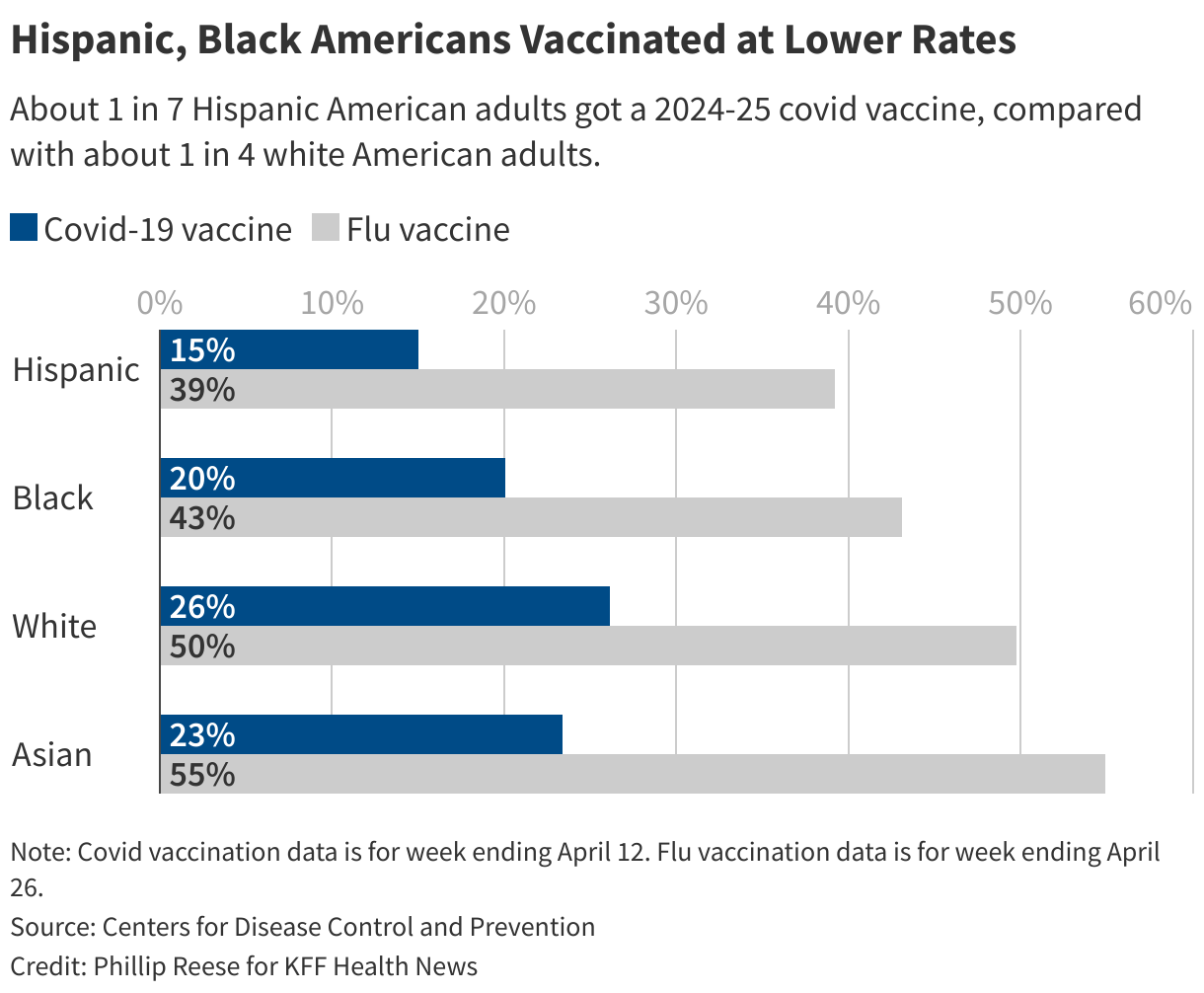
Hispanic, Black Americans Vaccinated at Lower Rates

Among the most commonly cited reasons for covid vaccine hesitation are fears about side effects, long-term health consequences, and the effectiveness of the vaccine, and mistrust of pharmaceutical corporations and government officials, according to a 2024 review of multiple studies, published in the journal Vaccines.

Covid vaccine hesitancy in the 2024-25 virus season was higher among Latinos, African Americans, men, uninsured people, and people living in Republican-leaning states, CDC data shows.

Latino adults were significantly less likely than adults from most other racial and ethnic groups to get a covid shot last season, with a vaccination rate around 15%.

Some of that may be due to age: A disproportionate share of Latinos are young. But public policy actions may also be a factor. The first Trump administration, for example, tied Medicaid to “public charge,” a rule allowing the federal government to deny an immigrant a green card or visa based on their dependence on taxpayer-funded programs. Some Latinos may be afraid to sign up for social services even after the Biden administration reversed those first-term Trump actions.

Haro-Ramos co-authored a study published in 2024 that found many Latinos were hesitant to get vaccinated because of fears about their immigration status, and that experiencing health discrimination, like care denials or delays, increased their vaccine hesitancy.

“Do you trust the health care system, broadly speaking? Do you want to provide your information — your name, your address?” Haro-Ramos said. “Trust is critical.”

Haro-Ramos said the problem has likely worsened since her study was published. The Trump administration revealed this summer that it would give the personal information of Medicaid enrollees to Immigration and Customs Enforcement. Many Latinos are canceling doctor appointments to head off possible confrontation with immigration enforcement officials.

“People are avoiding leaving their homes at all costs,” Haro-Ramos said.

Janani Rajbhandari-Thapa, an associate professor at the University of Georgia College of Public Health, recently co-authored a study of covid vaccination among nearly 1,500 African Americans living in south Georgia. The study found that participants were more likely to listen to their health care providers than faith leaders or co-workers when seeking advice on getting vaccinated.

More than 90% of those studied had received at least one dose of the vaccine, but those who were unvaccinated were more likely to agree with false statements that tied vaccines to miscarriages, to components’ remaining in the body for a long time, or even to the conspiracy that they implant a computer chip in the body.

“It’s the clinicians who can take the messages about vaccination — that these are myths,” Rajbhandari-Thapa said.


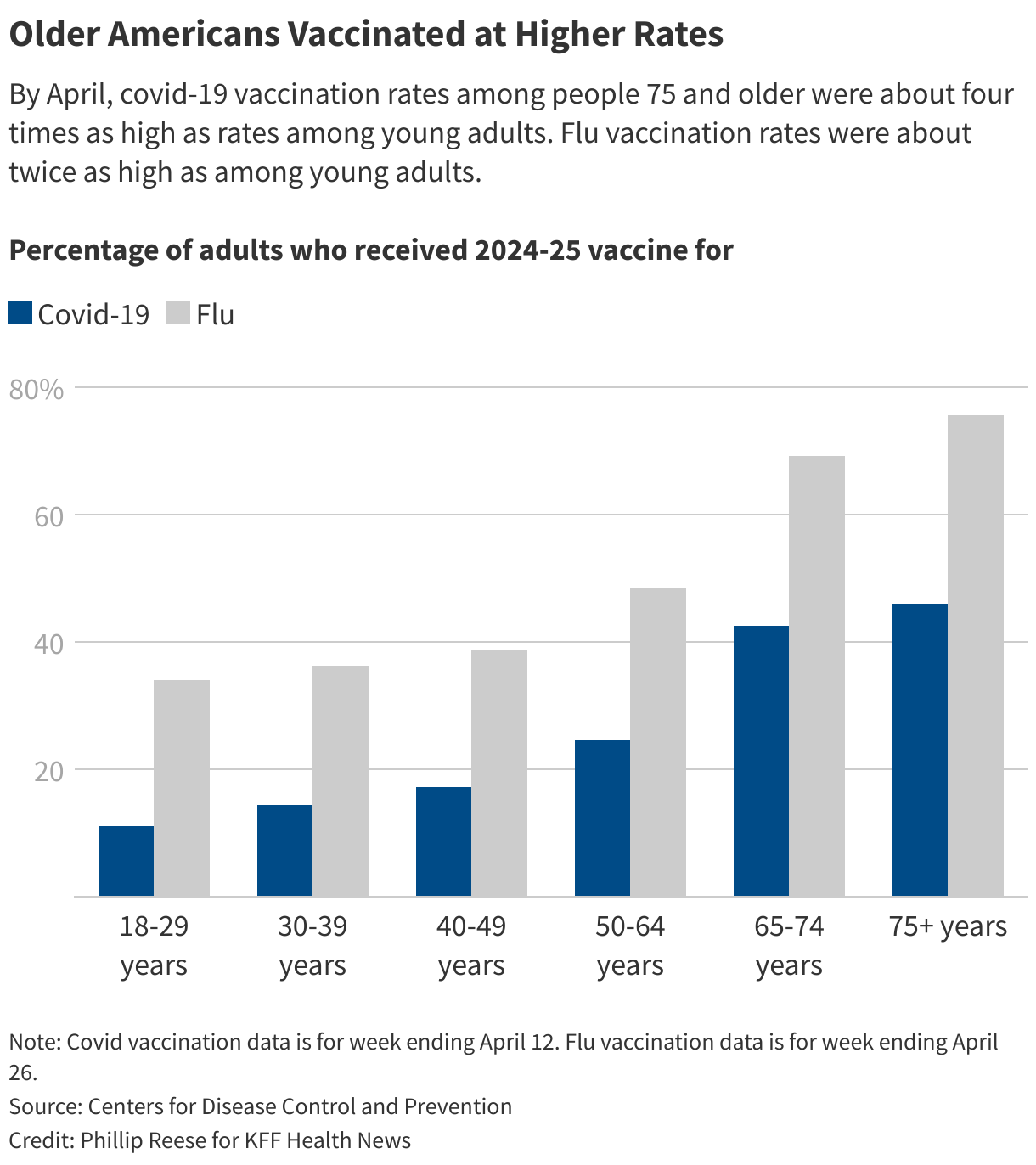
Older Americans Vaccinated at Higher Rates

Even though covid hospitalization and death rates have fallen dramatically since the worst days of the pandemic, fatal complications related to covid remain most common among older people. Around 89% of U.S. covid deaths last year were among people 65 and older, compared with about 81% of flu and pneumonia deaths.

As the pandemic falls into the rearview, young people have developed a sense of invincibility. Only 11% of Americans ages 18 to 29 received a vaccine during the 2024-25 virus season, the lowest vaccination rate among adult age groups. That’s far below the 70% of young adults who got at least one dose of the initial covid vaccines by November 2023.

While many people get covid after receiving a covid shot, because the vaccine’s ability to prevent infection wears off pretty fast, some misunderstand the purpose of the shot, said Otto Yang, an infectious disease specialist at UCLA Health.

“They think, ‘Well, the vaccine didn’t prevent me from getting covid, so the vaccine didn’t work,’” Yang said. “And what they’re not seeing is that the vaccine prevented them from getting severely ill, which is ultimately the most important thing.”

And the vaccine can help prevent long covid, which is a problem for all ages, Yang said. A recent Northwestern University study found that younger adults suffer worse symptoms of long covid than older adults.

Ultimately, Yang said, it is not a consistent choice to get a flu vaccine but forgo a covid vaccine, since both are safe, effective, and prevent serious illness. It is clear, he added, that people with compromised immune systems and those at higher risk should get a covid shot. The decision is “a little bit less clear” for others, but “probably most adults should be getting vaccinated, just like it’s recommended for the flu vaccine, as well as most children.”

Phillip Reese is a data reporting specialist and an associate professor of journalism at California State University-Sacramento.

Source link

Spain fines Musk’s X $5.8 million in cryptoasset advertising case

0

FILE PHOTO: Spain’s stock market supervisor has fined Elon Musk-owned X 5 million euros ($5.8 million) for failing to make sure that a cryptoasset company that used X for advertisements had authorisation to provide investment services.
| Photo Credit: Reuters

Spain’s stock market supervisor has fined Elon Musk-owned social media platform X 5 million euros ($5.8 million) for failing to make sure that a cryptoasset company that used X for advertisements had authorisation to provide investment services.

The fine, dated November 3, was published in Spain’s official bulletin on Thursday.

X, formerly known as Twitter, did not immediately reply to an emailed request for comment. The fine can be appealed before Spain’s High Court.

Madrid took steps to regulate the rampant advertising of cryptoassets in 2022, tasking the CNMV watchdog with vetting mass campaigns and making sure investors were aware of the risks involved.

“(CNMV has decided to) impose a fine on Twitter International Unlimited Company … for failing to fulfil its duties to verify whether Quantum AI was authorised to provide investment services by the CNMV and whether Quantum AI was included in the list of entities warned about by the CNMV or by foreign supervisory bodies,” the document said.

Source link

Google proposes adtech changes to avoid breakup after EU fine

0

Google also faces scrutiny over its advertising services in the United States [File]
| Photo Credit: REUTERS

Google on Friday announced changes to its advertising services to avert the risk of a breakup, two months after Brussels hit the U.S. giant with a massive fine.

The European Commission slapped a 2.95-billion-euro ($3.43 billion) antitrust fine on Google for favouring its own services in September, giving the company 60 days to resolve the issues raised.

The penalty drew an angry rebuke from U.S. President Donald Trump, who threatened fresh tariffs on the EU if it was confirmed. Google has said it will appeal the fine.

“Our proposal fully addresses the decision without a disruptive break-up that would harm the thousands of European publishers and advertisers who use Google tools to grow their business,” a Google spokesperson said.

Despite agreeing to the adtech changes, Google said it still disagreed with the EU decision.

Brussels will now assess the commitments, which come as the bloc treads a line between its determination to enforce its tech rules and its wariness of further provoking Trump.

The EU has set its sights on Google.

Only a day before Google’s announcement, the commission launched a new probe into the U.S. company under its digital competition rules over suspicions it is unfairly pushing down certain news outlets in search rankings.

Google also faces scrutiny over its advertising services in the United States.

A U.S. federal judge earlier this year decided against Google over its adtech practices. Google is also seeking to avoid a forced sale in that case in Virginia, and closing arguments are expected to take place on Monday.

The judge is set to make a decision in the following weeks or months.

When it announced the September fine, the commission said Google had unfairly used its dominant position in online advertising to favour its own services.

The online giant not only sells advertising on its own websites and apps, but also acts as an intermediary for firms wanting to place ads elsewhere to appear on mobile and computer screens, which Brussels says made it harder for rivals to compete.

Google on Friday said its plan included immediate product changes such as giving publishers the option to set varying minimum prices for different bidders when using Google Ad Manager.

And to address the EU’s accusations of conflict of interest, Google said it would increase the interoperability of its tools for publishers and advisers.

The European Commission confirmed Google had sent its plan.

“We will now analyse Google’s proposed measures to assess whether they effectively bring the self-preferencing practices to an end and address the situation of inherent conflicts of interest,” a commission spokesperson said.

Brussels has slapped multiple fines on Google in recent years.

It fined the giant 4.1 billion euros in 2018 for abusing the market dominance of its Android operating system, and in 2017 slapped a 2.4-billion-euro fine for anti-competitive practices in the price comparison market.

The EU also accused Google in March of treating its own services more favourably compared to rivals as part of a digital competition probe launched last year.

Source link

Breakthrough Alzheimer’s Drug Has a Hidden Problem

0

Researchers in Japan found that although the Alzheimer’s drug lecanemab successfully removes amyloid plaques from the brain, it does not restore the brain’s waste-clearing system within the first few months of treatment. The study suggests that by the time symptoms appear, damage to nerve cells and the glymphatic system is already well established, making short-term […]

Source link

Google’s NotebookLM upgraded with Deep Research, chat history

0

NotebookLM users will be able to create more in-depth reports with a list of sources [File]
| Photo Credit: REUTERS

Google is updating its AI-powered research assistant NotebookLM with Deep Research, allowing it to browse hundreds of sites in order to come up with detailed reports with annotated source lists to add to users’ notebooks.

The Deep Research feature was being rolled out on Friday (November 14, 2025), with users in some countries set to get the update in one or two weeks.

Google is further rolling out the ability for NotebookLM users to create custom video overview styles with text-based prompts.

Meanwhile, a new chat history prompt will let users close a session and resume it later without losing their previous content.

In addition to these updates, NotebookLM announced that flashcards and quizzes had been fully rolled out to all mobile users.

Source link

Digital Personal Data Protection Act notified after two years, RTI Act amended

0

Image used for representation purpose only.
| Photo Credit: Getty Images/iStockphoto

Large parts of the Digital Personal Data Protection Act (DPDP), 2023 were notified on Friday (November 14, 2025), a significant step forward in the Union government’s compliance of the 2017 K.S. Puttaswamy v. Union of India judgement of the Supreme Court, affirming the right to privacy, and the need for a law to protect Indians’ data. The DPDP Rules, 2025, a draft of which was circulated in January, and mulled over for a significant period of time, were also notified. 

The law, passed in August 2023 in Parliament, requires firms to safeguard Indians’ digital data, with exemptions for the “State and its instrumentalities,” and prescribes penalties for firms who breach these obligations. The law also weakens the Right to Information Act, 2005, transparency activists have said, by removing the obligation of government bodies to provide “personal information” if the public interest outweighs a public official’s right to privacy. 

While that amendment is in force from Friday (November 14, 2025) onwards, the actual obligations of “data fiduciaries,” who collect and use personal data, will have until November 2026 to comply with some provisions, such as putting out the details of their designated Data Protection Officer (DPO). That month next year, the Consent Manager framework, which allows firms to exercise data removal and amendment rights on behalf of “data principals” (users), will also come into force. It will take until May 2027 for large tech firms to be subject to the full force of the Act.

That includes the Data Protection Board of India (DPBI). Another notification (there were a total of four on Friday) sets the number of members at the DPBI at four. The board can hold inquiries in response to complaints and impose penalties in case of data breaches. The board’s members, who have not yet been chosen, will be appointed by the Ministry of Electronics and Information Technology (MeitY). 

The DPDP Act, 2023 has gone through three major drafts since 2017, with the first one in 2018 imposing conditions like data localisation that were furiously resisted by technology firms. The 2023 Act, which strips out many of the requirements of that original draft, has been relatively more welcome among large Indian and global tech firms, who as “significant data fiduciaries,” would face additional compliance requirements.

Source link