A new study explains how cholesterol-lowering medications can lead to muscle damage and identifies a possible approach to making these treatments safer. Statins have dramatically improved cardiovascular health by lowering cholesterol levels and reducing the likelihood of heart attacks and strokes. Yet many people who take these medications experience unwanted muscle symptoms, including soreness, weakness, […]
Clogged brain drainage spaces visible on MRI scans may serve as early predictors of Alzheimer’s before major brain damage occurs. Researchers from Nanyang Technological University, Singapore (NTU Singapore) have found that the brain’s natural “drains”, which help remove toxic waste from the organ, are more likely to become blocked in people who show early signs […]
Nancy Hunt arrived at an emergency room from a Genesis HealthCare nursing home in Pennsylvania in such dreadful shape, including maggots infesting her gangrened foot, that the hospital called an elder abuse hotline and then the police, her son alleged in a lawsuit.
Hunt died five days later. Her death certificate said the foot injury was a “significant” factor. Genesis denied wrongdoing but agreed to pay $3.5 million in a settlement Hunt’s son signed in August 2024.
Yet Genesis hasn’t paid most of that debt, court records show. It may never have to.
Once the nation’s largest nursing home chain, Genesis says it was spending $8 million a month defending and settling lawsuits over resident injuries and deaths in recent years. But the company is now poised to wipe the liability slate clean by seeking refuge in the most protective corner of the legal system for the nursing home industry: bankruptcy court.
The Genesis case, one of 11 large senior care bankruptcies this year, illustrates how health care companies can dodge public and financial accountability for alleged negligence through delays, confidentiality clauses, and bankruptcy maneuvers, a KFF Health News investigation found.
When it filed for bankruptcy in Dallas in July, Genesis estimated its total liability for nearly a thousand settled and pending lawsuits at $259 million. A KFF Health News review of the terms of 155 settlement agreements and corporate financial statements shows Genesis officials knew insolvency was possible yet included provisions in its settlement agreements allowing it to defer payment, often for a year or more.
As a result, Genesis paid nothing in 85 cases and only a portion in the other 70, according to civil court records and bankruptcy claims made available through people with access to them. It still owes $41 million of the $58 million it had agreed to pay in those cases, the records show.
Nellie Betancourt, shown in a photo with her husband, Gabe, had planned a trip to Las Vegas before she fractured her hip at a Genesis HealthCare rehabilitation center — an injury the medical examiner’s report said led to her death. “When she went into that place, I said, ‘Well, she’s going to be taken care of for a few more days and I’ll take her home,’” Gabe says. (Adria Malcolm for KFF Health News)
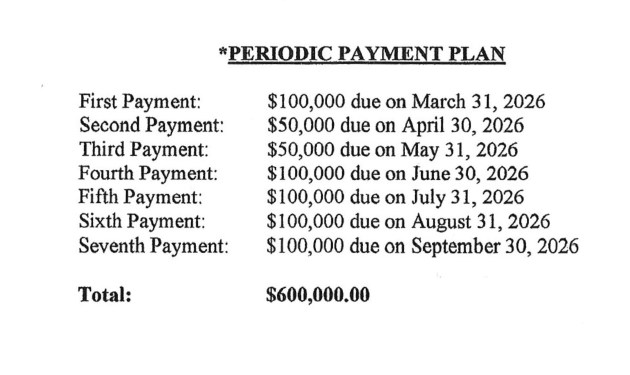
“It just feels like they killed my mom and got away with it,” said Vanessa Betancourt, whose mother, Nellie Betancourt, a retired nurse, fractured her hip at a Genesis home in Albuquerque, New Mexico — an injury the medical examiner’s report said led to her death. Genesis agreed to a $650,000 settlement with Betancourt’s family in April under the condition it would not need to pay the first of seven installments for another year, according to the settlement document.
Gabe Betancourt holds an old photograph of his wife, Nellie, that he keeps in his wallet. “I carry her with me everywhere I go,” he says. (Adria Malcolm for KFF Health News)
Genesis denied wrongdoing in all lawsuits and settlements. In a written statement, the company did not answer questions about individual personal injury cases. The statement said Genesis remained “focused on delivering high-quality, compassionate care to our patients and residents without disruption” during bankruptcy.
One lawsuit Genesis settled for nearly $1 million alleged nursing home managers ignored repeated warnings about a male resident’s behavior before he sexually assaulted a female Alzheimer’s patient, according to court records. In a case the company resolved for $500,000, a Genesis nursing home was accused of delaying the hospitalization of a resident who had vomited brown mucus. He died of a bowel obstruction. Genesis has paid nothing for either settlement, according to bankruptcy claims.
Creditors, including families of the deceased, are expected to salvage a fraction of what they were promised, if anything. On Dec. 10, the company’s owners were scheduled to seek approval by the U.S. Bankruptcy Court for the Northern District of Texas to sell its nursing homes and other assets to its largest investor, a private equity firm. In court papers, lawyers for residents and other creditors say the complex plan will prevent them from pursuing Genesis’ new ownership and other companies they blame for the company’s collapse.
John Anthony, a bankruptcy attorney representing 340 personal injury claims against Genesis, said, “They never had any intention to honor these deals.”
Low Ratings and Fines
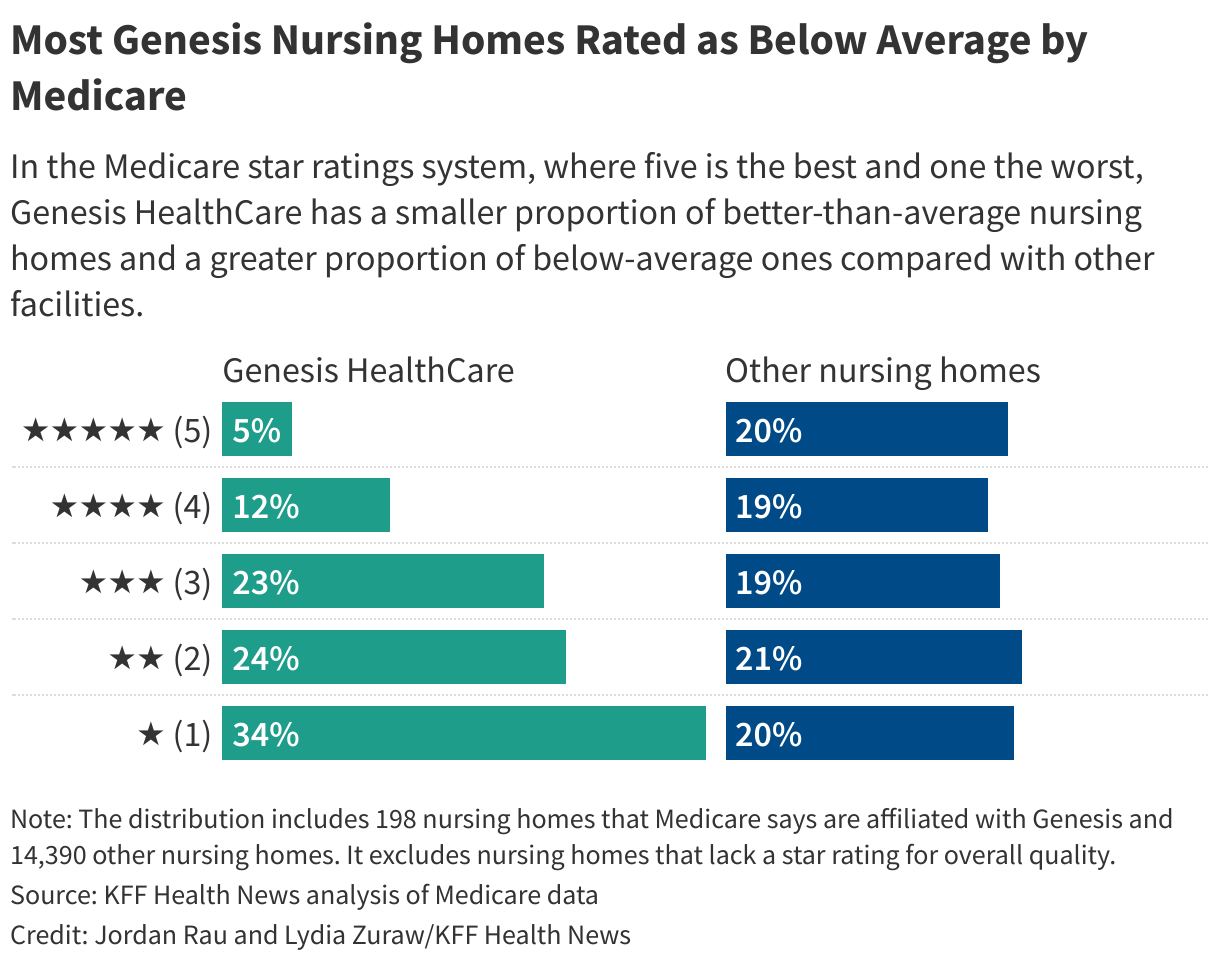
During years of financial turmoil, Genesis has frequently struggled to provide top-notch care, federal records show. Using its five-star system, the Centers for Medicare & Medicaid Services rated 58% of homes affiliated with Genesis as below average or much below average. CMS has fined Genesis homes $10 million for violating federal health standards over the past three years.
In its Chapter 11 filing, Genesis said it cared for about 15,000 residents in 165 nursing homes and 10 assisted living facilities in 18 states. They are centered in Pennsylvania, West Virginia, New Mexico, New Hampshire, New Jersey, Maine, Alabama, Maryland, and North Carolina, according to the bankruptcy filing.
The company said it owed $709 million in secured debt to lenders and the IRS. Under bankruptcy rules, those debts, backed by Genesis collateral, take precedence over the $1.6 billion in unsecured debt Genesis said it owes. Unsecured creditors include a pension fund; contractors that provided health services and equipment; Pennsylvania, New Mexico, and West Virginia for unpaid provider taxes; and former residents and their families who sued.
Dangers in Memory Care
Sandia Ridge Center, a Genesis home in Albuquerque, was repeatedly faulted by health regulators for not preventing sexual misbehavior in its memory care unit. In November 2021, CMS cited the home for lacking enough nurses to prevent sexual abuse among residents. An inspection report the following August identified more inappropriate sexual contact. Police were called to investigate sexual assault allegations in February and March of 2023, police reports show; neither resulted in criminal charges.
Then in April 2023, a 61-year-old male resident with alcohol-related dementia sexually assaulted a female resident with Alzheimer’s in the dining room, according to a police report and an inspection report. When the resident screamed for him to stop and that he was hurting her, he responded “shut up bitch I know you like this,” according to a lawsuit brought on behalf of the woman, identified in court papers as R.S.
Subscribe to KFF Health News’ free Morning Briefing.
Sandia Ridge management had been aware of the male resident’s behavioral issues for months, according to employee depositions in the case. Police had investigated a prior sexual assault allegation against him the previous year without bringing charges. In one deposition, a former activities assistant testified he hit her and twice pushed her into a bathroom while announcing, “I want to have sex with you.” When she reported him to a senior Genesis manager, she said in the deposition, the manager put his finger over his lips and said, “Shhh.”
The activities worker testified that R.S. used to happily sing along with Elvis Presley songs. After the assault, the worker said, R.S. “don’t sing anymore.”
Inspectors cited the home for failing to protect R.S. The same report said the home didn’t provide a therapist for another female resident who was being sexually harassed. Medicare fined Sandia Ridge Center $91,247. Genesis denied liability but settled R.S.’ lawsuit for $925,000 in May, according to the bankruptcy claim.
“We just felt we have to hold them accountable,” R.S.’ daughter said in an interview, speaking on the condition that she and her mother not be identified, because of the nature of the assault. “Maybe I’m wrong, maybe I’m naive, but the only way to do that is to sue someone, right?”
Genesis has not paid any of the settlement, according to the family’s claim filing.
Uptown Rehabilitation Center in Albuquerque, New Mexico, is one of 165 nursing homes Genesis HealthCare owns in the U.S. (Adria Malcolm for KFF Health News)
Growth and Debt
Genesis’ downfall can be traced to 2007, when affiliates of two private equity firms acquired the company in a $1.5 billion leveraged buyout, taking on substantial debt, according to its bankruptcy filing. Private equity also has been involved in other health care bankruptcies, including those of the HCR ManorCare nursing home chain, the prison health care contractor Corizon Health, and two for-profit hospital systems, Steward Health Care and Prospect Medical Holdings.
In 2011, Genesis raised $2.4 billion by transferring substantially all its nursing home buildings and other real estate to Welltower, a publicly traded real estate investment trust, according to Genesis’ bankruptcy filing. Genesis then rented the buildings back from Welltower, which made leasing costs a significant expense.
Genesis went on a nationwide buying spree. At its peak in 2016, it had grown to more than 500 nursing homes. In a court declaration, Louis Robichaux IV, a consultant overseeing Genesis’ bankruptcy restructuring, wrote that as the company expanded, it became harder to manage and “mired in corporate inefficiencies.” Robichaux wrote that Genesis’ financial woes were exacerbated by rapidly increasing labor costs and lawsuits, including some predating the covid pandemic.
But Genesis continued to teeter on the edge of insolvency. In audited financial statements for 2022 and 2023 submitted to a California oversight agency, management and auditors said rent and debt obligations raised “substantial doubt about the company’s ability to continue as a going concern.”
In a court filing, a committee appointed by the U.S. Trustee’s Office to represent the unsecured creditors in the bankruptcy accused Landau and Welltower of orchestrating a covert plan that allowed Welltower to keep getting its rents while Landau could run the company and “siphon value to himself.” The committee alleged their efforts forced the company into insolvency while “staffing levels and patient care declined precipitously.” Landau and Welltower did not respond to requests for comment.
Drawn-Out Lawsuits
Erin Pearson sued Genesis over the death of her father, James Sanderson, a retired mining company executive who died in 2018 after spending less than a month at Bear Canyon Rehabilitation Center in Albuquerque. In the memory care unit, Sanderson fell repeatedly, suffered medication errors made by nursing home staff, and developed a bowel obstruction and sepsis, according to the lawsuit, filed in 2019. Pearson’s lawyers said he was not hospitalized until eight days after nurses noticed he was vomiting brown mucus.
Staff at a Genesis HealthCare nursing home delayed hospitalizing James Sanderson, seen here with daughter Erin Pearson, for a week after he showed symptoms of a bowel obstruction, according to a lawsuit.(Erin S. Pearson)
After the judge rejected Genesis’ request to force Pearson into arbitration, Genesis appealed. It took 2½ years before an appeals court affirmed the original decision to let the case go forward in court, records show.
This past May, more than five years after suing, Pearson reached a $500,000 settlement, with the first payment required by November, according to a copy of the agreement. Nothing was paid, according to the bankruptcy claim.
“It was so drawn out and for so long,” Pearson said in an interview, calling Genesis’ bankruptcy “despicable.”
Payouts Postponed
Jennifer Foote, an Albuquerque attorney who represents clients in multiple lawsuits against Genesis, including Pearson’s, said the company frequently filed appeals. “They did not usually win them on these issues,” she said, “and our sense was that they were doing it as a delay tactic.”
Genesis HealthCare settlements included periodic payment plans, like this one from a $600,000 settlement in February 2025, included in a court record, that allowed the company to delay paying for a year or more. (KFF Health News screengrab)(KFF Health News screengrab)
Genesis started using installment payments around 2018, said Dusti Harvey, Foote’s law partner. “The payments wouldn’t start for several months out,” Harvey said. Foote said Genesis’ lawyers often wanted to time the payments to start the month the trial in the case was scheduled to occur.
Families had to wait even when comparatively small amounts of money were involved, settlement agreements show. Genesis’ settlement agreements also included a confidentiality clause prohibiting discussion of the incidents.
Genesis agreed to pay $42,000 in a November 2024 settlement, but the first payment was not due until nine months later. It was not paid, according to the bankruptcy claim.
A $250,000 settlement signed in October 2023 did not start paying out until the following September. When Genesis declared bankruptcy — 21 months after the case was resolved — it still owed $100,000, according to the family’s claim.
‘We Never Found Out the Truth’
Settling cases allowed Genesis to avoid the expense and publicity of a trial, at which details of how its nursing homes functioned might have been revealed. In October 2020, Margarett Johnson, a retired school bus driver, fell out of her wheelchair at a Genesis nursing home in Waldorf, Maryland, fracturing her jawbone, nose, and neck, according to a lawsuit brought by her family. Johnson was sent to a trauma center and placed on a ventilator. She died three months later, at age 76, from ventilator-associated pneumonia, the lawsuit said.
“It looked like she was hit by a truck,” Angelina Harley, one of her daughters, said in an interview. “I knew my mom was not going to come home. I knew the Lord was not going to punish her more.”
Genesis HealthCare still owes $112,500 from a $950,000 settlement over the death of Margarett Johnson after an accident in a Maryland nursing home, according to a bankruptcy claim. She is seen here with her brother William Tolson.(Angela Swann)
The company denied negligence and blamed the accident on Johnson’s jacket getting tangled in the wheel of her wheelchair, according to the lawsuit. Harley and her sister Angela Swann were dubious.
“We never found out the truth,” Harley said. “They wanted to settle out of court.”
The company denied liability but agreed to a $950,000 settlement in October 2024. It never paid the final $112,500 installment, according to a letter Johnson’s five children sent to the bankruptcy judge.
“If you settle out of court, you know doggone well you did something wrong,” Harley said.
Maddening Judges
By summer 2025, judges in some civil cases had run out of patience.
Alma Brown, a retired day care manager and accordion teacher living in a Genesis nursing home in Clovis, New Mexico, suffered falls, infections, bedsores, and other neglect that hastened her death in 2023, according to her estate’s lawsuit. In Santa Fe District Court, Judge Kathleen McGarry Ellenwood castigated Genesis after it failed to pay $2 million of the $3 million settlement to Brown’s estate or explain the delay.
Genesis “obviously benefited by not having to go to trial,” McGarry Ellenwood said in one hearing, according to a court transcript. “They assure me that they’re not trying to renege on their contract, but it certainly seems like they haven’t lived up to what the bargain was.”
Genesis declared bankruptcy the day McGarry Ellenwood announced she would impose more than $100,000 in fines, plus $10,000 more each day until the settlement was paid.
In Pennsylvania, Greg Hunt petitioned a judge to punish Genesis after it stopped payments of the $3.5 million settlement after the death of his mother, Nancy, the resident with the gangrenous foot. She had spent eight months in 2019 at Brandywine Hall, a Genesis facility in West Chester that was later sold and renamed.
In a filing with the Common Pleas Court of Montgomery County, Genesis admitted it was in arrears but asked the judge for more time, citing “unforeseen and exigent financial challenges.” Genesis said care for patients at its nursing homes would suffer if it had to pay immediately.
Unswayed, Judge Richard Haaz in June ordered Genesis to pay up, along with punitive interest. But the bankruptcy court stayed that order. Genesis still owes $1.4 million of the $2 million it was supposed to pay, according to Hunt’s claim. (The rest of the $3.5 million settlement is supposed to be paid by an insurer in January 2026.) Ian Norris, Hunt’s lawyer, declined to comment, citing confidentiality provisions in the settlement.
Court records indicate Genesis lawyers never disclosed in either case that it was preparing to declare bankruptcy.
‘Bankruptcy as a Tool’
In the first nine months of 2025, 10 other senior living companies with liabilities over $10 million entered Chapter 11 bankruptcy, according to Gibbins Advisors, a consulting firm.
Hamid Rafatjoo, a bankruptcy lawyer representing nursing homes who is not involved in the Genesis bankruptcy case, said filings may increase as the industry has become costlier to run and class action lawsuits have become a fixture.
“Nursing homes get sued all the time for everything,” Rafatjoo said. “A lot of operators wait too long to use bankruptcy as a tool.”
On Dec. 1, Genesis announced the results of its auction, saying it had elected to sell its assets to a private equity firm controlled by Landau. In a court filing, Anthony, the attorney for the personal injury claimants, alleged the auction was stacked in Landau’s favor despite an “objectively better and higher competing bid” from another private equity investor that would have provided more money to creditors. Genesis said in its statement that Landau’s group had increased its bid during the auction.
Sen. Elizabeth Warren (D-Mass.) and two other senators last month asked the U.S. Trustee’s Office to intervene in the case, out of concern that “individuals who already own or control Genesis are trying to sell it to themselves, wiping away legal and other creditor debts in the process.” Lawyers representing those in charge of the auction did not respond to a request for comment.
Families of former Genesis residents said they fear the capacity to purge lawsuits through bankruptcy emboldens nursing home owners who provide deficient care.
“They can file bankruptcy again,” said Gabe Betancourt, whose wife, Nellie, died after her stay at Uptown Rehabilitation Center in Albuquerque. “And we’re the ones that will pay for it, with our memories, our lives.”
“It’s almost two years now,” Gabe Betancourt says of the death of his wife, Nellie. “When you sleep with somebody for 67 years and you stretch your arm, she’s there. There’s no way I will ever forget her.” (Adria Malcolm for KFF Health News)
Nothing to launch Phone 3a Community Edition on December 9
| Photo Credit: Special Arrangement
After launching the Phone 3a Lite on November 27, the London-based company Nothing on Wednesday (December 3, 2025) announced the launch of Phone 3a Community Edition on December 9. The company said that it had received 700 submissions from its community members and will award £1,000 cash prize for the winning creators.
The Community Edition is expected to use the same specifications as Nothing Phone 3a Lite.
The Phone 3a was launched with a 6.77 inch flexible AMOLED display with a 120 Hz refresh rate and 3,000 nits peak brightness.
Nothing has used a 5,000 mAh battery in the Phone 3a. It supports up to 33W charging.
(For top technology news of the day, subscribe to our tech newsletter Today’s Cache)
Phone 3a had Snapdragon 7s Gen 3 with up to 12 GB RAM and up to 256 GB storage. It operates on Nothing OS 3.5 based on Android 15 out of the box.
Nothing Phone 3a sports a 50 MP main sensor, with an 8 MP ultrawide lens and a 50 MP telephoto camera. It has a 32 MP front lens for selfies.
Nothing Phone 3a Community Edition is likely to have a mid segment price tag in India.
A U.S. Immigration and Customs Enforcement agent is seen in Park Ridge, Ill., Sept. 19, 2025.
| Photo Credit: AP
The maker of an iPhone app that flagged sightings of U.S. immigration agents sued the Trump administration for free speech violations on Monday (December 8, 2025), alleging that U.S. Attorney General Pam Bondi used her “state power” to force Apple to remove the app.
Apple in October removed ICEBlock and other apps from its app store after Bondi said they put Immigration and Customs Enforcement officers at risk by enabling people to track ICE activity in their neighborhoods.
The lawsuit from ICEBlock app maker Joshua Aaron argued that the government’s actions violated the First Amendment.
The lawsuit also asks a federal judge to protect the Texas-based software developer from prosecution, alleging “unlawful threats made by Attorney General Bondi, Secretary of Homeland Security Kristi Noem, ICE Acting Director Todd M Lyons, and White House Border Czar Tom Homan to criminally investigate and prosecute Aaron for his role in developing ICEBlock”.
The Department of Justice didn’t immediately respond to a request for comment.
ICEBlock was the most widely used of the ICE-tracking apps in Apple’s app store until Bondi said in October that her office reached out to Apple “demanding that they remove ICEBlock” and claiming that it “is designed to put ICE agents at risk just for doing their jobs”.
Apple soon complied, sending an email to Mr. Aaron that said it would block further downloads of the app because new information “provided to Apple by law enforcement” showed the app broke the app store rules.
According to the email, which Mr. Aaron shared with The Associated Press in October, Apple said the app violated the company’s policies “because its purpose is to provide location information about law enforcement officers that can be used to harm such officers individually or as a group.”
Nothing will produce only 1,000 units of Phone 3a Community Edition globally.
The London-based tech startup said it received over 700 submissions across design, software, accessories, and visual storytelling for this phone.
It selected four winners: Emre Kayganacl (hardware design), Ambrogio Tacconi and Louis Aymond (accessory) Jad Zock (lock screen clock and wallpaper design), and Sushruta Sarkar (marketing campaign).
(For top technology news of the day, subscribe to our tech newsletter Today’s Cache)
The company also introduced a £1,000 cash prize per category to support creators in developing their work.
Phone 3a Community Edition has a 6.77 inch flexible AMOLED display with a 120 Hz refresh rate and 3,000 nits peak brightness.
Nothing has used a 5,000 mAh battery in the Phone 3a Community Edition, supported by a 33W charging. Charger is not included in the box.
Phone 3a Community Edition runs on Snapdragon 7s Gen 3 processor with 12 GB RAM and 256 GB storage. It operates on Nothing OS 3.5 based on Android 15 out of the box.
Nothing Phone 3a Community Edition sports a 50 MP main camera, with an 8 MP ultrawide lens and a 50 MP telephoto camera. It has a 32 MP front lens for selfies.
Nothing Phone 3a Community Edition will be available at ₹28,999, and will arrive in India on December 13 exclusively at a special drop event in Bengaluru.
The H200 chip, unveiled two years ago, has more high-bandwidth memory than its predecessor, the H100, allowing it to process data more quickly. File
| Photo Credit: Reuters
U.S. President Donald Trump said on Monday (December 8, 2025) that he will allow Nvidia to ship its H200 chips to approved customers in China and other countries, under conditions that he said would allow for continued strong national security.
The decision appears to settle a U.S. debate about whether Nvidia and rivals would maintain their global lead in AI chips by selling to China or withholding chips, though Beijing has told companies not to use U.S. technology, leaving it unclear whether Trump’s decision would lead to new sales.
Nvidia shares rose 2% in after-hours trading after Trump made the announcement on Truth Social, following a 3% rise during the day on a report by Semafor. Trump said that he had informed President Xi Jinping of China, where Nvidia’s chips are under government scrutiny, about the move and he “responded positively,” according to Mr. Trump’s post.
Mr. Trump said the U.S. Commerce Department was finalizing details of the arrangement and the same approach would apply to other AI chip firms such as Advanced Micro Devices and Intel. Trump’s post said the fee to be paid to the U.S. government was “$25%” and a White House official confirmed he meant 25%, higher than the 15% proposed in August.
“We will protect National Security, create American Jobs, and keep America’s lead in AI,” Mr. Trump wrote on Truth Social. “NVIDIA’s U.S. Customers are already moving forward with their incredible, highly advanced Blackwell chips, and soon, Rubin, neither of which are part of this deal.”
Mr. Trump did not say how many H200 chips would be authorized for shipment or what conditions might apply, only that exports would occur “under conditions that allow for continued strong National Security.”
Administration officials consider the move a compromise between sending Nvidia’s latest Blackwell chips to China, which Mr. Trump has declined to allow, and sending China no U.S. chips at all, which officials believe would bolster Huawei’s efforts to sell AI chips in China, a person familiar with the matter said.
“Offering H200 to approved commercial customers, vetted by the Department of Commerce, strikes a thoughtful balance that is great for America,” Nvidia said in a statement. Intel declined to comment.
The U.S. Commerce Department, which oversees export controls, and AMD did not respond to requests for comment.
A White House official said that the 25% fee would be collected as an import tax from Taiwan, where the chips are made, to the United States, where the chips will undergo a security review by U.S. officials before being exported to China.
Intel and Tata Electronics will also explore the opportunity to rapidly scale AI PC solutions for consumer and enterprise markets in India [File]
| Photo Credit: REUTERS
The electronics-manufacturing arm of the 156-year-old salt-to-software Tata group is investing about $14 billion to build India’s first semiconductor fabrication facility in Gujarat state and a chip assembly and testing facility in the state of Assam.
Prime Minister Narendra Modi has been pushing for India to rival global semiconductor powerhouses such as Taiwan, aiming to make the country a chipmaker for the world despite initial setbacks.
Intel and Tata Electronics will also explore the opportunity to rapidly scale AI PC solutions for consumer and enterprise markets in India, which they say is projected to be a global top-five market by 2030.
The move followed talks with the company, which was found in breach of digital competition rules over its “pay for privacy” system earlier this year [File]
| Photo Credit: REUTERS
Meta will allow European users of Facebook and Instagram to share less data and see fewer personalised ads after it was fined for breaking EU digital rules, Brussels said Monday.
The European commission said the U.S. tech giant undertook to make the option available from January to settle a legal dispute over its “pay or consent” system that saw it hit with a 200-million-euro ($233 million) fine.
“Meta will give users the effective choice between: consenting to share all their data and seeing fully personalised advertising, and opting to share less personal data for an experience with more limited personalised advertising,” the commission said.
It was the “first time” that such a choice was offered on Meta’s social networks, the body that acts as the 27-nation bloc’s digital and antitrust regulator said.
The move followed talks with the company, which was found in breach of digital competition rules over its “pay for privacy” system earlier this year.
Under the system, which has been vehemently criticised by rights groups, users have to pay to avoid data collection, or agree to share their data with Facebook and Instagram to keep using the platforms for free.
A commission probe concluded in April that Meta did not provide users with a less personalised but equivalent version of the platforms.
Meta was fined and warned it could face daily penalties under the landmark Digital Markets Act (DMA) unless it complied with the law.
The company had started giving European users the possibility of seeing less personalised ads already in November last year. But this did not spare it the fine.
A commission spokesman declined to detail how the new offering improved on that but added that while the firm’s undertaking did not automatically close the case against it, it represented a “very good step forward” and “positive news” for EU consumers.
Brussels would now monitor its “effective implementation” and “seek feedback and evidence from Meta and other relevant stakeholders on the impact and uptake of this new ad model”.
Acknowledging the commission’s statement, Meta said: “Personalized ads are vital for Europe’s economy-last year, Meta’s ads were linked to EUR213 billion in economic activity and supported 1.44 million jobs across the EU.”
FILE PHOTO: SoftBank Group and Nvidia are in talks to invest in Skild AI, in a more than $1 billion funding round that could value the maker of foundation models for robots at around $14 billion.
| Photo Credit: Reuters
Japan’s SoftBank Group and Nvidia are in talks to invest in Skild AI, in a more than $1 billion funding round that could value the maker of foundation models for robots at around $14 billion, according to sources and a term sheet seen by Reuters.
If successful, the funding will be at nearly triple Skild’s valuation from the $4.7 billion it commanded in a $500 million Series B round earlier this year that saw participation from Nvidia, LG’s venture capital arm and Samsung, among others, according to PitchBook data.
Founded in 2023 by former Meta AI researchers and backed by Amazon.com and Lightspeed Venture Partners, Skild is trying to overcome a key hurdle that has slowed the broader deployment of general-purpose machines in factories and homes by developing universal software designed to serve as the brain for robots.
The company focuses on AI models for robots of all form factors rather than building any hardware of its own, and has said its technology uses vast data to teach robots perception and decision-making skills similar to those of humans.
The talks underscore surging investor interest in humanoid robotics firms as advances in artificial intelligence make such robots increasingly capable of performing complex tasks.
Still, experts caution that truly general-purpose robotic applications remain technically challenging and could still be years away from widespread adoption.
Skild AI and SoftBank did not immediately respond to a request for comment, while Nvidia declined to comment. The talks remain fluid and some details could change, a source said, adding that the deal is expected to close before Christmas.
SoftBank was impressed by Skild’s technology in pilot projects, a person familiar with the matter said, requesting anonymity as the matter was private.
Robotics is a key part of CEO Masayoshi Son’s plan for SoftBank. The company scooped up the robotics business of Swiss engineering group ABB in a $5.4 billion deal in October.
Commerce Secretary Howard Lutnick is pushing to accelerate robotics development through meetings with industry CEOs, as the Trump administration weighs an executive order on robotics next year, Politico reported last week.
Skild AI unveiled its first general-purpose AI model in July, saying the system can adapt to a wide range of environments and tasks from warehouse logistics to household chores.
The company raised $300 million at a $1.5 billion valuation as part of its Series A round last year, which saw investments from Jeff Bezos, SoftBank Group and Khosla Ventures among others.