Home Blog Page 210

Are your favourite social platforms being degraded?

0

Not too many years ago, you could watch endless YouTube videos with ease, but now you must sit through unskippable ads to access the content you want—unless you pay. Twitter used to be a space to collect news, engage with verified figures, and discuss world events, but is now teeming with verified scammers. Instagram was once an app to post and admire cute photos, but it now apes TikTok and prioritises scrolling through viral and commercial short videos chosen by an algorithm. Google helped you find articles of repute and academic papers for projects, but now serves up an AI-generated mishmash of content that you will have to further vet.

What caused this degradation across your favourite platforms and apps? One theory that has gained traction is enshittification.

What is enshittification?

In 2022, the Canada-born author, tech journalist, and activist Cory Doctorow coined the term “enshittification.” The now-viral term helped put a name to a change that internet users are noticing: the feeling that many of your digital experiences, transactions, and services are not improving with time, but are actually becoming worse because of their makers’ updates.

Enshittification, according to Doctorow, is a way of naming the process through which internet platforms are being made deliberately worse for customers, by their decision-makers, until they decay completely.

“Here is how platforms die: first, they are good to their users; then they abuse their users to make things better for their business customers; finally, they abuse those business customers to claw back all the value for themselves. Then, they die,” wrote Doctorow in a blog post in 2023.

Enshittification is also used to refer to a range of symptoms that degrade your experience as an internet user or customer. Some examples include the insertion of advertisements, self-preferencing by tech companies, unfair bias in search results, once-free features becoming paid, genuine products being replaced with lower-value dupes, and more.

Doctorow also points out how apps offer massive potential for enshittification, because app users often have less freedom to block ads when compared to users who are accessing the same platform via the web.

Why does enshittification matter?

Last year, in his Marshall McLuhan lecture at the Transmediale festival in Berlin, Doctorow pointed to four factors that could either constrain or enable the enshittification of platforms, based on how strong they are.

These factors were [1] competition, [2] regulation, [3] self-help measures by users, and [4] the unionisation of tech workers. When these four factors are strengthened, according to Doctorow, internet platforms are forced to become better for users. When weakened, however, customers are more vulnerable to being exploited by tech giants.

In other words: when your experience with a shopping app or a streaming platform grows worse, much of this enshittification can be traced back to the dominance of just a few Big Tech players, looser antitrust enforcement by authorities, customers’ diminished capacity to control their digital experiences, and/or the inability of tech workers to say no to exploitative bosses, according to the author.

How have social media companies changed their user experience?

Meta-owned Facebook is an example that Doctorow frequently cites to demonstrate enshittification. Originally meant to serve users and help them stay connected, Facebook users are now “locked in” along with advertisers and publishers, according to him, meaning that content from these latter two groups now take precedence over less profitable posts, such as content from friends and those you are following.

Instagram is yet another example of this enshittification, with advertisements and recommended content now often crowding out updates from those you actually care about—without your consent. Now, with AI-powered accounts joining the fray, human users compete for attention with non-human accounts.

Switching platforms becomes difficult because a large number of people need to depart at once in order for the move to be effective, but it can happen.

“All it takes is one Cambridge Analytica scandal, one whistleblower, one livestreamed mass-shooting, and users bolt for the exits, and then FB discovers that network effects are a double-edged sword,” noted Doctorow in his 2024 speech.

Enshittification can also be seen with X (formerly Twitter) after Elon Musk’s takeover. Once a platform where verified world leaders, journalists, celebrities, and other noteworthy figures could connect with audiences, Twitter under Musk soon made its free blue tick verification a paid feature that could be bought by anyone ranging from neo-Nazis to scam bots in order to boost their presence, degrading the platform experience for everyone. Tweets, once an unchangeable record, can now be edited—if you pay for the privilege.

Dating apps such as Bumble and Hinge have also been accused of becoming “enshittified,” with certain profile selection, profile exposure, profile filters, and viewing features put behind paywalls, in order to encourage subscriptions. For instance, the feature to undo a mistaken “swipe left” gesture that rejects a profile is also a paid privilege on Bumble.

Enshittification could further explain the recent changes made to browsers like Google, which has injected its Generative AI-powered Overviews into the search experience, so that users are first shown a mashup of search results pulled from random sources across the web, with more errors likely to appear. This also preferences Google as opposed to other, more authoritative news sources and/or smaller publishers.

How have streaming and entertainment platforms changed?

Amazon Prime, Netflix, YouTube, and Spotify are all examples of how enshittification can affect even daily activities such as watching your favourite TV show or listening to music.

Rising subscription prices have nudged users to either pay more in order to again access the ad-free content they were enjoying at lower prices, or be forced to watch ads.

YouTube, for example, has degraded its free experience with multiple unskippable ads even as it tried to push more users to opt for its ad-free YouTube Premium subscription service. In addition to this, YouTube has also worked to obstruct the user experience of those who rely on external ad-blocking extensions in order to continue watching videos without forced commercial breaks. The company further announced a ‘Hype’ feature in certain countries that allows users to help boost creators in the YouTube Partner Program (those with 500 to 5,00,000 subscribers) and increase their exposure; this leads to users being shown more fan-promoted content.

Meanwhile, users have taken to social media to complain how the free version of Spotify is close to unusable, with non-paying users unable to even have control over the order in which they listen to their chosen songs. This dissatisfying experience pushes people into a paid subscription or forces them to find an alternative. Doctorow further alleged that Spotify replaces the ambient artists in its most popular playlists with soundalikes who aren’t entitled to royalties.

How have e-commerce platforms changed?

In a 2022 blog post, Doctorow used the case of e-commerce giant Amazon to give an example of enshittification, noting that “Amazon is an enshittified endless scroll of paid results, where winning depends on ad budgets, not quality.”

Doctorow went on to highlight how both sponsored product listings as well as Amazon’s own products often take precedence while a user is searching for items, meaning that they are not necessarily being shown the best products first.

Google, Apple, and Spotify have also been accused of this kind of self-preferencing, where content that is more profitable to the companies is shown first, to the loss of other business rivals.

Meanwhile, the difficulty of cancelling an Amazon Prime account became a legal challenge in itself. Per a U.S. Federal Trade Commission (FTC) lawsuit, Amazon allegedly enrolled millions of customers in Amazon Prime subscriptions without their consent, and also complicated the cancellation process.

The e-commerce giant will have to pay $2.5 billion to settle the case—a slap on the wrist for a company with a market cap of over $2 trillion.
Source link

Going beyond the Earth and to the moon

0

The space race between the U.S. and the Soviet Union had many firsts in space exploration, but is best remembered for the race to the moon. While small rockets sufficed to launch human beings into Earth orbit, taking them to the moon was a different ball game altogether. For this objective, a larger rocket was envisioned by the U.S. to help take them go beyond the Earth and to the moon. The result was the Saturn V rocket, a 363-feet tall rocket that still remains the largest and most powerful rocket brought into operational status.

Unlike their usual practice of test flying each stage of a new rocket before the launch of the full stack, NASA managers decided on an “all-up” approach for the Saturn V rocket. This meant that all three stages of this rocket were to be tested for the first time on a single launch.

A 15-day countdown test

On August 26, 1967, the Apollo 4 Saturn V arrived at Launch Pad 39 A at NASA’s Kennedy Space Center and in the months that followed, the engineers put the full stack through many integrated tests. This included a Countdown Demonstration Test (CDDT), which in itself took more than a couple of weeks.

Scheduled to be a six-day rehearsal of the final countdown, the CDDT began on September 29. Owing to many unexpected problems, which were handled by the team successfully, the CDDT was completed only on October 14. Malfunctioning power-producing fuel cells in the Service Module was one of the biggest problems encountered, and it needed a replacement. The launch date in itself was pushed from November 7 to November 9 owing to additional problems and this meant that the precount activities began on November 4 and the terminal countdown a couple of days thereafter.

 A rear view of the Saturn V on display at Space Center Houston, in NASA Johnson Space Center, Houston, Texas.
| Photo Credit:
Leijurv / Wikimedia Commons

Loudest noise ever

The Saturn V rocket’s five F-1 first stage engines roared to life at 7 a.m. on November 9. Generating 3.4 million kg of thrust, the rocket began its skyward movement a few seconds later. The noise associated with the launch was one of the loudest ever — natural or human-made — according to estimates made by scientists.

In fact, even the press site located several miles away was rattled by the vibrations resulting from the launch. This meant that American broadcaster and veteran journalist Walter Cronkite, usually known for his calmness and poise, had to raise his voice during his coverage to be heard over all the surrounding din.

“The building’s shaking,” he had said as the lead anchor for his channel’s coverage. “This big blast window is shaking. We’re holding it with our hands. Oh, the roar is terrific! Part of our roof has come in here.”

Once Saturn V cleared the launch tower, the flight’s control shifted to Mission Control at the Manned Spacecraft Center, now NASA’s Johnson Space Center in Houston. Here, Flight Director Glynn S. Lunney monitored the flight along with his team of controllers.

Coasting upwards

The firing of the engines of the different stages and the stage separations took place without incident to place Apollo 4 into a near-circular orbit around the Earth. During its two orbits around Earth in the next three hours, mission controllers verified functioning of all systems in preparation for the third stage’s second burn that would take the spacecraft into a highly elliptical orbit around Earth.

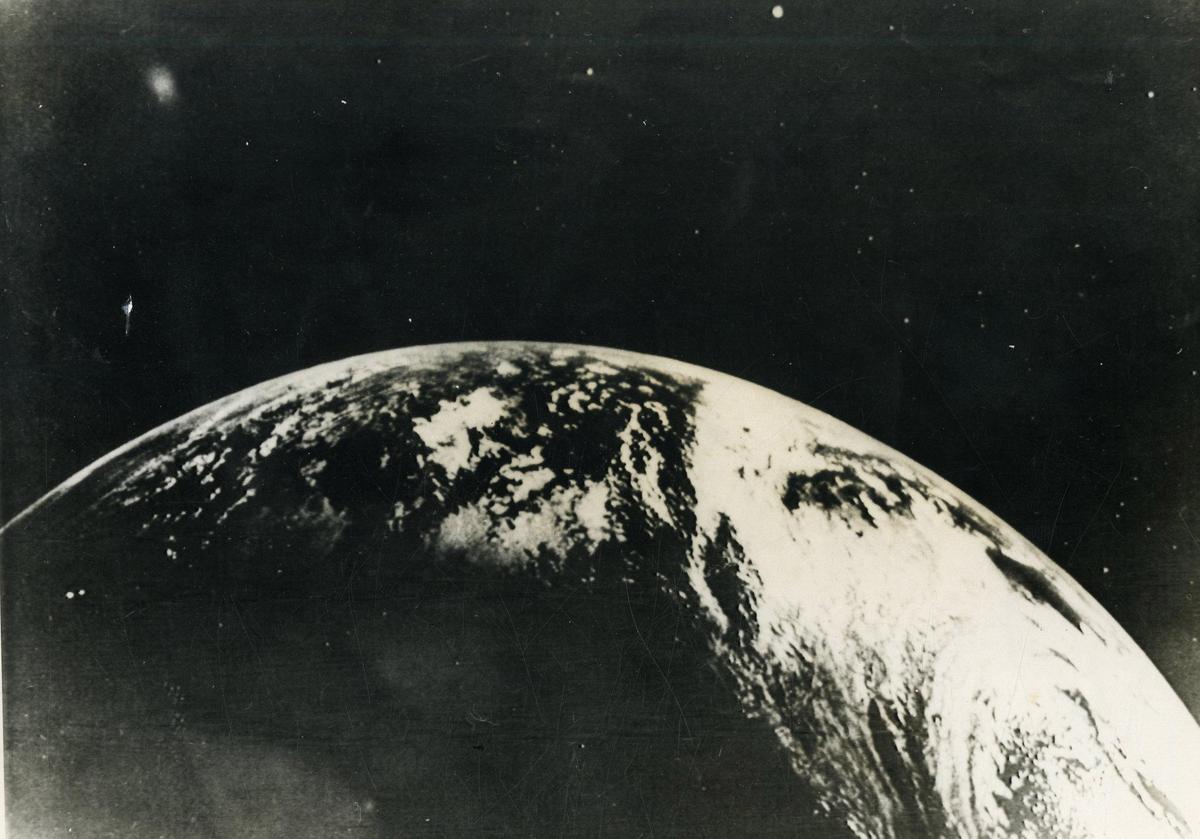
This view of the Earth was made through the command pilot's window of the Apollo 4 spacecraft during the November 9th orbital test flight. The picture was taken at an altitude of 9,850 nautical miles, a few seconds from orbital apogee, 5 hours 45 minutes and 1 second from blast-off. The view is looking south-west between Africa and South America. In extreme lower left is the Antarctic ice cap. (Picture should be held vertically with the Earth at the left for proper viewing).

This view of the Earth was made through the command pilot’s window of the Apollo 4 spacecraft during the November 9th orbital test flight. The picture was taken at an altitude of 9,850 nautical miles, a few seconds from orbital apogee, 5 hours 45 minutes and 1 second from blast-off. The view is looking south-west between Africa and South America. In extreme lower left is the Antarctic ice cap. (Picture should be held vertically with the Earth at the left for proper viewing).
| Photo Credit:
THE HINDU ARCHIVES

Coasting upwards, the Apollo spacecraft oriented itself to place maximum thermal stress on its heat shield. Five hours and 46 minutes after its launch, as the spacecraft reached apogee, or high point, 715 high-quality colour images of the Earth were clicked by the onboard camera.

When Apollo 4 began its descent, its nose was pointed towards the Earth before the engine was ignited to increase its velocity to approximate a return from the moon. The Command Module separated from the Service Module and the former encountered the Earth’s upper atmosphere at an altitude of 120 km, while still travelling at over 40,000 kmph. The heat shield absorbed the heat of the reentry reaching a temperature of 2760 degrees Celsius, while still maintaining a cabin temperature that would be comfortable for a crew.

Double-skip reentry

At an altitude of about 55 km, the spacecraft used its aerodynamic lift to briefly head out of the atmosphere, reaching a height of over 70 km before continuing its descent. This double-skip reentry was done to reduce both the deceleration and the heat loads on the spacecraft.

When Apollo 4 reached an altitude of 6.7 km, or 22,000 feet — lesser than the highest mountain peaks on Earth — it deployed its two drogue parachutes to slow and stabilise itself. At 10,000 feet — still over 3 km from the surface and more than three times the tallest building on Earth — Apollo 4 deployed its three main parachutes.

Once Apollo 4 splashed down on the Pacific Ocean — nearly 20 km from its intended target and about 13 km from the prime recovery ship, the U.S.S. Bennington — the capsule remained upright. In all, the Apollo 4 mission had lasted 8 hours, 27 minutes, and 9 seconds.

U.S. Navy frogmen had attached a floatation collar around the spacecraft within 20 minutes of splashdown. It was hoisted aboard the Bennington once the ship pulled alongside and the entire recovery operation lasted around two hours.

The Bennington sailed for Hawaii and arrived at the Pearl Harbour on November 11, where the spacecraft’s systems were shut down and all its hazardous fluids drained. The spacecraft was flown to Long Beach, California on November 15, and it was trucked to a facility in Downey, California for detailed postflight inspections.

The first flight of the Saturn V rocket and the success of the Apollo 4 mission was a timely boost for NASA. It paved the way to achieve President John F. Kennedy’s goal of “landing a man on the moon and returning him safely to the Earth” before the end of that decade.

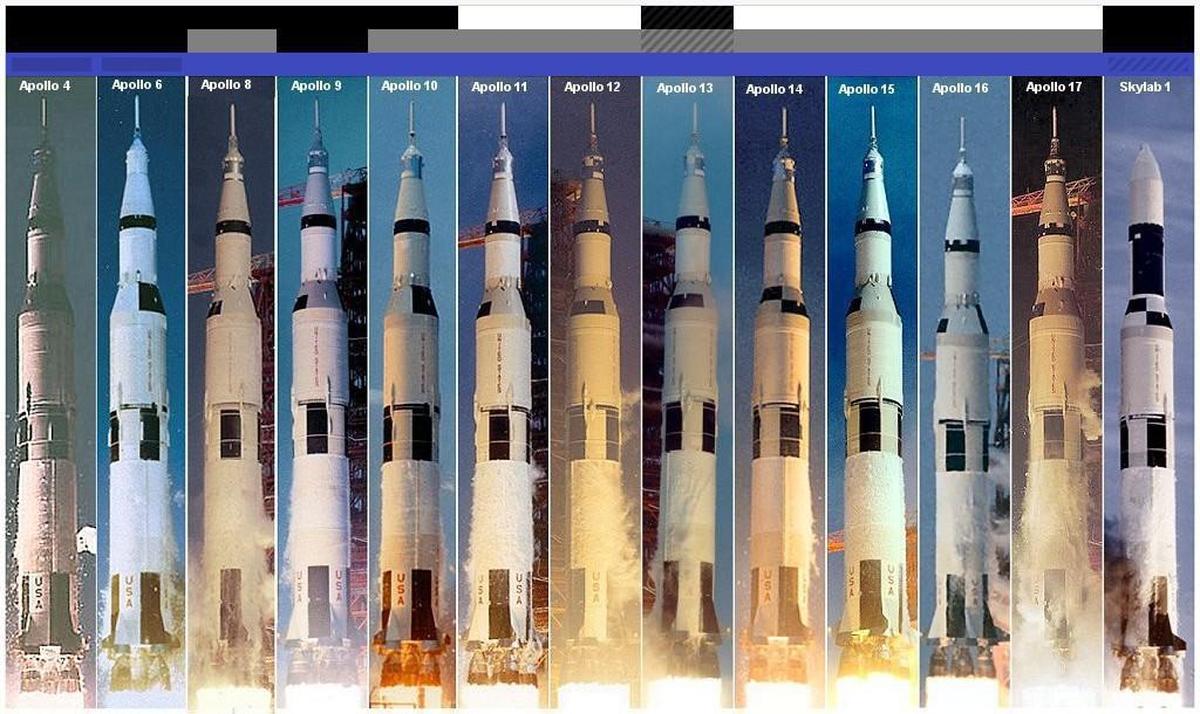
A collage showing all Saturn V launches.  The colour coded bars at the top indicate the destination of each mission:
Earth Orbit = Blue
Lunar Orbit = Grey
Lunar Landing = White

A collage showing all Saturn V launches. The colour coded bars at the top indicate the destination of each mission:
Earth Orbit = Blue
Lunar Orbit = Grey
Lunar Landing = White
| Photo Credit:
Tdadamemd and Reubenbarton / Wikimedia Commons

Lyndon B. Johnson, who was the U.S. President at the time, said of the flight: “The whole world could see the awesome sight of the first launch of what is now the largest rocket ever flown. This launching symbolises the power this nation is harnessing for the peaceful exploration of space.” It wasn’t long before Saturn V helped fulfil humanity’s dream of setting foot on the moon.

Published – November 09, 2025 01:53 am IST

Source link

How is Australia setting standards on training AI? | Explained

0

The story so far: On October 27, Attorney General of Australia Michelle Rowland unequivocally rejected proposals by the country’s own think-tank that sought to grant technology companies unchecked rights to mine copyrighted content for training AI. This decision marks a critical moment in the ongoing global debate between AI firms and copyright holders. Australia’s stance will have an impact on how tech giants mine data to train AI systems in the country.

What is at the heart of the issue?

At the heart of this controversy is the question of whether AI firms should be allowed to use copyrighted material, like books, music, artworks, and journalistic content, to train their AI systems without obtaining explicit permission from the creators.

The issue came to a head after the Productivity Commission, a government-backed independent agency, which takes inputs from industry bodies and big tech firms, suggested an exemption to existing copyright laws to mine text and data. In its report titled ‘Harnessing Data and Digital Technology’, the commission advocated for open access to vast troves of text data and voluntary industry standards in terms of guardrails. The commission argued that easing restrictions could unlock billions of dollars in foreign investment and bolster Australia’s economy.

This prompted immediate and vocal opposition. Authors, artists, trade unions, and media organisations called the proposal a way to get access to original content without paying for it. The commission’s interim report, published in August, further stoked anger by revealing it had not consulted with creatives nor modelled the real impact on Australia’s artistic economy before recommending the change.

How is the government responding?

In response to criticism from creatives, Attorney General Rowland said that “Australian creatives are not only world class, but they are also the lifeblood of Australian culture, and we must ensure the right legal protections are in place.” She emphasised that technology’s advancement must not come at the expense of those who generate the culture AI seeks to emulate or understand. Recognising the economic potential of AI, Ms. Rowland still asserted, “Australian creatives must benefit from these opportunities too.” To chart a way forward, the government has convened a Copyright and AI Reference Group (CAIRG) to consider alternatives. These include the possibility of a new paid licensing framework under the Copyright Act, which replaces the current voluntary system, and fairly compensates creators when their works are used for AI training. The aim is to establish a regime that balances technology-driven innovation with real value exchange so creators can decide how their works are used, and receive payment for the intellectual property.

How has the creative industry responded?

The decision represents more than a win for artists and media agencies as many see it as step in the right direction. Industry bodies see it as an important step in the right direction. For instance, Annabelle Herd, CEO of Australian Recording Industry Association, said in a LinkedIn post that the decision to “rule out a text and data mining exception for AI training of music and other copyright material is a critical step in the right direction. It is a win for creativity and Australian culture and First Nations culture, but it’s also a win for common sense.” She noted that the current copyright licensing structures are the foundation of the creator and digital economies and that IP laws drive innovation.

“Artists deserve the right to decide how their work is used and to share in the value it creates. Protecting that agency is how we safeguard Australia’s creative sovereignty and keep our culture strong,” she asserted. Media executives have widely endorsed the move, underscoring the need to let creators have control over their content. Some see Australia’s position in the broader AI debate as a defender of creator rights in an era of technological upheaval, while other view this as a signal to other democracies grappling with the same issues. Australia’s decision comes at a time when, around the world, tech companies are seeking to negotiate or sidestep copyright laws in pursuit of data to power ever larger, smarter AI models.

Yet the backlash from cultural and media groups highlights a growing unease with the notion that transformative technology should override established rights and undermine creative economies.

Why does this matter now?

As AI becomes increasingly capable of generating content, reproducing styles, and even mimicking unique voices, the line between inspiration and appropriation blurs.

Creators, authors and media organisations fear loss of agency, financial harm, and the cultural dilution that comes with unchecked content mining.

In addition, smaller players and independent artists, those with the least number of resources, are the most exposed to this AI onslaught. For such groups, meaningful copyright protection is synonymous with survival, creative integrity, and fair market participation.

Australia’s ruling is significant not simply for its immediate legal consequences, but for its deeper message that technological advancement must coexist with respect for creators, for culture, and for the economic infrastructure that sustains both.

The government’s next steps on potentially replacing voluntary licensing with a mandatory, paid system could set the standard for ethical AI development, championing genuine value exchange and fostering trust between innovators and the creative sector.

As other democracies wrestle with the question of who benefits from the AI revolution, Australia’s stance should remind them that innovation need not come at the cost of fairness, culture, and human creativity. Australia’s position signals that technology works best when it amplifies human creativity rather than exploit it.

Published – November 02, 2025 03:42 am IST

Source link

IIT Bombay researchers develop GPS-free control scheme for autonomous drone swarms

0

Novel scheme by IIT Bombay researchers to control drones can enable complex formation flying using only camera data, without GPS or inter-drone communication.

A new control scheme developed by Professor Dwaipayan Mukherjee and research scholar Chinmay Garanayak at the Indian Institute of Technology (IIT) Bombay enables unmanned aerial vehicles (UAVs) to fly in coordinated swarms without relying on GPS, inter-drone communication, or centralised control systems. The method uses bearing-only measurements obtained through onboard cameras to determine relative positions and maintain formation.

The researchers applied the scheme to Vertical Take-Off and Landing (VTOL) UAVs, which can lift off without a runway and hover mid-air. These drones are suitable for operations in confined spaces such as surveillance and monitoring. “Autonomy in a swarm is a critical task,” Mr. Mukherjee said. “This means that vehicles in a swarm should be able to decide their ‘actions’ based on variables they can measure with their on-board sensors, instead of having to rely on some global information being fed to them or some human/centralised computer deciding what their action ought to be. This is where our paradigm differs from usual ones,” he added.

The proposed ‘bearing-only’ control scheme allows each drone to use its onboard camera to observe its immediate neighbours and calculate bearing information. “In bearing-only control, the goal is to achieve formation control using only interagent bearing measurements,” Mr. Garanayak said. The system does not require GPS or communication with other drones or a central computer.

Camera-based measurements are less prone to noise than conventional distance sensors, simplifying the drone’s sensor system and reducing battery requirements and overall weight. The scheme is designed to work in areas where GPS is unavailable, or communication could be jammed, making it suitable for stealth-mode operations such as covert military missions.

VTOL drones are underactuated systems, which means they have six degrees of freedom but fewer directly controllable movements. While they can move vertically and rotate around three axes, lateral and forward-backward movements must be indirectly controlled. “Many of the results in the literature do not address the underactuated dynamics of VTOL vehicles and only focus on the kinematic model. This motivated us to consider the fully underactuated model of the VTOL UAV and explore its applicability to formation control,” Mr. Mukherjee said.

Underactuated systems require dynamic models that include position, orientation, velocities, forces, torques, and inertia. Previous attempts to apply bearing-only control to such models often fail due to instability or breakdowns in certain conditions. Mr. Mukherjee and Mr. Garanayak developed a control mechanism that ensures convergence and maintenance of the desired formation, even when drones start from imperfect positions. They have provided rigorous mathematical proof to support the reliability of the system. 

Their work addresses two operational scenarios. In the first, drones maintain formation at constant velocity using bearing and bearing-rate data. In the second, where formation and velocity vary over time, drones incorporate their own velocity measurements in addition to bearing data. The system can handle arbitrary time-varying configurations, allowing drones to navigate narrow passages, reconfigure into single-line formations, and adapt to changing mission requirements. 

The researchers plan to test the control scheme experimentally, using a drone swarm. On the future roadmap, they aim to address collision avoidance with theoretical guarantees. “Most existing algorithms rely on ad hoc collision avoidance schemes that do not come with any theoretical guarantees. Collision avoidance with objects in the environment and among drones is a challenge we are trying to tackle at a theoretical level,” Mr. Mukherjee said. 

Source link

Gray Hair May Be Your Body’s Secret Cancer Defense

0

The study reveals how hair pigment stem cells respond to DNA damage by making fate decisions that can result in either hair graying or the development of melanoma. Throughout life, our cells face continual challenges from both external and internal influences that can harm their DNA. This type of damage is known to play a […]

Source link

Disney content has gone dark on YouTube TV

0

Disney content has gone dark on YouTube TV, leaving subscribers of the Google-owned live streaming platform without access to major networks like ESPN and ABC.

That’s because the companies have failed to reach a new licensing deal to keep Disney channels on YouTube TV. Depending on how long it lasts, the dispute could particularly impact coverage of U.S. college football matchups over the weekend — as well as NBA and NFL games — on top of other news and entertainment disruptions that have already arrived.

In the meantime, YouTube TV subscribers who want to watch Disney channels could have little choice other than turning to traditional broadcasting or the company’s own platforms — which come with their own price tags.

Here’s what we know.

Disney content was pulled from YouTube TV after a carriage agreement expired on Thursday. The two sides have been unable to reach a new deal to continue licensing Disney channels on the platform — resulting in the current blackout.

YouTube TV says that Disney is proposing terms that would be too costly, resulting in higher prices and fewer choices for its subscribers. Google’s streamer has accused Disney of following through on “the threat of a blackout on YouTube TV as a negotiating tactic” — and claims that the move also benefits Disney’s own streaming products like Hulu + Live TV and Fubo.

Meanwhile, Disney says that YouTube TV has refused to pay fair rates of its channels — and is therefore choosing “to deny their subscribers the content they value most.” The California entertainment giant also accused Google of “using its market dominance to eliminate competition and undercut the industry-standard terms we’ve successfully negotiated with every other distributor.”

In a Friday note to employees, Disney Entertainment Co-Chairs Dana Walden and Alan Bergman and ESPN Chairman Jimmy Pitaro added that YouTube TV pulled Disney content Thursday night “prior to the midnight expiration of our deal” — and noted the platform also deleted subscribers’ previously-recorded programming. The Associated Press reached out to Google for further comment.

ESPN and ABC are among the biggest networks that YouTube TV subscribers can no longer access amid the dispute.

And beyond those top sports and news offerings, other Disney-owned content that is now dark on the platform include channels specific to U.S. college athletic regions, like the Atlantic Coast Conference and the Southeastern Conference. NatGeo and FX are also impacted.

Here’s a recap of the full list outlined by YouTube TV:

Google says that streamer adds-ons like 4K Plus and Spanish Plus are also affected.

Consumers can continue to watch Disney’s sports programming on the company’s own ESPN offerings — but it will come with an additional cost. For streaming, the network launched its own platform earlier this year under the same ESPN name, starting at $29.99 a month.

Other Disney content can be found on platforms like Hulu, Disney+ and Fubo. Again, those come with their own price tags. Disney also allows people to bundle ESPN along with Hulu and Disney+ for $35.99 a month — or $29.99 a month for the first year.

Disney also directed customers to a website called KeepMyNetworks.com to explore other options, which includes more traditional broadcast services.

But if you’re a YouTube TV subscriber and don’t have these streaming subscriptions or broadcast offerings, you might be left without access to this Disney content as long as the impasse lasts. YouTube TV said it would give subscribers a $20 credit if Disney content unavailable “for an extended period of time.”

YouTube TV’s base subscription plan costs $82.99 per month. Beyond Disney content, the platform currently offers live TV from networks like NBC, CBS, Fox, BBC, PBS, Hallmark, Food Network and more.

YouTube TV and Disney have acknowledged that the disruption is frustrating — and both maintain that they’re still committed to finding a resolution. But only time will tell.

The current blackout marks the latest in growing list of licensing disputes that impact consumers’ access to content.

From sports events to awards shows, live programming that was once reserved for broadcast has increasingly made its way into the streaming world over the years — as more and more consumers ditch traditional cable or satellite TV subscriptions for content they can get online. But renewing carriage agreements can also mean tense contract negotiations, particularly amid growing competition in the space.

YouTube TV and Disney have been down this road before. In 2021, YouTube TV subscribers also briefly lost access to all Disney content on the platform after a similar contract breakdown between the two companies. That outage lasted less than two days, with the companies eventually reaching an agreement.

Some past impasses have been shorter and limited to a matter of hours — or found a way to temporarily ward of disruptions at the last minute. In August, for example, YouTube TV reached a “short-term extension” in its contract dispute with Fox, and the two later reached a new licensing deal.

Published – November 03, 2025 08:37 am IST

Source link

Trump says Nvidia’s Blackwell AI chip not for ‘other people’

0

Nvidia, the world’s most valuable company, dominates the market for AI chips [File]
| Photo Credit: REUTERS

Nvidia’s advanced Blackwell chip for artificial intelligence would not be available to “other people,” U.S. President Donald Trump said Sunday.

Nvidia, the world’s most valuable company, dominates the market for AI chips.

Questions have swirled about whether Trump would allow shipments of a version of the Blackwell to China since August, when he suggested he might allow sales of a scaled-down version of Nvidia’s next-generation advanced GPU chip in China.

However, Trump’s remarks to reporters aboard Air Force One suggest his administration may not be inclined to grant broad overseas access to the prized chip.

“The new Blackwell that just came out, it’s 10 years ahead of every other chip,” Trump said as he flew to Washington after a weekend in Florida. “But no, we don’t give that chip to other people,” he added.

The possibility that Blackwell chips might be sold to Chinese firms has drawn criticism from China hawks in Washington, who fear the technology would supercharge China’s military capabilities and accelerate its AI development. Republican Congressman John Moolenaar, who chairs the House Select Committee on China, said such a move “would be akin (to) giving Iran weapons-grade uranium.”

Trump had hinted he might discuss the chips with Chinese President Xi Jinping ahead of their summit in South Korea last week, but ultimately said the topic did not come up.

Nvidia CEO Jensen Huang said last week that Nvidia has not sought U.S. export licenses for the Chinese market because of Beijing’s stance on the company.

“They’ve made it very clear that they don’t want Nvidia to be there right now,” he said during a developers’ event, adding that it needed access to China to fund U.S.-based research and development.

Nvidia said on Friday that it would supply more than 260,000 Blackwell AI chips to South Korea and some of the country’s biggest businesses, including Samsung Electronics.

Source link

“Most Effective Therapy to Date” – New Treatment Wipes Out Bladder Cancer in 82% of Patients

0

A slow drug-release system has proven highly effective in treating certain bladder cancer patients whose tumors were previously unresponsive to therapy. A new targeted drug delivery system known as TAR-200 has shown remarkable results in a phase 2 clinical trial involving patients with high-risk non-muscle-invasive bladder cancer that had not responded to previous therapies. In […]

Source link

AI song generator Udio offers brief window for downloads after Universal settlement upsets users

0

Artificial intelligence song generation platform Udio said it would give its frustrated users 48 hours starting Monday to download their songs before the company shifts to a new business model to comply with a legal settlement.

The short reprieve comes after Udio on Wednesday said it had settled copyright infringement claims brought by Universal Music, a label with artists including Taylor Swift, Olivia Rodrigo, Drake and Kendrick Lamar.

AI companies are now fighting so many copyright lawsuits that a tech industry lobby group, the Chamber of Progress, last week called on U.S. President Donald Trump to sign an executive order directing federal attorneys “to intervene in legal cases” to defend the industry’s practice of building generative AI tools by feeding them on copyrighted works.

Citing more than 50 pending federal cases, the group asked for help stopping court fights leading to “potentially company-killing penalties” that threaten AI innovation. But artists have warned that AI tools built on their works also threaten their livelihoods.

In the biggest settlement so far, AI company Anthropic agreed to pay $1.5 billion — or $3,000 per book — to settle claims from authors who alleged the company illegally pirated nearly half a million of their works to train its chatbot.

Udio and Universal didn’t disclose the financial terms of their new music licensing agreements. They also said they will team up on a new streaming platform.

As part of the agreement, Udio immediately stopped allowing people to download songs they’ve created, which sparked a backlash and apparent exodus among paying users.

“We know the pain it causes to you,” Udio later said in a post on Reddit’s Udio forum, where users were venting about feeling betrayed by the platform’s surprise move and complained that it limited what they could do with their music.

Udio said it still must stop downloads as it transitions to a new streaming platform next year. But over the weekend, it said it will give people 48 hours starting at 11 a.m. Eastern time Monday to keep their “past creations.”

“Udio is a small company operating in an incredibly complex and evolving space, and we believe that partnering directly with artists and songwriters is the way forward,” said Udio’s post.

The settlement deal was the music industry’s first since Universal, along with Sony Music Entertainment and Warner Records, sued Udio and another AI song generator, Suno, last year over copyright infringement.

Udio and Suno pioneered AI song generation technology, which can spit out new songs based on prompts typed into a chatbot-style text box. Users, who don’t need musical talent, can merely request a tune in the style of, for example, classic rock, 1980s synth-pop or West Coast rap.

Record labels have accused the platforms of exploiting the recorded works of artists without compensating them.

In its lawsuit filed against Udio last year, Universal sought to show how specific AI-generated songs made on Udio closely resembled Universal-owned classics like Frank Sinatra’s “My Way,” The Temptations’ “My Girl,” ABBA’s “Dancing Queen” and holiday favorites like “Rockin’ Around the Christmas Tree” and “Jingle Bell Rock.”

A musician-led group, the Artist Rights Alliance, said Friday that the Universal-Udio settlement represents a positive step in creating a “legitimate AI marketplace” but raised questions about whether independent artists, session musicians and songwriters will be sufficiently protected from AI practices that present an “existential threat” to their careers.

“Licensing is the only version of AI’s future that doesn’t result in the mass destruction of art and culture,” the group said. “But this promise must be available to all music creators, not just to major corporate copyright holders.”

Published – November 03, 2025 09:02 am IST

Source link

Nexperia’s Dutch headquarters says it welcomes announcements lifting block on shipping chips

0

Nexperia said its focus is now on ensuring the stability of supply to customers [File]
| Photo Credit: REUTERS

Nexperia BV, the Dutch chipmaker, said on Sunday it welcomed recent statements by the U.S. and Chinese governments removing barriers to the company shipping its chips, but it declined to comment on statements made by its Chinese subsidiary that it will accelerate steps towards becoming independent.

Nexperia said its focus is now on ensuring the stability of supply to customers. The Dutch government said separately it is continuing talks with the Chinese and other governments, and industry, on a “constructive way forward” for Nexperia.

A fight over control of Nexperia, which makes large volumes of basic chips used in cars, has led to shortages and alarmed automakers around the globe.

Source link