Home Blog Page 60

Wielding Obscure Budget Tools, Trump’s ‘Reaper’ Vought Sows Turmoil in Public Health

0

When President Donald Trump posted a satirical music video on social media in early October depicting his budget director, Russell Vought, as the Grim Reaper lording over Democrats in Congress, public health workers recognized a kernel of truth.

Vought has exerted extraordinary control over government spending this year, usurping congressional decisions on how the nation’s money is used. His push for more layoffs during the government shutdown is only the latest blow, following months of firings, canceled grants, and withheld funds.

By cutting and freezing public health funds, in particular, the Trump administration has already begun to undercut efforts to provide medical care, outbreak response, housing assistance, and research across the U.S., according to health officials, nonprofit directors, and federal agency staffers interviewed by KFF Health News.

Since most federal funds for public health flow to states, Vought is rivaling the Department of Health and Human Services secretary, Robert F. Kennedy Jr., in his ability to upend government-led efforts to keep Americans healthy. In Texas, Centers for Disease Control and Prevention funds to stem a measles outbreak weren’t available until after the crisis had subsided and two children had died. A project to protect Alabamans from raw sewage and hookworm was abandoned. People with HIV have had to delay medical care as clinics scale back hours. Time-dependent surveys on HIV and maternal mortality were halted. Food banks have canceled events. Tobacco prevention programs lapsed. Initiatives to protect older adults at risk of falling have been harried.

No matter what budget Congress ultimately passes for next year, the Trump administration may continue to thwart financial support for such programs in ways that will harm people’s health. “The White House has shown that they are willing to unilaterally exert control over funding,” said Gillian Metzger, a constitutional law professor at Columbia University.

“This is a huge deal,” she added, “because the power of the purse is central to Congress’ ability to shape and direct policy.”

Before he was appointed to lead the White House’s Office of Management and Budget this year, Vought outlined budgetary strategies the executive branch could deploy to wrest power from Congress and federal agencies in Project 2025, the Heritage Foundation’s conservative blueprint.

Vought’s tactics unfolded this year, often below the radar. They include abrupt grant cancellations, extraordinary constraints on how funds can be spent, and excessive layers of review, agency officials say, at every step in the grantmaking process. Getting money out the door has been further complicated by layoffs that have gutted offices overseeing grants on chronic disease prevention, HIV, maternal mortality, and more.

Government employees have described these tactics to members of Congress, said Abigail Tighe, executive director of the National Public Health Coalition, a group that includes current and former staffers at the CDC and HHS. “We want Congress to act, because this is preventing states and communities from doing critical public health work to keep our country safe,” she said. “If they don’t have capacity, we all collectively suffer.”

Democrats on the House and Senate appropriations committees have pushed for transparency, but the extent to which money Congress appropriated for public health in 2024 and 2025 has gone unspent because of the administration’s disruptions is not yet known. “This is a sophisticated strategy to cause money to lapse and then say, ‘If they can’t spend it, they don’t need it,’” said Robert Gordon, a public policy specialist at Georgetown University and a former assistant finance secretary at HHS.

“No one thought this was possible or legal, but that is what’s happening,” he said.

Details on how the administration has subverted health spending have received little attention because many changes have been made quietly — and people who rely on federal funds fear retribution. The Trump administration has defunded and threatened federal offices that hold the government accountable and fired whistleblowers. It has abruptly revoked funds for local governments and organizations.

Vought and spokespeople at the White House and the OMB did not respond to queries from KFF Health News. However, Vought described his intentions in a Sept. 3 speech. He said that federal agencies and Congress had gained more power over spending since the 1970s and that their control became “woke and weaponized” under Presidents Barack Obama and Joe Biden.

“Thankfully, President Trump won,” he said. “And we have now been embarked on deconstructing this administrative state.”

Many Parts, Many Malfunctions

The Trump administration delayed calls for applications for 2025 funding, leaving many nonprofits and local governments with only a couple of weeks to put together detailed applications for multimillion-dollar grants. (Amy Maxmen/KFF Health News)

Like a car, the federal budget process has many components that can break down. Through the OMB and its partner, Trump’s Department of Government Efficiency, or DOGE, the administration has intervened at various junctures. “There are so many ways in which money is not operating in the way it is supposed to operate,” said Bobby Kogan, the senior director of federal budget policy at the Center for American Progress, a left-leaning think tank, and a former OMB adviser.

Typically, Congress passes a budget that appropriates money for the next fiscal year to federal agencies. For many public health programs, ranging from housing assistance to cancer screening, agencies then post open calls online for states, local governments, and organizations to apply for funding. Agency experts select winners and send notices of awards — or notices of ongoing funding to groups that previously won multiyear awards.

Next, the OMB, which administers the federal budget, activates money for agencies, like a bank activates a credit card, so that grantees can spend and get reimbursed rapidly. Auditors keep an eye on spending, but the government has in the past limited interruptions so that programs run smoothly.

Early on, the Trump administration canceled billions of dollars in awards granted in 2024 and early 2025 for research and global health. In March, it clawed back $11.4 billion in covid-era funds that Congress had earmarked for health departments that were using the money for disease surveillance, vaccinations, and more.

Although some funds have been restored because of lawsuits, the Supreme Court has allowed other cuts by the administration to stand while the cases move through the courts.

Beyond these “shotgun” cancellations, the administration has taken a quieter, “in-the-weeds, slowing, cutting, conditioning” approach that’s frozen funds for public health, said Matthew Lawrence, a law professor specializing in health policy at Emory University.

By August, the CDC’s center for HIV and tuberculosis prevention had doled out $167 million less than the historical average, according to an analysis by the Center on Budget and Policy Priorities, a think tank focused on reducing inequality. The CDC’s funding for chronic disease prevention lagged by $259 million, the Ryan White HIV/AIDS Program had underspent by $105 million, and funds for mental health at the Substance Abuse and Mental Health Services Administration were more than $860 million behind what was expected.

An unknown amount of Congress’ 2025 funding for research and public health has yet to be awarded and will probably lapse this year, said Joe Carlile, an author of the center’s analysis and an associate OMB director during the Biden administration. The obstructions appear to be concentrated in areas where the White House proposed cutting the federal budget next year. “The administration may be executing their 2026 budget request through administrative controls,” Carlile said.

“This is boring but crazy-high stakes,” he added. “A one-branch veto of spending neuters the power of the purse in the Constitution that Madison said was the fundamental check on the executive branch.”

Incremental Chaos
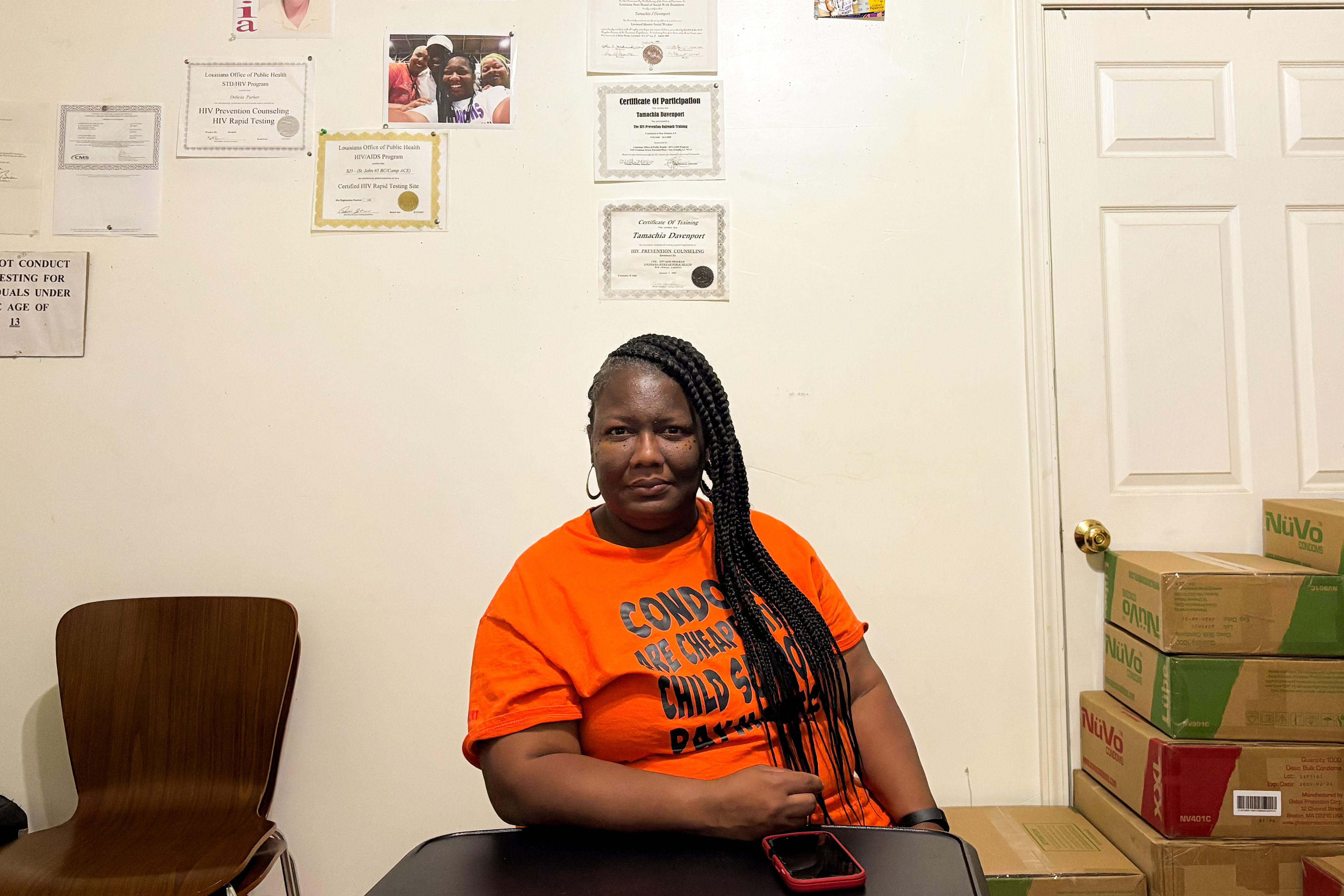
A portrait of a woman sitting in her office with an array of credentials on the wall behind her.
When federal funds were delayed, Tamachia Davenport, program director at the St. John AIDS outreach ministry in New Orleans, had to decide between cutting staff or forgoing supplies that prevent the spread of HIV and other sexually transmitted infections. (Amy Maxmen/KFF Health News)

A key tactic Vought described in Project 2025 occurs when the OMB activates funds for agencies in installments, called apportionments. Vought wrote that “apportioned funding” could “ensure consistency with the President’s agenda.”

Under Vought, the OMB shrank the size of apportionments, HHS and CDC staffers said. It’s illegal for agencies to let grantees withdraw money before the total amount is in the metaphorical bank, so that delayed agencies’ ability to greenlight spending.

The OMB and DOGE also placed conditions on apportionments through memos, footnotes, and spoken directives telling agencies to ensure that spending “aligns with Administration priorities,” according to reports and HHS employees who said that notices of funding opportunities and awards required excessive layers of sign-off. The CDC and other agencies circulated lists of priorities that reflect White House stances, including those targeting diversity, equity, and inclusion efforts; immigration; and transgender rights. Public health efforts have been especially caught up in red tape, since many focus on populations bearing an unequal burden of death, disease, and injury.

Groups that rely on federal funds have largely been unaware of the reasons grants were held up, but they’ve fielded what they viewed as unsettling queries. For example, Kathy Garner, the head of a Mississippi nonprofit, said officials asked her to defend the exclusion of men from a program to shelter women who experienced domestic violence.

Delays were made worse by uncertainty. Grantees said they’ve been unable to reach program officers because tens of thousands of federal workers have been laid off. Agency officials said firings slow funding further.

“Everyone’s inbox is full of letters from grant recipients asking, ‘How do we proceed?’” one high-ranking CDC official told KFF Health News, which granted agency officials anonymity because of their fears of retaliation. “We just say, ‘Please wait.’”

Time was critical as a measles outbreak surged in West Texas early this year. The state asked for federal funding for the response in March, but it didn’t arrive until May, after the outbreak had largely faded in Texas, according to an investigation by KFF Health News. Apportionment control was a key reason, CDC staffers said.

In July, 81 HIV organizations sent a letter to Kennedy. “With every day of delayed FY2025 funding release, the delivery of essential HIV services is compromised,” said the letter, which was reviewed by KFF Health News. Because of delays and uncertainty, it said, HIV clinics had laid off case managers and reduced clinician hours, closed sites, and pared down hotlines that patients call with urgent questions. The funds arrived about a month later, but HIV providers remain shaken.

Lauren Richey, medical director at University Medical Center’s HIV clinic in New Orleans, backed out of hiring a sorely needed dentist she had recruited. “I was afraid to tell someone to move across the country for a job when I wasn’t sure if or when we’d get the funding for their salary,” she said. “The wait is now three to four months for dental services, when it was usually a couple of weeks at most.”

Tamachia Davenport, program director at the St. John AIDS outreach ministry in New Orleans, said that “a lot of us are having to rob Peter to pay Paul.”

When the group didn’t get CDC funds it expected this summer, Davenport had to decide between cutting staff or supplies. Concerned her top employees would take jobs elsewhere, she stopped buying the condoms they distribute throughout the city to prevent the spread of sexually transmitted infections.

Louisiana already has one of the highest rates of HIV, chlamydia, and gonorrhea in the country. Condoms cost far less than treating these diseases. For a person infected by HIV at age 35, such costs exceed $326,000.

Groups focused on cancer, diabetes, and heart disease also report lasting repercussions from delays, as well as ongoing fears that they will happen again. Louisiana State University’s Healthy Aging Research Center canceled some of its workshops to train health workers on caring for people with dementia. “There may be fewer people who have this very specific expertise next year in Louisiana and Mississippi,” said Scott Wilks, the director of the center. “That’s on top of the big shortage we have already.”

Nationwide surveys tallying maternal and infant mortality froze for about five months because of funding delays, causing an irrecoverable gap in data that had been collected continuously since 1987, CDC officials say.

“We are seeing the administration get their way with or without an approved budget,” one said. “It’s such a terrible shame to play with people’s health this way.”

DOGE also inserted itself into grant reimbursements this year, stalling the rapid turnaround that public health groups typically expect to cover salaries, rent, and other monthly costs outlined in budgets that have already been approved. In what’s now labeled Departmental Efficiency Review, itemized expenses must be regularly justified by multiple government officials, according to documents reviewed by KFF Health News.

DOGE posted on its website expense reports covering about a month’s span from April to May. Nearly 230 of the individual expenses filed to federal agencies during that period are for $1 or less. Other entries break down monthly salaries for individual employees and petty costs for postage or monthly subscriptions.

“Public funds deserve scrutiny, but this is different from audit practices I’ve been a part of,” Carlile said.

DOGE also stalled calls for applications for 2025 funding — and some calls never appeared as the fiscal year came to a close on Sept. 30. Among them are programs for groups that provide housing assistance. People will be evicted when these organizations run out of money left over from 2024, said Steve Berg, chief policy officer at the National Alliance to End Homelessness.

Other solicitations came out months behind schedule, leaving groups with a few weeks to put together complicated applications for multimillion-dollar awards, including for Alzheimer’s care, addiction recovery, senior support, and chronic disease management.

“They’ve set projects up to fail,” one HHS official said.

Source link

India’s new AI governance guidelines push hands-off approach

0

The report emphasises seven principles for AI: trust, people-centricity, “responsible innovation,” equity, accountability, understandability of LLMs, and “safety, resilience and sustainability”.
| Photo Credit: Reuters

Advocating a hands-off approach to the regulation of artificial intelligence in the country, the Ministry of Electronics and Information Technology (MeitY) released the India AI Governance Guidelines on Wednesday (November 5, 2025). The document is a significantly changed revision of a framework put out for consultation in January this year.

The report was drafted by a committee formed in July and headed by Balaraman Ravindran, the head of the Department of Data Science and Artificial Intelligence at IIT Madras. The broader group that worked on the previous framework was headed by Principal Scientific Adviser Ajay K. Sood.

These guidelines are separate from a draft amendment to the IT Rules, 2021, which would require labelling of AI-generated content on social media platforms. That draft is in a public consultation stage, separately from the formulation of these guidelines.

The guidelines will “be a cornerstone in developing AI for India, and can be a role model for AI governance globally,” MeitY Additional Secretary Abhishek Singh said.

Also Read | IT Ministry proposes mandatory labelling of AI-generated content on social media

Innovation with guardrails

The report emphasises seven principles for AI: trust, people-centricity, “responsible innovation,” equity, accountability, understandability of LLMs, and “safety, resilience and sustainability.” Mr. Ravindran stressed that the governance guidelines seek to signal India’s largely hands-off approach to AI. “We’re calling this the AI Governance Guidelines, not AI regulation or anything like that, because we don’t want it to be viewed as something that throttles AI adoption in India,” he said. “It’s as much about enabling adoption and making it impactful for India.”

While the previous framework laid emphasis on minimising risks inherent in deploying AI, the current model scales this back to promoting innovation with guardrails. The report also strips away much of the previous work done by NITI Aayog and the Organisation for Economic Cooperation and Development that was foundational to the earlier draft framework’s approach.

‘No immediate plans for AI law’

In the long term, the report says, new laws should be drafted based on “emerging risks and capabilities” of AI systems. Responding to reports on the government considering a new AI law, IT Secretary S. Krishnan indicated that there were no immediate plans, but as and when there would be an urgent need for such legislation, the government would act swiftly.

The report’s launch comes as part of the government’s steady flow of “pre-events” for the Delhi AI Impact Summit to be held in February 2026, an international gathering that has been preceded by similar events at Bletchley Park in the U.K., as well as in Seoul and Paris.

COMMENT | The approach to regulating AI in India

India-specific risk framework

The report has six recommendations in addition to the seven principles: expand access to AI infrastructure and “leverage the power of digital public infrastructure for scale, impact and inclusion”; build capacity by skilling in AI; “adopt balanced, agile and flexible frameworks” as far as regulating AI is concerned; mitigate risks by looking at “India-specific” factors that need to be addressed; boost accountability in the AI ecosystem by requiring “greater transparency… about how different actors in the AI value chain operate”.

In the short term, the report recommends establishing “key governance institutions,” developing some of the India-specific risk frameworks mentioned above, and increasing access to AI safety tools. In the “medium term,” the report recommends amending laws and regulations as needed, operationalising AI incidents systems for cybersecurity purposes, and integrating DPIs like Aadhaar with AI.

Source link

How do Google Maps know traffic routes?

0

PHOTO: Dado Ruvic / REUTERS

Manu was late for work. Not once did she remember hitting the snooze button on her phone, but she was late. It was 8:40, but her working hours would begin at 9:00. What she needed was a traffic-free route, and she had Google Maps to help her find it. She sighed in relief as she saw that a blue-lined route was available. Without a second thought, she grabbed her bag and bike keys and rushed out the door.

Google maps

Wow! Manu sure was lucky for that blue line! Whether you go to school, college, work, or even a distant market, more than once, you would have taken out your phone and opened Google Maps. It is a web-mapping platform that is utilised by many consumers on a daily basis, and was created by Google. It provides people with well-displayed maps, satellite imagery, location search,  aerial photography, and many more incredible features. But one of its highly underlooked uses is something we often take less than ten seconds to check, and that would be its traffic detection capability. Whatever vehicle you take, be it a car, bus, bike, or auto, etc. Google Maps proves to be a highly efficient assistant in letting you know which route will ensure that you get to your destination on time. In this case, the colour of the lines indicating the roads is what a user pays attention to. Blue line means its ‘go!go!go!’, orange line means ‘slight traffic’, and red line means ‘Do not enter unless you want to be late!’

How does it do it?

So here’s the big question. How exactly can this app on your phone take up the role of a seer and tell you which road is the best choice for your travels? Well, there are many ways it does it, but three methods stand out from the rest. History, real-time information sensors, and machine-learning. 

Firstly, there’s history. They say learning from the past can help you make decisions for the future. This principle is also utilised by Google Maps when detecting traffic within the multiple pathways to your destination. The app analyses and studies traffic patterns from the past, and the average speed vehicles drive on a certain road at different times of day. By studying this historical database of information, Google Maps can make a prediction on what road will hold traffic at a certain timeframe.

Secondly, we have real-time information sensors. This information is brought to your phone from traffic sensors installed by government agencies or private companies that are particularly skilled in traffic data collection. GPS information on speed, direction, and location is all sent to Google Maps, which uses it to predict traffic flow. Radar and infrared technology are used to transfer wireless data to the server. The real-time information also comes from other smartphones with Google Maps when users enable the GPS. 

Thirdly, machine learning is a prominent feature that the app uses to analyse the data provided by the previous two sources of information (history and real-time data). Ever since it acquired DeepMind, the app uses Graph Neural Networks, a machine-learning architecture, to create a complex interconnected structure of road networks and traffic signals. These predictions are affected by many external factors like weather, road blocks, accidents, etc. 

Source link

Concerns Over Fairness, Access Rise as States Compete for Slice of $50B Rural Health Fund

0

RAPID CITY, S.D. — Echo Kopplin wants South Dakota’s leaders to know that money from a new $50 billion federal rural health fund should help residents with limited transportation options.

Kopplin, a physician assistant who works with seniors, low-income people, and mental health patients in the rural Black Hills, shared her thoughts at a meeting hosted by state officials.

South Dakota’s leaders did a “good job of diving in” and asking questions to get “deeper at the root of the problem,” she said.

Kopplin later told KFF Health News how one of her rural patients recently missed two appointments because of a broken-down car and no access to public transportation.

Echo Kopplin, a physician assistant in rural South Dakota, says she’s glad officials hosted public meetings across the state to hear from “front-line workers” before crafting their application to the Rural Health Transformation Program.(Echo Kopplin)

Nationwide, health care workers like Kopplin and thousands of others — from patient advocates to technology executives — flocked to town halls or online portals during the seven weeks state leaders had to craft and submit their applications for the Rural Health Transformation Program to the federal Centers for Medicare & Medicaid Services. That deadline was Nov. 5.

“We will give $50 billion away by the end of the year,” CMS Administrator Mehmet Oz said Nov. 6 at a Milken Institute event in Washington. He said all 50 states had submitted applications.

The program will “allow us to right-size the health care system,” Oz said, adding that innovations from the rural work “will spill over to suburban and urban America as well.”

Among applications and summaries publicly shared by states, themes include workforce development, telehealth, and access to healthy food. In Kansas, leaders want to build a “Food is Medicine” program. Wyoming officials propose a new program called “BearCare,” a state-sponsored health insurance plan that patients could use only after medical emergencies.

But many health policy experts and Democrats are raising alarms that the Republican-backed program will become a “slush fund.” Critics worry it will fail to reach the small-town patients they say need it most, especially as states face nearly a trillion dollars in Medicaid spending reductions over the next decade. Medicaid, a joint federal-state program, serves nearly 1 in 4 rural Americans.

“The status quo is tremendous distress in rural communities,” said Heather Howard, a professor of the practice at Princeton University and director of the university’s State Health and Value Strategies program, which is tracking the rural health fund. The new funding won’t be enough to offset the Medicaid losses, she said.

Congressional Republicans added the five-year, $50 billion Rural Health Transformation Program as a last-minute sweetener to President Donald Trump’s massive tax-and-spending legislation. The move helped win support for the One Big Beautiful Bill Act from conservative holdouts who worried that the Medicaid cuts in the bill would harm rural hospitals in their states.

In Montana, which hosted an online public forum before submitting its application, a nonprofit director pitched youth peer support as a way of battling high suicide rates. A registered nurse asked state leaders to “think maybe even bigger” and consider statewide universal health care.

And in Georgia, a technology-focused chain of primary care clinics that serves seniors proposed expanding its operations into that state in its online public comment. A rural grant writer asked for “safe and stable housing.”

The law says half of the $50 billion will be divided equally among all states with an approved application. The rest will be doled out according to a points-based system. Of the second half, $12.5 billion will be allotted based on each state’s rurality. The remaining $12.5 billion will go to states that score well on initiatives and policies that, in part, mirror the Trump administration’s “Make America Healthy Again” objectives.

Top Senate Democrats have raised alarms about the rural health program. They include Ron Wyden of Oregon and Tina Smith of Minnesota, who called on a federal watchdog agency to investigate the fairness and implementation of the fund. Taylor Harvey, a Wyden aide, said the Government Accountability Office has confirmed it will investigate.

According to the federal statute, no less than a quarter of states with an approved application may share the second half of the funding each fiscal year, CMS spokesperson Catherine Howden said. The agency plans to publish summaries of approved state projects, according to CMS guidance.

A handful of conservative-leaning states — including Texas, Arkansas, Louisiana, and Oklahoma — have already instituted regulatory and legislative initiatives, such as prohibiting “non-nutritious” foods in benefit programs, that garner additional points in the program application process.

Michael Chameides, a county supervisor in rural New York, said he fears the money could “be used in ways that would hurt certain states or reward certain states.” Chameides is also the communications and policy director with the Rural Democracy Initiative, a national advocacy organization that released a rural action report last month.

Edwin Park, a research professor at Georgetown University’s Center for Children and Families, said federal lawmakers gave Oz and his agency “really excessive discretion” when awarding the money.

Federal administrators have added rules that aren’t within the statute that created the program, Park said. For example, its application guidelines say states cannot use more than 15% of their funding to pay providers for patient care — payments that are expected to take a hit due to the Medicaid cuts.

Georgetown’s health policy experts and Democrats aren’t the only ones with concerns. Some Republicans and small hospitals in Ohio worry the money will go to large health systems instead of smaller, independent hospitals that serve people within their rural communities.

CMS’ Oz repeated the idea of getting “big hospitals to adopt smaller institutions” at the Washington gathering after applications were filed. He used similar language at a rural health summit hosted by South Dakota-based Sanford Health. “How do we get big hospitals to adopt smaller hospitals? Not to take them over, but to keep them viable by giving them good telehealth services, specialty support, radiology support,” he said at the October event.

Sanford owns or manages dozens of hospitals and hundreds of clinics and long-term care centers, as well as a health insurance company. The system reported about $81 million in operating income during the first six months of fiscal year 2025, according to a recent bond rating report.

Last year, Sanford opened a “command center” for its systemwide telehealth initiative. It launched a telehealth expansion in 2021 and offers virtual care for 78 medical specialties, Sanford President and CEO Bill Gassen said.

“We’ve tried to imagine, what if that number doubles?” Gassen said. The startup costs for telehealth are high, he said, and the rural fund could be a unique opportunity “for us to make virtual care available to more patients, to more communities, to more hospitals and health systems across the country.”

Gassen, who is set to chair the American Hospital Association in 2027, said Sanford leaders have met with state and federal officials, including Oz, whom he’s known for years, and Chris Klomp, a top deputy at CMS and a senior adviser to Health and Human Services Secretary Robert F. Kennedy Jr.

The word “telehealth” appears 36 times in the rural health program’s 124-page application guidelines. But Don Robbins Jr., chief executive of a small hospital on the Illinois-Kentucky border, chuckled at the idea of using the funding for that purpose.

Robbins, whose 25-bed Massac Memorial Hospital averages five to seven patients in its beds each day, said his hospital does not regularly offer telehealth. Even if it did, he said, patients living more than a mile outside of town couldn’t use it because they don’t have a good internet connection.

The small hospital reported a $31,314 loss in September, Robbins said. “I think if we get anything out of it,” Robbins said of the rural health program, “we’ll be lucky.”

Kopplin, the physician assistant who attended the South Dakota meeting, is cautiously optimistic about the rural health fund. She views it as a wonderful chance for states to test out ideas and learn from what works and what doesn’t.

But “in a lot of ways this bill is going to be a band-aid approach” for rural health, she said. “It’s not really going to fix the problem.”


Source link

Will run AI queries on Indian data centres: Microsoft

0

Microsoft will enable AI processing in India by 2025, enhancing local data governance and compliance for its customers. File
| Photo Credit: Reuters

Microsoft said it would allow customers of its productivity suite in India to have AI processing conducted within the country itself, starting by the end of 2025.

The firm said “in-country data processing for customers’ Microsoft 365 Copilot interactions [would be] available in 15 countries around the world,” with India, Australia, Japan and the United Kingdom getting the option by the end of the year.

The announcement is a tonal shift from large tech firms’ resistance over the last few years against proposed data localisation mandates, such as India’s in 2018. Since then, Microsoft and other firms have dramatically increased their data centre footprint around the world, with India seeing a surge of investments, and as regulated industries — such as finance — have been required to keep data within Indian borders, data residency has turned from cumbersome requirement to a sweetener for cloud and data centre providers.

Microsoft emphasised that regulations are at the heart of why it is making this offer, even though local data processing may have some marginal advantages in terms of “latency,” the time data takes to travel from one place to another. “This offer is designed to enable customers, particularly those in government and highly regulated industries, to access Microsoft 365 Copilot with an additional option for governance, security, and regulatory compliance,” the firm said.

Google, Microsoft and Meta have data centres in India, where a lot of their customers’ content and data is already stored. However, it is less common for these datacentres to be equipped with the relatively power-hungry graphics processing units (GPUs) on which AI models are deployed. ChatGPT maker OpenAI and Google have been working on setting up such datacentres in India.

Source link

Toothpaste Made From Hair Could Regrow Tooth Enamel

0

Toothpaste derived from human hair could provide a sustainable and clinically effective method for protecting and repairing damaged teeth. Researchers have found that a toothpaste made from human hair could provide an environmentally friendly and clinically proven way to strengthen and repair damaged teeth. A new study reveals that keratin, a natural protein present in […]

Source link

OpenAI’s ChatGPT Go free annual subscription rolls out in India

0

Free access is being offered for a limited time period [File]
| Photo Credit: REUTERS

OpenAI’s new low-cost subscription offering is now available in India for free, as part of the AI company’s initiative to reach out to more users in the country.

ChatGPT Go, which is OpenAI’s budget ₹399/month plan, will be free for users in India for a year starting on Tuesday (November 4, 2025) for users signing up then, OpenAI had announced last month.

Those who already have ChatGPT Go will also get the offering for free for 12 months.

Free access is being offered for a limited time period.

“Ahead of our first DevDay Exchange event in India, we’re making ChatGPT Go freely available for a year to help more people across India easily access and benefit from advanced AI,” Nick Turley, VP and head of ChatGPT at OpenAI, had said in a statement last month.

A ChatGPT Go subscription includes features that come with the Free plan, as well as extended access to GPT-5, extended access to image generation, extended access to file uploads, extended access to advanced data analysis, longer memory for more personalised responses, and access to projects, tasks, or custom GPTs, per an official OpenAI document.

OpenAI is gradually increasing its presence in India, as it sets up its first Indian office in Delhi and prepares to hire Indian talent. The company has also put out advertisements both online and offline.

In August, OpenAI CEO Sam Altman called India’s AI adoption “amazing to watch.” He said that ChatGPT users grew 4x in the past year, and that OpenAI would invest “much more” in India.

Source link

Apple got 30% value share in Q3 2025 in Indian smartphone market

0

Apple got 30% value share in Q3 2025 in India
| Photo Credit: PTI

Apple’s dominance in India is yet again confirmed by research firm CyberMedia Research (CMR), which noted that it achieved 30% value share during Q3 2025 in India. Samsung got 22% share. Overall, Vivo retained the top spot with 18% share in the quarter, followed by Samsung (15%), Oppo (13%), Xiaomi (13%) and Apple (9%).

Apple also entered the top five smartphone brands in India for the first time. The older generation iPhones (iPhone 16 and 15 series) together accounted for 82% of Apple’s portfolio in Q3 2025. The iPhone 17 series and iPhone 16e, each contributed 8%.

Largely, India’s smartphone market grew 7% year-on-year (YoY) growth on festive demand, accelerated 5G adoption, and a strong premium push for premium phones.

5G smartphones accounted for 89% of total shipments in the quarter, up 16% YoY. Interestingly, 5G phones in ₹6,000 to ₹10,000 price band surged over 1600% YoY.

(For top technology news of the day, subscribe to our tech newsletter Today’s Cache)

Vivo led the 5G smartphone market with 18% market share, followed by Samsung at 16%.

Vivo’s leadership was credited to Y19, Vivo T4X, Vivo Y39 and Vivo T4 Lite models which accounted for 42% of their 5G shipments.

Samsung’s uber-premium segment (above ₹1 lakh) witnessed 151% YoY growth in shipments during Q3 2025, driven by demand for Galaxy S and Galaxy Z series smartphones.

Oppo secured the third position with 13% market share, with shipments increasing by 8% YoY, led by the Oppo K13x, A5 Pro, and A5x models.

OnePlus recorded a 13% YoY decline in Q3 2025, with the new OnePlus 13 series contributing 40% of shipments, while the Nord line up drove growth with a 60% share.

Xiaomi garnered a 13% market share, declining 18% YoY, driven by fewer launches, weak offline presence within the affordable and value-for-money segments.

Motorola registered a 57% YoY growth driven by its strong 5G portfolio, expanded offline presence, and focused play in the value-for-money and premium segments.

Transsion Group recorded a 4% YoY growth in Q3 2025.

Lava emerged as one of the top two fastest-growing brands on a QoQ basis in the overall market. In the sub-₹10,000 segment, Lava recorded an 114% YoY shipment growth.

In Q3 2025, the 2G feature phone segment declined 14% YoY, while 4G feature phones declined by 24% YoY. The 2G feature phone segment was dominated by Itel Mobile (42%), Lava (29%) and HMD (19%).

MediaTek led the India’s smartphone chipset market with 44% market share. Qualcomm led the premium smartphone segment (above ₹25,000) with a 36% share.

Source link

A Common Drug Might Help Reverse Genetic Hearing Loss, Scientists Say

0

Scientists identified mutations in the CPD gene as a cause of congenital hearing loss, showing that they damage the inner ear’s sensory cells by disrupting arginine and nitric oxide signaling. Experiments in animals revealed that arginine and sildenafil (Viagra) could help repair these pathways and restore hearing function. Discovery of a Gene Behind Rare Hearing […]

Source link

Elon Musk’s Starlink to start services in India

0

Starlink’s business operations vice-president Lauren Dreyer said she was “excited” to further India’s digital vision [File]
| Photo Credit: REUTERS

India’s Maharashtra state, home to financial hub Mumbai, will be the first to roll out Elon Musk’s Starlink internet service in the world’s most populous country, the chief minister said.

The launch of Starlink, which provides high-speed internet to remote locations using low-orbit satellites, has sparked fierce debate in India over issues ranging from predatory pricing to spectrum allocation.

India, projected to have more than 900 million internet users by year’s end, granted Starlink a licence in June.

Maharashtra was “poised to become the first Indian state to formally collaborate with Starlink”, the state’s Chief Minister Devendra Fadnavis said on the Musk-owned platform X late Wednesday.

“This collaboration… will ensure the state leads India in satellite-enabled digital infrastructure.”

In March, India’s biggest telecom service providers, Jio Platforms and its rival Bharti Airtel announced deals with SpaceX to offer Starlink internet to their customers.

Starlink’s business operations vice-president Lauren Dreyer said she was “excited” to further India’s digital vision.

“Looking forward to connecting schools, medical facilities and beyond in the most remote and unconnected areas once Starlink receives final approvals”, Dreyer said in a statement.

Major technology firms looking to court users in the world’s fifth-largest economy have made a flurry of announcements about expanding into the country this year.

In October, Google announced it will invest $15 billion in India over the next five years to build a giant data centre and artificial intelligence base there, the largest AI hub it is investing in outside of the United States.

U.S. companies Anthropic, OpenAI are both planning Indian offices, while Perplexity announced a major partnership in July with Indian telecom giant Airtel.

Source link