Home Blog Page 70

Nvidia, Deutsche Telekom to build 1 billion euro AI cloud centre

0

U.S. tech giant Nvidia and Deutsche Telekom said Tuesday a one-billion-euro ($1.1 billion) industrial artificial intelligence hub will soon be launched in Germany, Europe’s latest bid to catch up in the global AI race.

The centre will enable companies in Europe, from major organisations to startups, to use AI in processes ranging from design to robotics via “secure” IT infrastructure on the continent, Germany’s biggest telecoms operator said.

The move marks an attempt by Europe to make up lost ground in the battle for AI dominance, with the United States and China currently in the lead.

It also comes amid a growing focus in Europe on so-called “data sovereignty” — ensuring citizens’ and industrial data is stored at home, where it can be protected under local laws, rather than handed over to foreign tech firms.

“Germany’s engineering and industrial strengths are legendary, and now it’s being supercharged by AI,” said Nvidia CEO Jensen Huang at a Berlin launch event for the project, which is due to go live in the first quarter of 2026.

Industry in Germany, Europe’s biggest economy, is especially concerned about speeding up adoption of AI to ensure it can keep pace internationally.

Deutsche Telekom boss Timotheus Hoettges said that “AI is a huge opportunity” at a time Germany, which has been mired in recession for two years, was facing challenges. “It will help to improve our products.”

The centre, based in the southern city of Munich, will be powered by thousands of Nvidia’s advanced AI chips and provide about 50 percent more power for AI in Germany, according to Deutsche Telekom.

The telecommunications operator is providing the physical infrastructure while German firm SAP is supplying the software platforms, including AI technologies, to run the site.

The centre will “guarantee the highest standards of data protection, security and reliability”, Deutsche Telekom said.

German industrial conglomerate Siemens, a partner in the project, said it will use the new centre to boost its own AI capabilities and to offer enhanced software services to clients.

Its customers like auto giants Mercedes-Benz and BMW will be able to conduct complex AI-powered simulations to help develop their vehicles, Siemens said.

Europe has in recent times stepped up its AI efforts.

The continent’s fastest supercomputer Jupiter was inaugurated in September in Germany, with researchers saying it could boost efforts to train AI models.

Worries about “data sovereignty”, and particularly an overreliance on U.S. tech giants, have escalated since US President Donald Trump returned to the White House this year.

Ties have frayed between the United States and Europe across a range of issues, including EU tech regulations, which Trump has repeatedly criticised.

In September, SAP called on Europe to catch up with the United States and build up its digital capabilities, stressing it was important that firms on the continent could rely on local IT services.

“We cannot wait five years,” SAP board member Thomas Saueressig said. “Europe is far behind.”

Published – November 05, 2025 11:04 am IST

Source link

Scientists Revive an Ancient Human Gene That Could Help Cure Gout

0

Scientists at Georgia State University have used CRISPR gene editing to restore an ancient enzyme humans lost millions of years ago potentially reversing the buildup of uric acid that causes gout. Gout is an ancient form of arthritis caused by the buildup of sharp crystals in the joints, leading to swelling and intense pain. Now, […]

Source link

WhatsApp debuts on Apple Watch with chats, voice notes and more features

0

The app supports recording and sending voice messages, as well as sending quick emoji reactions to incoming messages [File]
| Photo Credit: REUTERS

Meta-owned WhatsApp gets a huge upgrade as the messaging service will now be available as app in Apple Watch. Through the app, users can manage their chats without needing to reach for their iPhones.

The app will provide call notifications, enabling users to see who is calling directly from their wrist. Users can also read full WhatsApp messages, even lengthy ones, on their Apple Watch.

Additionally, the app supports recording and sending voice messages, as well as sending quick emoji reactions to incoming messages.

WhatsApp claims the media experience has been improved, with clear images and stickers now visible on the watch. Users can also view more of their chat history on screen. WhatsApp assures users that personal messages and calls remain private with end-to-end encryption.

The platform notes that this update marks the beginning of further enhancements for the app on Apple Watch, with more functionality expected in the future.

The new WhatsApp Apple Watch app requires Apple Watch Series 4 or later, running watchOS 10 or later.

Source link

Goodbye, Cavities? Scientists Just Found a Way to Regrow Tooth Enamel

0

Scientists at the University of Nottingham have developed a new protein-based gel that can restore tooth enamel by mimicking the body’s natural growth processes. A newly developed material has been used to create a gel capable of repairing and rebuilding tooth enamel, offering a potential breakthrough in both preventive and restorative dental care. Scientists from […]

Source link

Motorola launches Moto G67 Power with Snapdragon chip and Sony sensor in India

0

Motorola launches Moto G67 Power with Snapdragon chip and Sony sensor in India
| Photo Credit: Special Arrangement

Motorola on Wednesday (November 5, 2025) launched the new Moto G67 Power smartphone in India, catering to the budget segment buyers. The new Moto G67 Power is IP64 rated for splash and dust resistance, along with military-grade certified for durability.

The Moto G67 Power has 6.7 inch FHD+ display with a 120 Hz refresh rate display and 1050 nits brightness. The phone’s display is being protected by Corning Gorilla Glass 7i and supports smart water touch technology.

Motorola has used a 7,000 mAh battery in the Moto G67 Power with a 33W charger in the box. It also features Dolby Atmos stereo speakers and Hi-Res Audio.

The Moto G67 Power runs on Snapdragon 7s Gen 2 processor with 8 GB RAM, expandable up to 24 GB with RAM boost, and 128GB UFS 2.2 storage. It operates on Hello UX based on Android 15.

(For top technology news of the day, subscribe to our tech newsletter Today’s Cache)

Moto G67 Power sports a 50 MP Sony Lytia 600 camera, supported by an 8 MP ultrawide and a 32 MP selfie camera. The phone supports 4K recording in all cameras.

Moto G67 Power comes in Pantone-curated vegan leather design, available in Cilantro Green, Parachute Beige, and Blue Curacao shades.

It also features Smart Connect 2.0 with Swipe to Share, and Swipe to Stream for multitasking across devices.

Moto G67 Power will be available in a single 8 GB RAM + 128 GB storage variant at ₹15,999, starting November 12 on Flipkart, Motorola, and leading retail stores.

Source link

Google’s Project Suncatcher aims to scale AI data centres in space

0

FILE PHOTO: Google announced a new research project that aims to launch AI chips into space via solar-powered satellites called Project Suncatcher. 
| Photo Credit: Reuters

Google announced a new research project that aims to launch AI chips into space via solar-powered satellites called Project Suncatcher. The new ‘moonshot’ project was jumpstarted because Google believed that space could be the best place to scale AI compute. 

CEO Sundar Pichai shared the news on X saying, “Inspired by our history of moonshots, from quantum computing to autonomous driving, Project Suncatcher is exploring how we could one day build scalable ML compute systems in space, harnessing more of the sun’s power (which emits more power than 100 trillion times humanity’s total electricity production). Like any moonshot, it’s going to require us to solve a lot of complex engineering challenges.”

The idea has come out as the world deals with the growing environmental impact in terms of water and electricity from the construction of AI data centers.

A blog posted by Google has described their vision involving scalable data centers with its Tensor Processing Units (TPUs) orbiting on solar-powered satellites. The company said that the solar panels on these satellites could generate enough electricity to make them eight times more powerful than the ones on earth. 

However, there are multiple technical challenges that could take years to solve. Satellites have to be able to communicate well with each other at high-speed in space while being at a much closer than they are currently. 

This will require wireless solutions that can operate at tens of terabits per second. Google said that while early testing on earth has shown bidirectional speeds up to 1.6 Tbps, they believe this can be scaled. 

Pichai also added that a lot of testing would be required to be done around issues like “thermal management and on-orbit system reliability.” 

The company has tested its Trillium TPUs to check if they can withstand damage from radiation and stated that they can survive “a total ionizing dose equivalent to a 5 year mission life without permanent failures.”

Google plans to launch a couple of prototype satellites by 2027 in partnership with the company Planet.

Source link

Can’t Exercise? Study Suggests This Heat Therapy Is the Next Best Thing

0

A study from the University of Oregon found that immersing in hot water can help lower blood pressure and strengthen the immune system. Hot tubs and saunas are both known for easing sore muscles and providing comforting warmth, but new research suggests that hot tubs may deliver even greater health rewards. According to a recent […]

Source link

Realme announces UI 7.0 OS in India: Check rollout roadmap and features

0

Realme announces UI 7.0 OS in India: Check rollout roadmap and features
| Photo Credit: Special Arrangement

Chinese smartphone maker Realme on Wednesday (November 5, 2025) unveiled its new operating skin, Realme UI 7.0, which is based upon Android 16. It will come pre-installed in Realme’s upcoming flagship smartphone, the Realme GT 8 Pro.

Realme GT 7 Pro will also get the new UI 7.0 version with upgrades rolling out starting in November. The company has released the roadmap of the UI 7.0 rollout to other Realme devices in Q4 2025 and Q1 of 2026.

Realm UI 7.0 rollout roadmap in Q4 2025

Realm UI 7.0 rollout roadmap in Q4 2025
| Photo Credit:
Special Arrangement

Realme said that this new OS version “brings a leap forward in intelligence, personalisation, and smoothness.”

Realme’s new UI 7.0 will have a new light glass design which claims to bring transparency, depth, and fluidity to the interface. It will have components like the new Ice Cube Icons, Misty Glass Control Center and Breathing Dock.

Realm UI 7.0 rollout roadmap in Q1 2026

Realm UI 7.0 rollout roadmap in Q1 2026
| Photo Credit:
Special Arrangement

Realme’s new operating skin will bring the new Flux Theme 2.0 with large text themes, panoramic always-on-display, and support for Live Photos and video wallpapers with an AI-powered Dynamic Depth of Field effect that focuses on the main subject.

(For top technology news of the day, subscribe to our tech newsletter Today’s Cache)

Users will be able also customise their devices with fingerprint animations, interactive Flux Desktop icons that can be resized and recoloured, as well as a new set of widgets and lock screen styles.

With Realme UI 7.0, the new AI Notify Brief will summarise non-urgent notifications into a personalised morning and evening briefing.

The AI-guided skin will also offer AI framing master that will identify the best framing.

Realme UI 7.0 claims to work smoothly with iPhones and Apple Watch Connect, allowing calls and messages to appear directly on Realme devices while syncing health data from Apple Watch.

Source link

SUPER ASHA: A video game that allows you to experience the lives of ASHA workers

0

Like many Indian women, Priya Goswami’s mother lived a dual life: balancing her professional obligations with unpaid domestic labour. “My mother is a senior secondary teacher, and I would see her wake up at 5 am every day to finish household chores before she left for her work,” recalls the award-winning filmmaker and feminist tech entrepreneur. It was hard, of course, but Priya, who now shuttles between Hong Kong and India, understands why her mother did it. “For Indian women, financial independence is a political act so that they retain some independence in a patriarchal society,” says the co-founder, creative head and CEO of Mumkin, an AI-based application that enables difficult conversations around gender, culture and society.

The appreciation she gained from watching her mother juggle her many responsibilities drew her to the stories of India’s Accredited Social Health Activists (ASHA), says Priya, who has recently designed an immersive, web-based original game, SUPER ASHA, which highlights the challenges faced by these workers. “When I met some of the ASHA workers, I saw the resilience of the women who brought me up. For me, the ASHA workers’ story is a tribute to my mother and women like my mother who manage impossible hours.”

The latest version of SUPER ASHA will be released at the Mozilla Festival in Barcelona as part of her multimedia exhibition titled ‘Digital Bharat’, which will be held between November 7 and 9. This exhibition, which explores the impact of Digital Public Infrastructures (DPIs) on health and livelihood in India via photos, videos and of course, the game, “brings you face-to-face with the lived realities of some of the most marginalised populations in India, community health workers and daily-wage labourers,” says Priya, currently part of an 18-month fellowship programme offered by the Mozilla foundation, which kicked off in September 2024.

As part of the Mozilla Fellowship cohort, which “couples civil society organisations in the Global Majority with public interest technologists across various geographies,” as the foundation’s website describes it, she had the opportunity to focus on stories revolving around the world’s largest invisible workforce: women. “My biggest draw was to be able to go on the ground and highlight some of their stories,” says Priya, who carried out extensive on-ground research during the fellowship and also shot two three-minute-long documentary videos — one on ASHA workers and one on daily-wage labourers — both of which would become part of Digital Bharat. While doing so, “The ASHA workers’ story became an even bigger one for me,” she says, expanding on the series of events which led up to the game.

Priya spoke to ASHA workers from three states for the exhibition
| Photo Credit:
Special Arrangement

In October last year, she bumped into Sunita Rani, the general secretary of the Haryana ASHA Workers Union, as well as a couple of other ASHA workers at a gathering held at the Goethe-Institut in Delhi. The meeting made her realise that “these women were not just forming the backbone of India’s healthcare system by providing community health services, but are now gathering and digitising health records of people across India,” explains Priya, pointing out that despite their essential role, they are severely underpaid, earning anywhere between ₹5,500 and ₹10,000 per month and facing constant systemic neglect.

This meeting prompted her to think about several things, she says. “The question of the largest invisible workforce in the world, women, carrying on care labour, is one angle. But another angle is also that they are now doing data labour, and do not have the option of opting out of doing it.” Additionally, this direct on-ground deployment of community health workers, which results in data being collected for a pool or tank, also raises questions about the data itself: how it is being stored, used and regulated, says Priya. “There is no governance, policy-based framework in India. Also, health is specifically a State subject.”

She travelled to Haryana, Maharashtra, and Kerala to meet ASHA workers, understanding the challenges they faced, some of which were very specific to the states in which they lived and worked. One of her most poignant memories of those travels occurred at the recently concluded ASHA worker strike in Kerala in May, where she witnessed a group of LGBTQ youth come in to support these workers. When she went up to talk to these youth, they told her that since ASHA workers were frontline workers, they knew what no one else did. “They told me that if they had to hide their gender from the government survey, the ASHA worker would shield them,” recalls Priya.

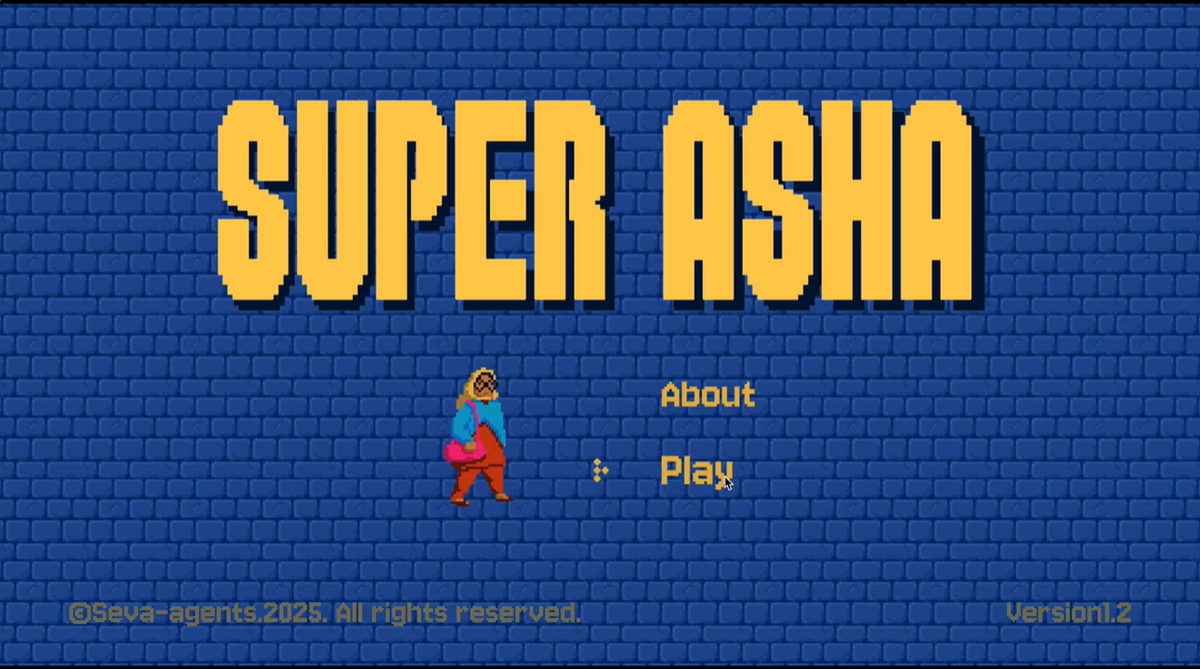
SUPER ASHA was born from a need to create an immersive experience of the lives of regular ASHA workers, essentially putting “people in the shoes of these workers and letting them experience the data and care labour,” she says of the game, which was supported by the Mozilla Foundation and Mumkin. The game, which is divided into time windows, has players become ASHA workers to help them understand how exhausting and complicated the job can be. “The whole idea is that you will be her every hour and experience what she’s supposed to do,” says Priya, who has drawn on “hard-hitting, true stories” gathered from the field to design the game.

A screenshot of the game

A screenshot of the game
| Photo Credit:
Special Arrangement

To design SUPER ASHA, Priya worked with a team of artists, including Ranjitha Rajeevan and Basim Abu NP, “without whom this game would not have been possible. They are gamers, and I am not.” The focus, she says, was to make the simplest game possible; so they designed it based on the popular game Super Mario. “Super Mario has to jump hoops to get to Princess Peach, so let ASHA also do that,” she says. However, as a player goes to higher levels, the settings become more complex, she says, drawing a parallel to ‘Papers, Please’, a puzzle simulation video game “where you play as an immigration officer, where stamping people to enter a border or not is a moral choice,” she says.

The first version of SUPER ASHA was showcased at the eighth annual ACM FAccT conference, held in Athens, Greece, from June 23 to 26, alongside other multimedia artefacts from the Digital Bharat exhibition. A more refined version of the game, SUPER ASHA v1.2, will be launched at the Mozfest Barcelona display. This version “starts at 5am ASHA time and goes on till 3pm.” The game will likely be out in the public domain by November 7, “with any versions from then on be accessible to all,” says Priya, who especially wants to target technologists and policy makers through this game.

“They should be able to play the game and understand the constraints of this job.” Even better, of course, would be this: implementing policy based on the understanding that conducting data labour, such as logging records, changes the nature of care and support ASHAs offer. “The two (care and data labour) should not be carried out by the same human apparatus, the ASHA worker, because care setting is a very different context,” says Priya

Source link

Listening to Music May Cut Dementia Risk by 39%, Study Finds

0

People who always listen to music have a 39% lower risk of developing dementia, while those who play a musical instrument experience a 35% reduction in risk. Listening to music after the age of 70 may significantly lower the risk of developing dementia, according to a large Monash University study involving more than 10,800 older […]

Source link