Lava is back and this time, it isn’t playing safe. The brand has returned with the Agni 4, the successor to last year’s Agni 3, which made headlines for its quirky secondary display. While it still proudly carries the Made in India badge, the Agni 4 takes a very different path in design and identity, choosing to stand apart rather than build on its predecessor’s character. Starting at ₹24,999, it lands straight into the most unforgiving battleground of mid-range smartphones, competing with the OnePlus Nord CE 5, Motorola Edge 60 Fusion, and Motorola Edge 60 Stylus. The question is simple: does Lava’s new challenger have the firepower to stand out? Let’s find out.
Design
The Agni 4 marks a complete departure from the design language of the Agni 3. Gone is the experimental dual-display approach. Instead, Lava has leaned into craftsmanship and material quality. The phone features a precision-engineered aluminium alloy metal frame, something you usually see in phones priced above ₹50,000. It instantly elevates the in-hand feel with a sturdy yet premium character. The Matte AG Glass back (in Phantom Black and Lunar Mist White) looks elegant, though the Lunar Mist variant is slippery and demands a case. At 195g, the Agni 4 feels slightly heavy but settles nicely in the palm due to its balanced weight distribution.
Flip it around, and the front oozes refinement thanks to its ultra-slim 1.7 mm equilateral bezels. It creates a clean, symmetrical look, something even the Nord CE 5 doesn’t fully achieve with its slightly larger chin. Buttons feel crisp, and the new customisable Action Key is a clever addition that lets you map over 100 shortcuts (torch, camera, apps, DND, you name it). As feature-rich as this sounds, the IP64 rating is a letdown. When phones like the Edge 60 Fusion and 60 Stylus offer IP68, Lava’s lower rating feels dated and unsafe in a segment where dust and splash protection is increasingly standard.
The Agni 4’s durability story doesn’t end there, though. The phone includes Corning Gorilla Glass and Lava’s own anti-drop diamond frame structure, which boosts resistance against accidental falls. Wet Touch Control, a feature shared with Motorola’s devices, keeps the display responsive even with damp fingers. While the Agni 4 certainly nails the premium construction vibe, it lacks the more practical flourishes of the Edge 60 Stylus (like the headphone jack and stylus slot) and the superior protection of the Nord CE 5. Still, in terms of sheer metal craftsmanship, it outclasses most competitors in this bracket.
(For top technology news of the day, subscribe to our tech newsletter Today’s Cache)
Display
The Agni 4 packs a 6.67-inch 1.5K+ AMOLED panel with a 120 Hz refresh rate, 10-bit colour, 446 PPI, and a massive 2,400 nits peak brightness. It’s a stunning display on paper, and largely impressive in real-world use. Colours pop, the contrast is strong, and the high brightness ensures excellent visibility even outdoors. Scrolling feels smooth thanks to the 120 Hz panel, and HDR content on apps like YouTube looks punchy and immersive.
That said, the competition is fierce. The Motorola Edge 60 Fusion pushes brightness to 4,500 nits and offers HDR10+ certification, clearly delivering a superior multimedia experience. The Nord CE 5, while only FHD+, counters with an extremely fluid Super Fluid AMOLED and excellent outdoor visibility at 1,430 nits. The Edge 60 Stylus, too, offers a slightly higher peak brightness at 3,000 nits. So while the Agni 4’s display is bright and sharp, it doesn’t quite dominate the segment, but it comfortably holds its ground as one of the better 1.5K panels under 25K.
OS and AI
Where Lava swings big is software. The Agni 4 ships with stock Android 15, free of bloatware, pop-ups, or duplicate apps, something Motorola fans will appreciate immediately. But the real head-turner is Vayu AI, Lava’s new “emotionally responsive” AI companion that sits right on the home screen. Unlike Google Gemini or Moto AI’s functional approach, Vayu tries to add personality and warmth. It responds playfully, controls system functions through voice, and acts as a bridge to a growing AI ecosystem.
It gets better. The phone includes Expert AI Agents tailored for real Indian needs: an AI Math Teacher, AI English Tutor, emotional companions, Horoscope AI, a call summary tool, a rewriting assistant, an AI photo editor, and even a text-to-image generator. Features like Circle-to-Search and visual intelligence are baked in on the system level. Compared to the Edge 60 Fusion’s more minimal Moto AI or the Nord CE 5’s Gemini-assisted tools, Lava’s ecosystem is much more ambitious. Whether that ambition translates into consistent real-world reliability is something long-term users will judge, but in terms of sheer feature depth, Agni 4 is the most AI-forward device in its class.
Performance
Powering the Agni 4 is the MediaTek Dimensity 8350 5G, built on a 4nm process and clocked at up to 3.35 GHz. Paired with 8 GB RAM + 4GB virtual RAM and 256 GB UFS 4.0 storage, the phone feels snappy in daily use; app switching is smooth, animations rarely drop frames, and multitasking is fluid. On Geekbench, the phone scores 1,436 (single-core) and 4,366 (multi-core), while the GPU hits 9,557. These are strong numbers for this category.
But let’s talk about competition.
The OnePlus Nord CE 5 uses the Dimensity 8350 Apex, a slightly tweaked version of this chip, and posts marginally lower scores (1,312 / 4,073 / 7,302). In everyday use, the difference is hard to notice, but in bursts of heavy tasks, the Agni 4 does feel faster. Meanwhile, the Edge 60 Fusion runs a Dimensity 7400, which is weaker in CPU and GPU tests, and the Edge 60 Stylus’ Snapdragon 7s Gen 2 also trails behind.
Gaming is surprisingly stable on the Agni 4. Titles like CODM and BGMI run at high frame rates with minimal stutter, aided by the 4300 mm² VC cooling system and Game Booster Mode. The phone stays warm but never uncomfortably hot, even after long sessions. Thanks to UFS 4.0 storage, faster than what the Nord CE 5 and Motorola rivals use, loading times are noticeably snappier. Overall, Agni 4 delivers one of the smoothest performance packages in this segment.
Camera
Unfortunately, this is where the Agni 4 fails to keep up.
Lava Agni 4 camera sample
| Photo Credit:
Haider Ali Khan
On paper, the camera system looks competitive: a 50 MP OIS main sensor, 8 MP ultra-wide, and a 50 MP EIS selfie camera with 4K 60fps support on both sides. But the real-world experience reveals major inconsistencies. The biggest issue is flickering, especially in challenging lighting, which makes photos look unstable and sometimes unusable. Colours swing unpredictably, skin tones often shift, and dynamic range is erratic.
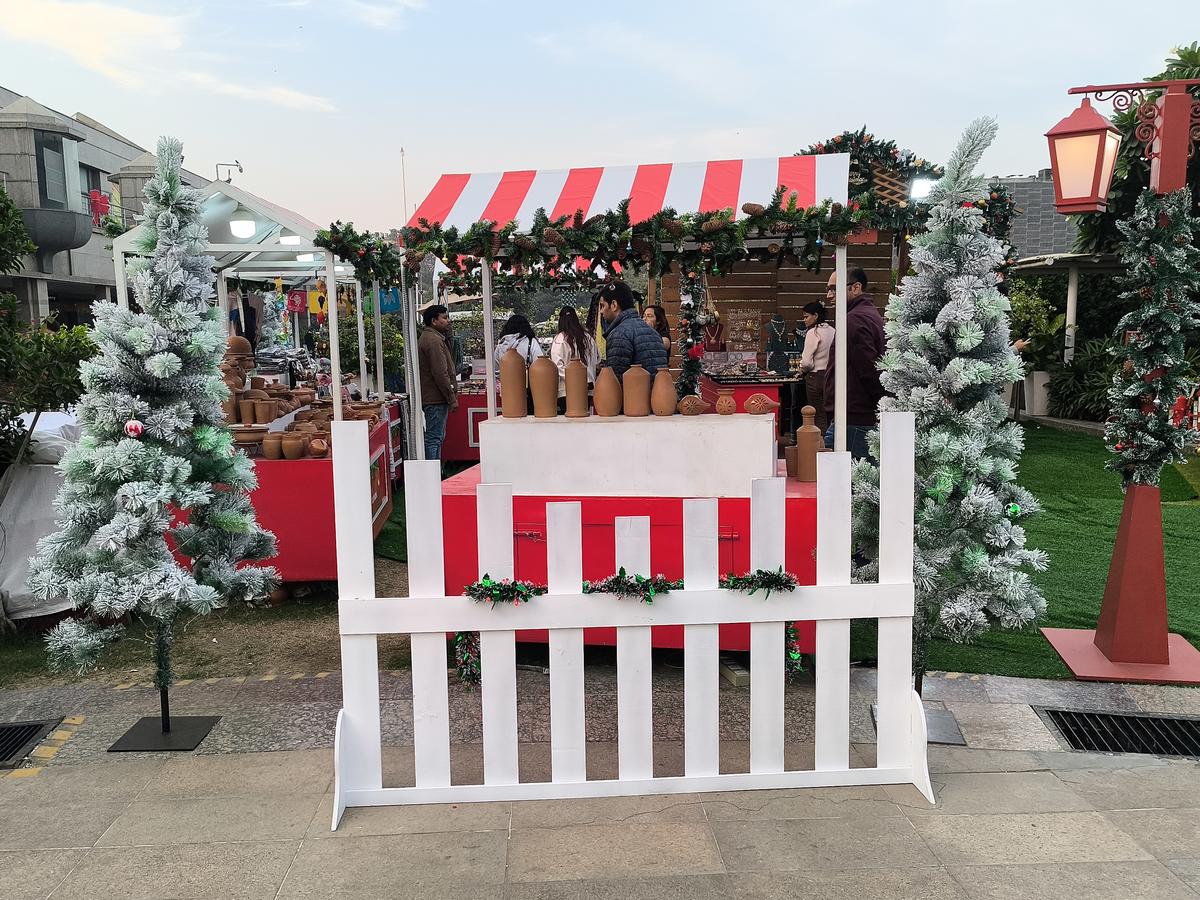
Lava Agni 4 camera sample
| Photo Credit:
Haider Ali Khan
The portrait mode struggles with edge detection, frequently blurring parts of the subject or failing to apply depth correctly. The ultra-wide camera is weak, delivering soft details and skewed colours. In natural light, you do get some good shots, the sensor is capable, but the software tuning holds it back. Night photos lean heavily towards artificial brightening, losing realism and often adding noise.

Lava Agni 4 camera sample
| Photo Credit:
Haider Ali Khan
Selfies fare better, thanks to the high-resolution sensor, but EIS isn’t always consistent, and textures can look overly smoothed. When phones like the Nord CE 5 deliver consistently excellent portraits, or the Edge 60 Stylus produces vibrant night shots, the Agni 4’s camera performance feels disappointing. In a ₹25,000 phone, the camera cannot afford to be the weak link, but here, it is.
Battery
Battery life, however, is where Lava redeems itself. The Agni 4’s 5,000 mAh battery with intelligent power optimisation easily lasts a full day of active use; streaming, gaming, 5G browsing, and photography included. Lava claims 14 hours of YouTube, and it’s not far from reality. The phone also supports 66W fast charging, taking it from 0–50% in under 19 minutes.
Compared to competitors, the Agni 4 sits between the Motorola twins (68W charging) and slightly below the Nord CE 5’s 80W system, though the Nord also has a much larger 7,100 mAh battery. Practically, though, all these phones deliver reliable endurance, and the Agni 4 is no exception.
Verdict
Made in India smartphones deserve appreciation, and Lava is pushing boundaries. The Lava Agni 4 gets a lot right. It has a premium aluminium build, a sharp 1.5K display, fast performance, great battery life, and arguably the most ambitious AI suite in this segment. But when placed beside the OnePlus Nord CE 5, Motorola Edge 60 Fusion, and Edge 60 Stylus, it falls short in one critical area: camera performance. The Agni 4 shows promise, and with better camera optimisation, Lava could turn this into a true category disruptor. For now, it’s a bold step forward, hoping to see it developing into a complete package as its rivals already are.