What’s the one thing that you — or the elders with you in case you haven’t got your own yet — make sure you carry with you every time you step out of the house? For nine out of ten of us (or maybe even a larger percentage), the answer will likely be our smartphones. Ubiquitous and useful — though there’s no denying their pitfalls — these devices are at the forefront of personal tech at the moment.
The HP-35, a handheld scientific calculator, paved the way and served as a precursor for most of the personal tech devices that we employ on an everyday basis today. But before we head to how the HP-35 came to be, we will first have to look at the 9100 programmable calculator that came from the same stable.
The stable, or company, that we are talking about here is the Hewlett-Packard, started by two Stanford University graduates, Bill Hewlett and Dave Packard. Founded in 1939, HP grew into a Fortune 500 company with about 9,000 employees by the mid-1960s.
An original HP calculator on HP founder Bill Hewlett’s desk.
| Photo Credit:
Robert Scoble / flickr
The Green Machine
It was under these circumstances that Tom Osborne, an American engineer, brought the Green Machine — an electronic calculator that he had built — to Hewlett in 1965. Even though the Green Machine couldn’t do transcendentals (sine, cosine, tangent, etc.), Osborne said it could when questioned about it. Hewlett was impressed with what he saw and brought on Osborne as a consultant to turn the Green Machine into an actual calculator.
What started as a six-week consultancy turned into six months, then a year, and then another. Working alongside HP engineer Dave Cochran, Osborne finished the typewriter-sized 9100 programmable calculator early in 1968.
One for each pocket!
Once the 9100 was out in the market, Hewlett placed one of the most famous design briefs before Osborne and Cochran: “I want it to be a tenth of the volume, ten times as fast and cost a tenth as much.” In essence, Hewlett was asking the duo to come up with a device that matched the 9100 in terms of speed and accuracy at executing complicated functions and algorithms, but at the same time fitted in their shirt pockets!
Even though it seemed an impossible ask at the time of asking, it came into the realm of possibility thanks to the progress made in integrated circuits. Work on it informally began in November 1970, but soon ran into a roadblock owing to the costs involved at a time when profits were dwindling.
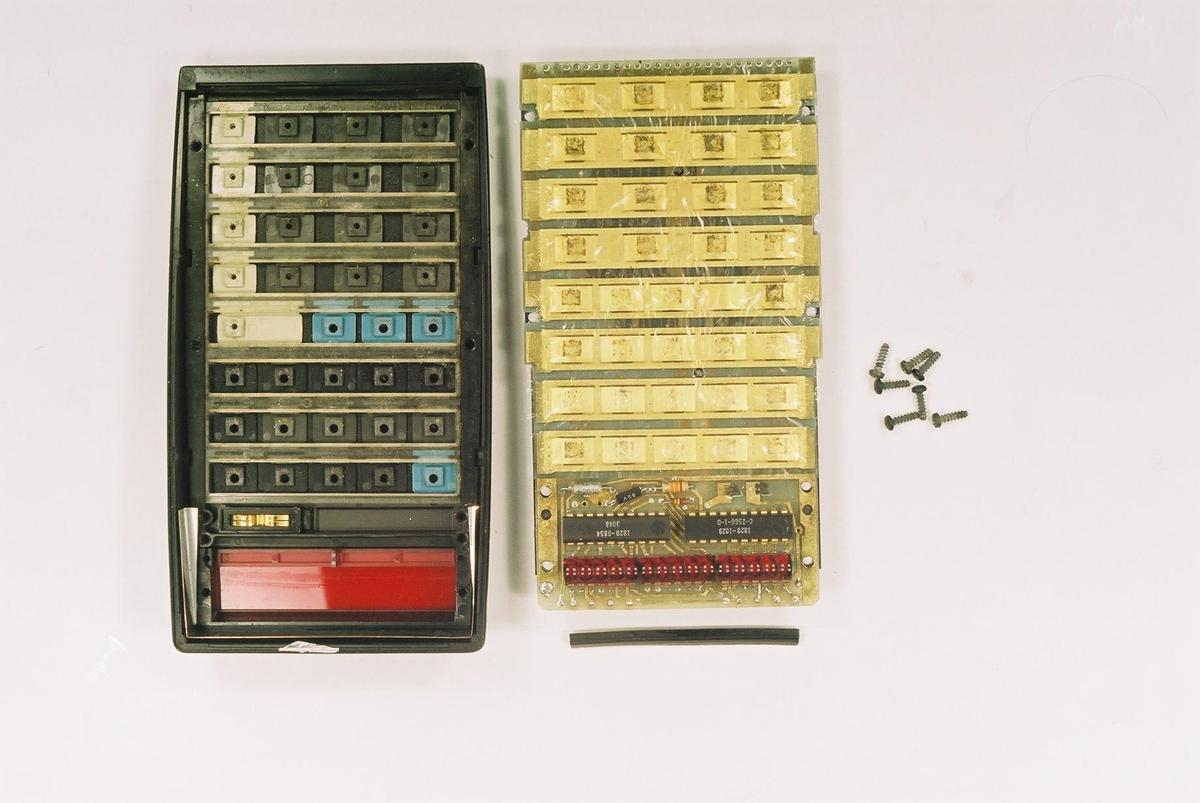
The printed circuit board (PCB) of the HP-35.
| Photo Credit:
tony_duell / flickr
Initial market study
Hewlett believed he owed shareholders due diligence and roped in Stanford Research Institute for an initial market study. In a market flooded with cheap four-function calculators and $20 slide rulers that had been the standard calculation tool for three centuries, reviewers concluded that the calculator in question would be too expensive, without predicting how many takers might be there for such a costly calculator.
Despite the report pointing in the other direction, Hewlett decided to plough ahead, giving the official go-ahead for the project on February 2, 1971. The months that followed saw the logic, hardware, and design teams come together to build a one-of-a-kind device, the likes of which hadn’t been seen before.
Liljenwall breaks the walls
As for the design, industrial graphic designer Ed Liljenwall, who had been with the company for a decade, took the lead. Rather than design an enclosure to fit around the electronics like he’d done till then, he designed a case within which the electronics would fit in. In addition to literally flipping the industry with such an outside-in design approach, he paid attention to smaller details, thereby defining the way scientific calculators looked in the decades that followed.

The main board of the HP-35.
| Photo Credit:
Kucharek / Wikimedia Commons
By November, prototypes were designed in two basic styles, the simpler of which was chosen for production. When Hewlett saw the prototype, he decided that it would be named HP-35, as the calculator had exactly 35 keys. Priced at $395 — 20 times the cost of a slide rule and four times that of a four-function calculator — HP needed to sell 10,000 to break even.
Ditching their traditional sales routes, HP decided to sell this calculator directly to the customers and also at retail stores. Following a press conference in New York on January 4, 1972 when the device was announced, HP-35 was introduced to the world at large on February 1.
Doubts evaporate
The doubts about whether the HP-35 would sell quickly vanished as it almost seemed like every mathematician, engineer, and scientist wanted one in their pockets. If anyone still harboured any doubts, they had to contend with the fact that some students were even selling their cars in order to be able to afford the calculator.
The first models that were sold had a raised dot or bump on the number 5 (you can still see this in physical keyboards and telephone landlines; it is designed to enable users to find the centre of the keypad by touch) and a small hole to the right of the on/off switch that lit up red when the calculator was turned on. While the latter feature was deemed redundant (the display lit up when turned on, didn’t it?) and hence was dropped after about 10,000 units, the former feature wasn’t included after about 80,000 units were produced.
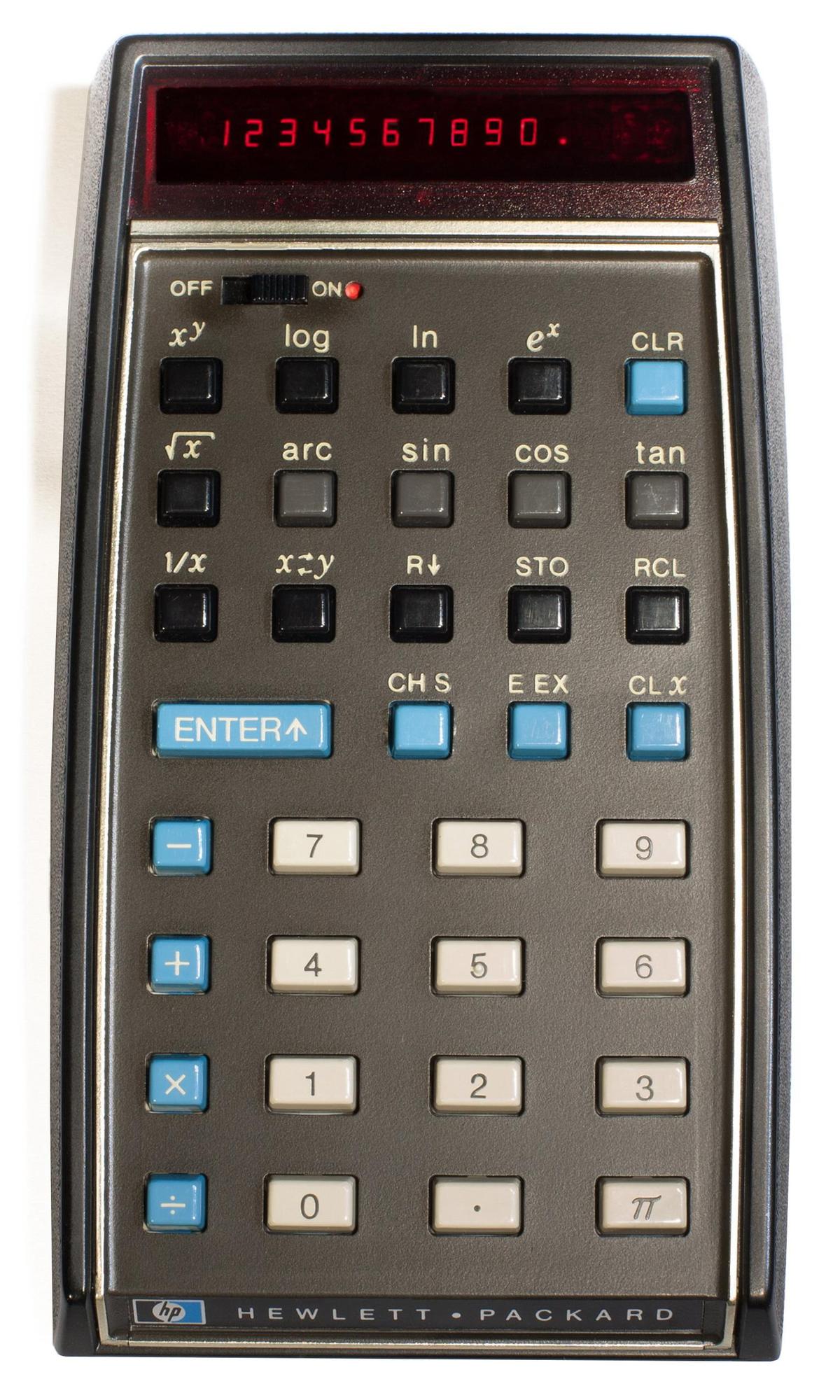
One of the first models of HP-35 produced. Notice the small hole next to the on/off switch, which was removed in later models.
| Photo Credit:
Mister rf / Wikimedia Commons
While they needed 10,000 to break even, they instead sold 1,00,000 in the first year alone and nearly 3,50,000 calculators by 1975. Many of these are still in existence, and even continue to work! The HP-35s with a hole are even considered a collector’s item.
The success of the HP-35 meant that its legacy stays on in the field of handheld devices — be it game consoles or smartphones. The influence of the world’s first handheld scientific calculator can be seen in these devices in many ways, be it the programming, logic, or design.
So, the next time you enter an examination hall where the use of scientific calculators is permitted, spare a thought for these humble gadgets. They might have sounded the death knell for the slide ruler when they made their way, but their own very existence now seems to be only a matter of time. Even if they fade away into oblivion, there’s no denying the fact that the HP-35, and the scientific calculators that came by thereafter, heralded the age of consumer electronics as we know it today.
Published – February 01, 2026 12:42 am IST