In the crowded arena of flagship smartphones, networking performance has quietly become a major battleground. According to new data from Ookla, that compares networking performances of iPhone 17 series and other flagship Android devices, including Pixel 10 Pro, shows just how far networks, silicon and software integration matter.
The bottomline is: Apple’s strategy of bringing networking hardware in-house is beginning to pay off.
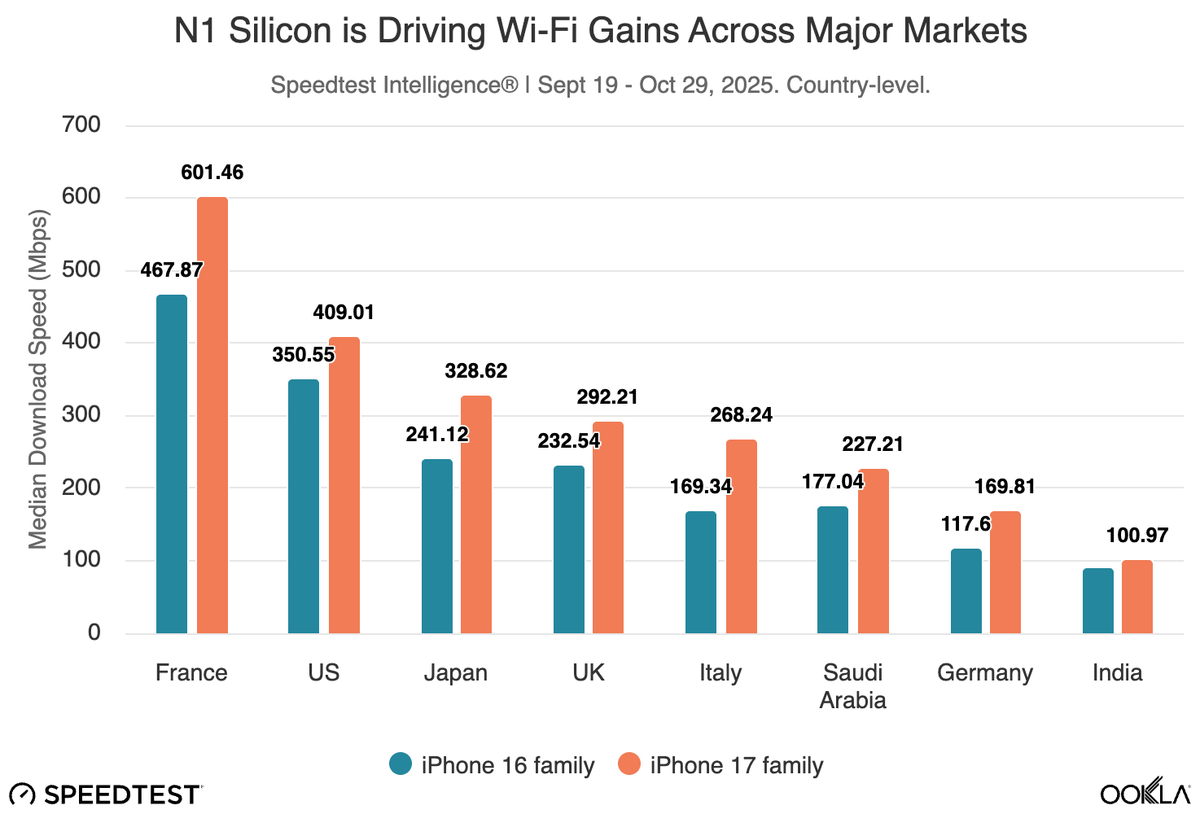
At the heart of the iPhone 17 family’s performance leap lies the new in-house networking chip, the N1. Previously, Apple’s handsets used connectivity chips supplied by Broadcom where Wi-Fi, Bluetooth and other radio functions were outsourced.
With the N1, Apple has made a strategic shift, bringing Wi-Fi 7, Bluetooth 6 and Thread radio support onto a single die under its own control. [On paper the N1 is capped at 160 MHz channel width (while other devices offer up to 320 MHz) but the real-world data tells a more nuanced story.]
Ookla’s crowdsourced Speedtest Intelligence data shows that the iPhone 17 series has achieved a global median download speed of 329.56 Mbps, while the Pixel 10 Pro-series managed 335.33 Mbps, giving Google’s device a narrow edge in median download throughput.
However, when one looks at the chip’s capabilities in challenging conditions (think for instance, dense residential areas), the iPhone 17 family recorded 56.08 Mbps compared to the Pixel’s 53.25 Mbps, suggesting Apple’s networking chip boosts resilience in tougher environments.
The N1’s differentiation
How does the N1 chip translate into stronger connectivity? The key lies in integration. The N1 unites Wi-Fi 7 (though limited to 160 MHz), Bluetooth 6 and Thread into a single platform, enabling Apple to optimise hardware and software together rather than relying on third-party modules.
This shift away from Broadcom means Apple can reduce supply-chain reliance, tune its radios to its own devices ecosystem and deliver more consistent performance across environments. Moreover, while the N1 lacks support for full 320 MHz channels, Apple appears to have focused on improving the “floor” of performance by lifting slower speeds more strongly rather than chasing maximums that few users currently experience. That, to put it crudely, translates to clearer WhatsApp calls on a poor network.
Practically, the iPhone 17 series tends to hold up better under challenging network conditions, crowded Wi-Fi networks, weaker signal zones or congested bands.

The Pixel 10 Pro, on the other hand, edges it at the median in more ideal conditions. For instance, per the Ookla report, in North America, where 6 GHz Wi-Fi and Wi-Fi 7 adoption are relatively higher, the iPhone 17 series posted a median download of 416.14 Mbps and a 90th-percentile download of 976.39 Mbps — both among the highest in the dataset. This is significant given the N1’s theoretical limitations in channel width.
Against the Android
And beyond the head-to-head with the Pixel 10 Pro, the iPhone 17 also performed well against leading Android flagship phones, including the Samsung Galaxy S25 family. The Galaxy S25, equipped with Qualcomm’s FastConnect 7900 WiFi silicon, did not lead any major metric, but registered the lowest latency in several regions, indicating strong responsiveness.
When it comes to upload speeds, Xiaomi’s 15T Pro, powered by MediaTek’s Wi-Fi silicon leads in many regions and provides low latency and strong responsiveness.
So which device “wins”? It depends on your priorities. If you care about raw median throughput under typical conditions, the Pixel 10 Pro slightly outpaces the iPhone 17 series. If your concern is consistent performance across worse networks, like dense living environments or multi-device Wi-Fi hotspots, then the iPhone 17 with Apple’s N1 chip appears to have the upper hand.

Apple’s strategy of migrating away from Broadcom-sourced wireless chips and building the N1 in-house is bearing fruit. The company may not be chasing the absolute theoretical best link speeds right now, but its optimization shows up in everyday real-world performance.
As broader adoption of Wi-Fi 7, 6 GHz band devices and 320 MHz channels rolls out globally, the competitive landscape may shift again, but for now, Apple’s twin goals of integration and consistency are translating into a tangible networking advantage.
The Pixel 10 Pro still puts up compelling numbers, but the iPhone 17 series may just offer a steadier connectivity experience in the less-ideal real world.
Published – November 19, 2025 02:01 pm IST