Home Blog Page 192

A Small Texas Think Tank Cultivated Covid Dissidents. Now They’re Running US Health Policy.

0

Martin Kulldorff, chair of the Trump administration’s reconstituted CDC vaccine panel, made a shocking — and misleading — statement as the group met in September. Referring to a clinical trial, Kulldorff, a biostatistician and former professor at Harvard Medical School, said eight babies born to women who received Pfizer’s covid vaccine while pregnant had birth defects, compared with two born to unvaccinated women.

“It is very concerning to have a fourfold excess risk of birth defects in these pregnant women,” Kulldorff then said.

Scientists criticized Kulldorff’s questions and remarks in that meeting because they suggested that the vaccine caused birth defects, which is not supported by evidence. The birth defects would have occurred before the women received the vaccine, the scientists said. They say it was one of several scientifically unsubstantiated claims by newly appointed members of the Centers for Disease Control and Prevention’s Advisory Committee on Immunization Practices, an influential panel that guides which vaccines millions of people receive and whether insurance covers their cost.

Many of the new panel members share a connection to a little-known think tank making its mark in President Donald Trump’s Washington: the Brownstone Institute.

Libertarian author Jeffrey Tucker created the nonprofit institute in 2021, fueled by backlash against covid lockdowns and other pandemic-era policies. “You cannot do something like that to the world and expect people just to sit by and go, ‘OK, that’s normal,’” Tucker said in an interview.

Tucker has endorsed child labor; said of covid shots that “there is no evidence at all that the vaccines saved millions,” contradicting numerous studies showing the opposite; and opposes vaccine mandates.

His institute’s covid contrarians seek to limit the government’s role in protecting Americans from disease. The Austin, Texas-based think tank has received millions from donors whose identities are shielded in tax filings. And in recent months, its associates have catapulted to the highest levels of government.

At least eight people with ties to the Brownstone Institute hold or recently held senior positions at federal health agencies or key roles advising the government, exercising significant authority over access to vaccines and scientific research.

They include Jay Bhattacharya, director of the National Institutes of Health, which has been racked by funding cuts and firings under the Trump administration, as well as senior Food and Drug Administration officials Vinay Prasad and Tracy Beth Høeg. Prasad has been involved in restricting the use of covid vaccines. Høeg has voiced skepticism about vaccine mandates and some childhood immunizations.

Bhattacharya was a senior scholar for the organization. Brownstone has published Bhattacharya’s and Prasad’s writings on its website. Høeg has reported receiving payment from the group.

The institute has compensated Kulldorff and published his articles. Tucker wrote in October that 2020 marked “the beginning of a long friendship” with Kulldorff “that continues to this day.” Three other ACIP members share connections with the organization: MIT operations management professor Retsef Levi, who has spoken as part of at least one Brownstone event; physician Robert Malone, who speaks at its events and whose articles appear on its website; and Case Western Reserve University professor and epidemiologist Catherine Stein, who in 2022 authored an article calling for an end to vaccine mandates at universities.

Thomas Buckley, a public relations professional who wrote for the institute, accepted a political appointment as a top NIH spokesperson after thousands of workers at the biomedical research agency were fired. Buckley noted on Substack that his Brownstone writings “led to my new job.”

“That’s maybe his judgment,” Tucker said.

Buckley, when asked to elaborate, said in an email that he interviewed Bhattacharya “for a story that was later published on Brownstone — it was simply me being polite.” He said he resigned from the NIH on Sept. 30. NIH spokesperson Laci Williams declined to confirm his departure date.

Despite the ascendence of those with ties to his group, Tucker said that “anybody who thinks that somehow Brownstone is some big plot, it’s crazy.” He said he is not in regular contact with Health and Human Services Secretary Robert F. Kennedy Jr., whose department oversees the CDC, FDA, and NIH.

“I don’t have any influence,” Tucker said.

Sowing Vaccine Doubt

People with ties to the institute have sown doubt about covid vaccines or routine childhood immunizations, dismissing widespread evidence that they are safe and the benefits outweigh the risks.

“They’ve successfully placed their ideology inside the mechanism that determines U.S. vaccine policy,” said Jake Scott, a physician at Stanford Medicine who specializes in infectious diseases. “It’s very, very troubling.”

Tucker said that Brownstone “doesn’t have any operational impact on the ACIP committee at all” and that “if somebody wasn’t troubled by Brownstone, there’s probably no reason for us to exist.”

Tucker and Brownstone’s associates express libertarian views and promote distrust of government, including public health authorities.

“The evidence is mounting and indisputable that MRNA vaccines cause serious harm including death, especially among young people. We have to stop giving them immediately!” Levi posted on social media in 2023, referring to vaccines based on messenger RNA technology, which Pfizer-BioNTech and Moderna used to develop their covid shots. Stein wrote that covid vaccine mandates are “unethical” and not scientifically justified. Bhattacharya asserted on a podcast with Trump ally Stephen Bannon that mRNA technology for vaccines is “no longer viable,” and he has overseen mass terminations of NIH grants for scientific research.

Kennedy in June fired all 17 members of the CDC’s vaccine panel and has replaced them with 12 people so far, including individuals with connections to the Brownstone Institute. Tucker said that he did not propose to the White House or HHS that they be appointed and that Brownstone has not paid them over the past year.

During the September ACIP meeting, several new panel members expressed skepticism of vaccines and dismissed evidence — including the CDC’s own data — demonstrating that they are safe and effective.

That included Kulldorff’s questions and remarks about covid vaccines and birth defects.

In a Pfizer clinical trial, hundreds of pregnant women were given covid vaccines or a placebo during the second and third trimesters of pregnancy. But the birth defects Pfizer reported in its clinical study typically would have formed long before the vaccine was given, said Jeffrey Morris, a biostatistics and public health professor at the University of Pennsylvania Perelman School of Medicine.

“To say that this is a major safety risk,” Morris said, “is beyond a stretch.”

“This one really upsets me because it’s just so misleading,” he said.

Multiple large studies have shown no association between covid vaccines and miscarriage, stillbirth, or birth defects.

In response to questions for this article, Kulldorff said: “In the randomized trial, there were four times as many birth defects in children born to mothers receiving the Pfizer covid vaccine during pregnancy compared to the placebo-receiving control group. To ensure vaccine confidence, it is the responsibility of ACIP to note and inquire about such discrepancies, and it is the manufacturer’s responsibility to thoroughly examine it through additional follow-up studies.”

Kulldorff said he is “not affiliated with the Brownstone Institute” but declined to respond to additional questions, including whether he is currently compensated by the organization or has donated to it. The Brownstone Institute paid Kulldorff $108,333 in 2022, according to tax filings.

Levi said he heard about the Brownstone Institute from social media. He said he is in contact with Tucker “once in a while” but said Tucker has not advised him on vaccines since he was named to the CDC’s vaccine panel. Levi said he has “never received any compensation,” “never had any affiliation,” and “never donated or given any money” to the group.

Bhattacharya did not respond to questions. Williams, the NIH spokesperson, who had earlier declined to respond, citing the federal government shutdown, did not respond to a query seeking comment after the shutdown ended Nov. 12.

Stein declined to comment and referred questions to HHS. Department spokesperson Andrew Nixon said in a statement that Stein’s ACIP appointment “reflects the Administration’s commitment to independent, evidence-based science. Her professional record speaks for itself.”

The Brownstone Institute’s website says it works “to support writers, lawyers, scientists, economists, and other people of courage who have been professionally purged and displaced during the upheaval of our times.”

“There’s a danger associated with a state-imposed orthodoxy,” Tucker said in the interview. “I think Brownstone has a moral obligation to care for dissidents and create settings in which they’re able to test their ideas against people with whom they disagree.”

He said that “there’s never harm that comes from open debate and open distribution of information and views.” But Brownstone’s critics say its associates make extreme claims about vaccines and promote anti-vaccine messages.

“They kind of position themselves as defending freedom, but they consistently platform covid minimizers and vaccine skeptics,” Scott said.

Tucker took issue with the description, saying “it presumes that we know exactly with scientific precision the severity of covid, and so anybody who falls short of explaining that with amazing precision is a minimizer.”

Jeffrey Tucker was a speaker at the National Conservatism conference on Sept. 2 in Washington.(Dominic Gwinn/Middle East Images via AFP/Getty Images)

In early September, Scott testified at a Senate subcommittee hearing on vaccines alongside Toby Rogers, a political economist and Brownstone Institute fellow who doesn’t list any medical credentials. Rogers wrote last year in his Substack newsletter that “vaccines are a civilization-destroying technology” and has promoted the debunked idea that vaccines cause autism. “My belief is that the autism and chronic disease epidemics are primarily caused by toxicants — mostly from vaccines and about a dozen additional toxicants,” Rogers said at the Senate hearing. Numerous studies have shown there is no link between vaccines and autism.

Days later, members of Kennedy’s handpicked panel of CDC vaccine advisers “spent hours elevating these theories” about vaccines “that are not really based in solid evidence or high-quality studies,” Scott said. “They manufactured doubt about established vaccines, entertained all this speculation without any evidence — that’s the real damage.”

Levi, responding to that criticism, said: “For the first time in a long time we are issuing objective, evidence-based immunization recommendations through ACIP with honest and transparent discussion of the benefits, risks, and uncertainties.”

As the panel weighed whether to delay the hepatitis B shot given to most newborns, Høeg, a senior adviser for clinical sciences at the FDA, questioned whether the vaccine is safe. “We should have some humility and consider that we may not know all of the potential safety issues,” she said to the CDC panel.

Widespread evidence shows that the hepatitis B newborn dose is safe and that the shot has very few side effects. Starting in 1991, the CDC recommended that the first of three shots of hepatitis B vaccine be given to infants shortly after birth. The move virtually eliminated the potentially fatal disease among American children. Babies infected with the virus at birth have a 90% chance of developing chronic hepatitis B.

In academic journals, Høeg has disclosed receiving payment from the Brownstone Institute but did not specify the amount. She has described Tucker as “a good friend.” Høeg did not respond to a request for comment for this article.

In an email, the FDA’s Prasad said that he “has received no money from Brownstone or any person(s) affiliated” and that all his content published on its website “was republished from his own personal Substack.”

Tucker said he has not advised Prasad or Høeg on vaccines since they became FDA officials. He described the latest CDC vaccine panel meeting as “a breath of fresh air.”

The Covid Contrarian Clubhouse

The Brownstone Institute, on its website, previously called itself “the spiritual child of the Great Barrington Declaration,” the controversial pandemic treatise Bhattacharya, Kulldorff, and Oxford University epidemiologist Sunetra Gupta co-authored in October 2020 that argued against lockdown measures to prevent the covid virus from spreading.

They proposed that widespread immunity against covid could be achieved by allowing healthy people to get infected, known as herd immunity, with protective measures instituted for medically vulnerable people.

The proposal was criticized at the time by many public health experts and high-ranking government officials, including then-NIH Director Francis Collins, who called its authors “fringe epidemiologists,” according to emails the American Institute for Economic Research obtained through a Freedom of Information Act request. (Tucker was AIER editorial director from 2017 to 2021.)

“They’ve been willing to publish articles of some very extreme anti-vaccine people,” Dorit Reiss, a professor at University of California Law-San Francisco focused on vaccine-related legal and policy issues, said of the Brownstone Institute. “They’re trying to give a more respectable veneer to the result of the Great Barrington Declaration,” she added.

In response, Tucker said: “I don’t think being an extremist is a good basis on which to shut somebody’s thoughts down. We need provocations.”

Tucker said he did not propose that Bhattacharya — who was a senior scholar at the institute and wrote 29 articles from July 2021 through October 2024 — be nominated to lead the NIH. More than one-third of the articles were co-authored with Kulldorff, who became Brownstone’s senior scientific director in November 2021.

Kulldorff told National Review he was fired from the Harvard-affiliated Mass General Brigham hospital system and placed on leave at the university that month after he refused to be vaccinated against covid, saying he had natural immunity. Kulldorff said he was hospitalized for a covid infection in early 2021.

The Brownstone Institute reported nearly $7.4 million in contributions, grants, and other payments between 2021 and 2024, with about 35% coming from tax-exempt foundations and donor-advised funds, according to an analysis of tax filings. Donor-advised funds allow people to secure tax deductions for anonymous charitable contributions. Tucker said the organization has 17,000 donors, most of them small, but declined to elaborate on funders.

The filings show the institute has also received funding from foundations run by people with backgrounds in business, including in tech, finance, law, and banking. According to a review of tax records, many of them have also given to anti-vaccine organizations; groups such as the Independent Medical Alliance, which promoted ineffective treatments for covid; or prominent organizations in conservative politics, such as the Federalist Society, the Alliance Defending Freedom, and the Heritage Foundation. Brownstone in 2023 received $67,350 from Donors Trust Inc., which funds conservative causes.

As of 2024, the Brownstone Institute’s board included David Stockman, a White House budget chief under President Ronald Reagan; libertarian economist Donald Boudreaux; and Roger Ver, an investor known as “Bitcoin Jesus.”

Ver’s website said he gave more than $1 million to the institute.

In 2024, Ver was indicted by a federal grand jury for allegedly committing tax fraud costing the IRS at least $48 million. On Oct. 14, the Justice Department announced that Ver had entered into a deferred prosecution agreement to resolve federal tax charges against him and has paid the IRS nearly $50 million. The government has moved to dismiss the indictment against him.

‘People Are Very Skeptical’

Other than publishing posts on its website, the institute awards fellowships and convenes conferences and retreats. Its associates testify in front of Congress. And it holds a “Supper Club” series in cities throughout the country.

“The goal of Brownstone is to make possible wide-ranging conversations about the failure of the system and the solutions to it,” Tucker said.

Ashley Grogg, a registered nurse and founder of Hoosiers for Medical Liberty, spoke at a Supper Club in August on “informed decision-making,” primarily about vaccines.

“People are very skeptical,” Grogg said in an interview. “How do we trust people moving forward? Do we really think that we can trust the new leadership that’s coming in to do the right thing?”

She said she was connected to Brownstone through one of her members. Grogg said she does not think newborns should universally be given the hepatitis B vaccine shortly after birth and opposes vaccine mandates. “I don’t want to take anything away from anybody,” but people who refuse to be vaccinated should not be “withheld from society,” Grogg said.

In September, as the CDC’s vaccine advisers met, Tucker took to the social media platform X to amplify statements questioning vaccines, including from panel members with ties to the group he created. One was Malone saying, “It’s clear that a significant population in the United States has significant concerns about vaccine policy and about vaccine mandates.” Another was from Levi, who, referring to covid vaccines, said, “Most of us are extremely concerned about the safety and the lack of robust evidence both on safety and efficacy for not only pregnant women, but their babies.”

There is strong evidence that mRNA and non-mRNA covid vaccines are safe for pregnant women. A mother’s vaccination while pregnant also helps protect newborns. CDC data that drew upon medical records in 12 states found that nearly 90% of babies who were hospitalized with covid had mothers who did not get the vaccine while pregnant.

In response to questions for this article, Levi said in an email that “the claim that there is strong evidence for the efficacy and safety of covid vaccination during pregnancy in the absence of appropriate clinical trials is not consistent with fundamental regulatory principles” and that panel members “were also concerned by the potential safety signal in the single (small) clinical trial that was conducted, and other research.” Malone did not respond to questions for this article.

Kulldorff, the ACIP chair, said the panel will review vaccines given during pregnancy, childhood, and adolescence.

Less than a week after the ACIP meeting in Atlanta, Levi gave a Brownstone Institute talk about artificial intelligence systems.

Brownstone was a sponsor this month when Children’s Health Defense, a leading anti-vaccine nonprofit founded by Kennedy, held its annual conference in Austin.

And during the institute’s own annual conference recently in Utah, Bhattacharya was one of three people who received its first “Brownstone Prize.”

“I would think it represents a kind of integrity and courage in public life,” Tucker said, “and stand up for what you believe is the truth, even at some degree of personal risk.”


Source link

Roblox steps up age checks and groups younger users into age-based chats

0

Roblox is stepping up its age verification system for users [File]
| Photo Credit: REUTERS

Roblox is stepping up its age verification system for users who want to chat with other players and implementing age-based chats so kids, teens and adults will only be able to communicate with people around their own age.

The moves come as the popular gaming platform continues to face criticism and lawsuits over child safety and a growing number of states and countries are implementing age verification laws.

The company had previously announced the age estimation tool, which is provided by a company called Persona, in July. It requires players to take a video selfie that will be used to estimate their age. Roblox says the videos are deleted after the age check is processed. Users are not required to submit a face scan to use the platform, only if they want to chat with other users.

Roblox doesn’t allow kids under 13 to chat with other users outside of games unless they have explicit parental permission — and unlike different platforms, it does not encrypt private chat conversations, so it can monitor and moderate them.

While some experts have expressed caution about the reliability of facial age estimation tools, Matt Kaufman, chief safety officer at Roblox, said that between the ages of about 5 to 25, the system can accurately estimate a person’s age within one or two years.

“But of course, there’s always people who may be well outside of a traditional bell curve. And in those cases, if you disagree with the estimate that comes back, then you can provide an ID or use parental consent in order to correct that,” he said.

After users go through the age checks, they will be assigned to age groups ranging from under 9, 9 to 12, 13 to 15, 16 to 17, 18 to 20 and over 21. Users will then be able to chat with their age group or similar age groups, depending on their age and the type of chat.

Roblox said it will start enforcing age checks in Australia, New Zealand, and the Netherlands in the first week of December and the rest of the world in early January.

A growing number of tech companies are implementing verification systems to comply with regulations or ward off criticism that they are not protecting children. This includes Google, which recently started testing a new age-verification system for YouTube that relies on AI to differentiate between adults and minors based on their watch histories. Instagram is testing an AI system to determine if kids are lying about their ages.

“While we welcome the new age ID measures as a step forward, it remains to be seen how effective it will be and whether Roblox will stay the course on a voluntary measure once public scrutiny fades,” said Shelby Knox, director of online safety campaigns at the advocacy group ParentsTogether. “We have to remember this comes from a platform that has historically been slow to address systemic predatory behavior despite being marketed to and used by very young children.”

Source link

Google announces best apps and games of 2025 on Play Store in India

0

Google announces best apps and games of 2025 on Play Store in India
| Photo Credit: Special Arrangement

Google on Tuesday (November 18, 2025) announced the best of apps and games on Play Store in India during 2025. It also reveals that Indians are using AI-rich apps which provide them meaningful services. In fact, 69% of Indians say their first interaction with AI came through an app on their Android device.

Overall, District: Movies Events Dining got the ‘Best App of 2025’ title, and CookieRun India: Running Game, the ‘Best Game of 2025.’

Because of AI adoption, apps like invideo AI: AI Video Generator, Best for Personal Growth, did well and Toonsutra: Webtoon & Manga App, Best Hidden Gem, offered new AI-powered tool for turning original comics into immersive experiences.

Apps like Goodnotes: Notes, docs, PDF, Best App for Large Screens, and Luminar: Photo Editor, Best Multi-device App, featured in the list of 2025 best apps.

(For top technology news of the day, subscribe to our tech newsletter Today’s Cache)

Daily Planner: To Do List Task, Best Everyday Essential, appeared for integrating task management. SleepisolBio: sleep, alarm, Best for Watches app, helped users assisting with managing sleep and stress.

Google also introduced Top Trending, which spotlights apps that have grown significantly in popularity over the year and have had a notable impact on the ecosystem. In this, Instamart: 10 Mins Grocery App came on top along with Seekho: Short Learning Videos and Adobe Firefly: AI Generator.

The Google Play and Android ecosystem has enabled over 3.5 million jobs across India, and supported the Indian economy with over ₹4 trillion in revenue, claims Google.

In gaming, CookieRun India: Running Game, the Best Game and Best Pick Up and Play, and Free Fire Max, the Best Ongoing game, have created authentic connections with local audiences through in-game content, including skins, distinctly Indian soundtracks, and characters in Indian outfits.

Kamala, Horror Exorcism Escape, the Best Indie game, has delivered survival puzzle horror experience, a new and challenging genre. Real Cricket Swipe, the Best Made in India game also made it to the list.

CookieRun India: Running Game and Real Cricket Swipe short swipes, have made these games easy to play. Disney Speedstorm, the Best Multi-device Game, has demonstrated strong performance across multiple form factors, including seamless continuity on foldable phones.

Source link

Between Apple’s iPhone 17 series, Samsung Galaxy S25, and Google’s Pixel 10 Pro, which one wins the WiFi battle?

0

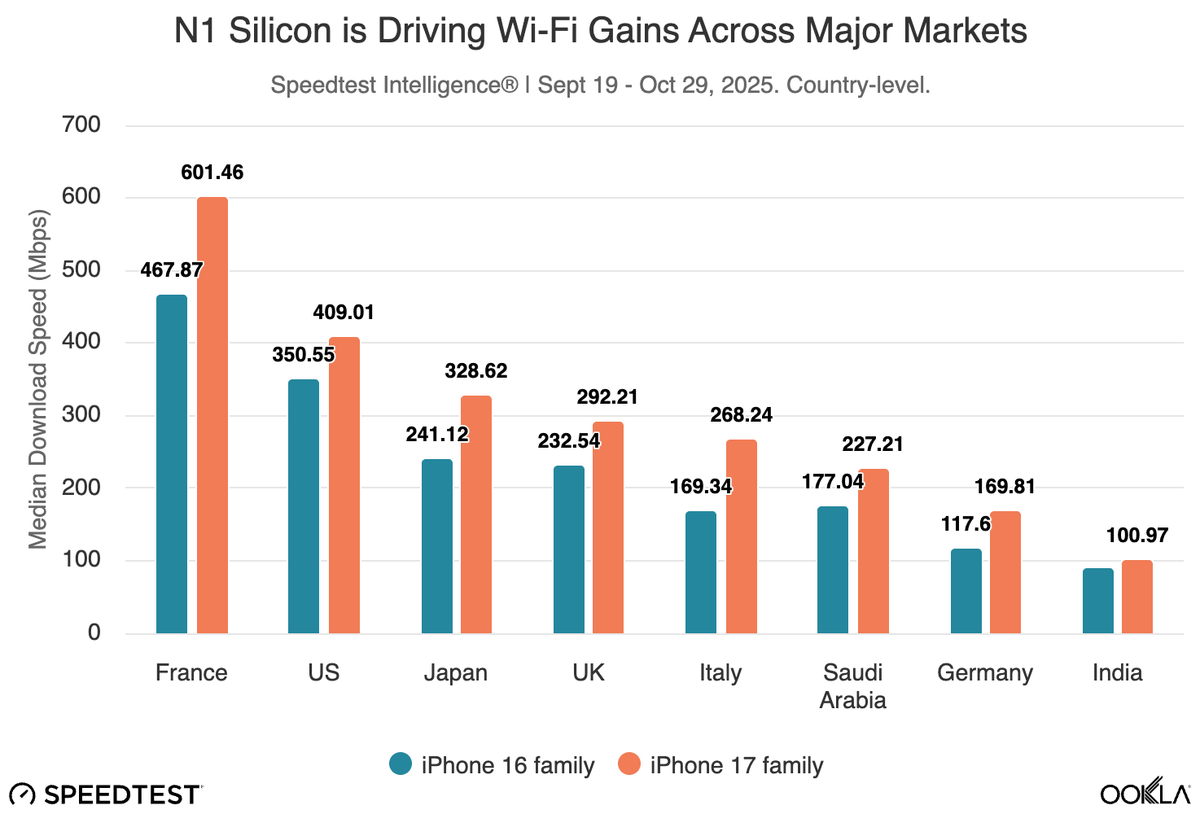
In the crowded arena of flagship smartphones, networking performance has quietly become a major battleground. According to new data from Ookla, that compares networking performances of iPhone 17 series and other flagship Android devices, including Pixel 10 Pro, shows just how far networks, silicon and software integration matter.

The bottomline is: Apple’s strategy of bringing networking hardware in-house is beginning to pay off.

At the heart of the iPhone 17 family’s performance leap lies the new in-house networking chip, the N1. Previously, Apple’s handsets used connectivity chips supplied by Broadcom where Wi-Fi, Bluetooth and other radio functions were outsourced.

With the N1, Apple has made a strategic shift, bringing Wi-Fi 7, Bluetooth 6 and Thread radio support onto a single die under its own control. [On paper the N1 is capped at 160 MHz channel width (while other devices offer up to 320 MHz) but the real-world data tells a more nuanced story.]

Ookla’s crowdsourced Speedtest Intelligence data shows that the iPhone 17 series has achieved a global median download speed of 329.56 Mbps, while the Pixel 10 Pro-series managed 335.33 Mbps, giving Google’s device a narrow edge in median download throughput.

However, when one looks at the chip’s capabilities in challenging conditions (think for instance, dense residential areas), the iPhone 17 family recorded 56.08 Mbps compared to the Pixel’s 53.25 Mbps, suggesting Apple’s networking chip boosts resilience in tougher environments.

The N1’s differentiation

How does the N1 chip translate into stronger connectivity? The key lies in integration. The N1 unites Wi-Fi 7 (though limited to 160 MHz), Bluetooth 6 and Thread into a single platform, enabling Apple to optimise hardware and software together rather than relying on third-party modules.

This shift away from Broadcom means Apple can reduce supply-chain reliance, tune its radios to its own devices ecosystem and deliver more consistent performance across environments. Moreover, while the N1 lacks support for full 320 MHz channels, Apple appears to have focused on improving the “floor” of performance by lifting slower speeds more strongly rather than chasing maximums that few users currently experience. That, to put it crudely, translates to clearer WhatsApp calls on a poor network.

Practically, the iPhone 17 series tends to hold up better under challenging network conditions, crowded Wi-Fi networks, weaker signal zones or congested bands.

The Pixel 10 Pro, on the other hand, edges it at the median in more ideal conditions. For instance, per the Ookla report, in North America, where 6 GHz Wi-Fi and Wi-Fi 7 adoption are relatively higher, the iPhone 17 series posted a median download of 416.14 Mbps and a 90th-percentile download of 976.39 Mbps — both among the highest in the dataset. This is significant given the N1’s theoretical limitations in channel width.

Against the Android

And beyond the head-to-head with the Pixel 10 Pro, the iPhone 17 also performed well against leading Android flagship phones, including the Samsung Galaxy S25 family. The Galaxy S25, equipped with Qualcomm’s FastConnect 7900 WiFi silicon, did not lead any major metric, but registered the lowest latency in several regions, indicating strong responsiveness.

When it comes to upload speeds, Xiaomi’s 15T Pro, powered by MediaTek’s Wi-Fi silicon leads in many regions and provides low latency and strong responsiveness.

So which device “wins”? It depends on your priorities. If you care about raw median throughput under typical conditions, the Pixel 10 Pro slightly outpaces the iPhone 17 series. If your concern is consistent performance across worse networks, like dense living environments or multi-device Wi-Fi hotspots, then the iPhone 17 with Apple’s N1 chip appears to have the upper hand.

Apple’s strategy of migrating away from Broadcom-sourced wireless chips and building the N1 in-house is bearing fruit. The company may not be chasing the absolute theoretical best link speeds right now, but its optimization shows up in everyday real-world performance.

As broader adoption of Wi-Fi 7, 6 GHz band devices and 320 MHz channels rolls out globally, the competitive landscape may shift again, but for now, Apple’s twin goals of integration and consistency are translating into a tangible networking advantage.

The Pixel 10 Pro still puts up compelling numbers, but the iPhone 17 series may just offer a steadier connectivity experience in the less-ideal real world.

Published – November 19, 2025 02:01 pm IST

Source link

Jio ups AI appeal with Google Gemini 3 as part of free Jio Gemini Pro Plan for unlimited 5G users

0

The offer can be instantly activated on the MyJio app via a ‘Claim Now’ banner [File]
| Photo Credit: REUTERS

Jio has spruced up its AI offering to now include Google’s latest Gemini 3 model as part of Jio Gemini Pro Plan, making it available free for 18 months for the telco’s users having unlimited 5G data plans.

The Gemini Pro Plan (valued at ₹35,100) will be free for 18 months to every eligible Jio Unlimited 5G customer, expanding beyond the previous youth-only offer, according to the company.

The offer can be instantly activated on the MyJio app via a ‘Claim Now’ banner.

Jio said it is bringing significant enhancements to its Jio Gemini offer proposition with the roll-out of Google Gemini 3 as part of the Jio Gemini Pro Plan, available free for 18 months to all Jio Unlimited 5G customers.

“Biggest AI drop of the year! Unlock Google’s newest AI model, Gemini 3. Pro Plan now free for 18 months with the Jio Unlimited 5G plan,” Jio said in a post on X.

Google has announced Gemini 3, and has labelled the latest version of its artificial intelligence model Gemini as its “most intelligent model”.

Gemini 3 is “state-of-the-art in reasoning, built to grasp depth and nuance – whether it’s perceiving the subtle clues in a creative idea, or peeling apart the overlapping layers of a difficult problem”, according to a Google blogpost.

Google said Gemini 3 is far better at figuring out the context and intent behind user request, requiring less prompting. Gemini 3 in AI Mode will make a day-one debut in Search, offering more complex reasoning and new dynamic experiences.

The tech titan further announced that Gemini 3 is also coming today to the Gemini app, to developers in AI Studio and Vertex AI, and in its new agentic development platform, Google Antigravity.

Jio’s latest offer comes at a time when telecom operators in India are leveraging AI to grab market share, differentiate offerings, and enhance customer engagement.

Source link

Microsoft launches tracker to manage autonomous AI in the workplace

0

Artificial intelligence needs a manager, too, per Microsoft [File]
| Photo Credit: REUTERS

In Microsoft’s view, humans are not the only ones to manage in a workplace. Artificial intelligence needs a manager, too.

The software maker on Tuesday announced Microsoft Agent 365, a programme for its customers to track what it expects to be 1.3 billion agents automating office work by 2028. Agents are AI-powered programmes that perform tasks on humans’ behalf. Microsoft and other companies are actively marketing agent software. While some customers have successfully deployed these systems for code generation, others have struggled with implementation, fueling concerns about a market bubble.

According to Microsoft, just like IT staff can see who is on a company’s network and manage what resources they can access, its latest software aims to extend similar controls to supervising AI agents. The programme lets IT personnel quarantine rogue agents while equipping authorized ones, whether built on Microsoft or other software like Salesforce, with a range of productivity tools and aiming to secure them from cyberattacks, said Microsoft.

In an interview, Judson Althoff, the CEO of Microsoft’s commercial business, said the product came out of requests from business leaders to get a handle on AI agents at work and measure their return on investment.

“Take supply chain. You might have an inventory agent. You might have an out-of-stock agent,” said Althoff. “Without this kind of a tool, understanding how those things compose in an overall process is really, really hard.” Microsoft Agent 365 is available to license holders that sign up for an early access program. The company announced the news at the start of Microsoft Ignite, a technology conference in San Francisco.

Other announcements included Work IQ, which lets companies build agents on top of the same intelligence and business data powering its AI called Microsoft 365 Copilot.

Source link

Beyond Ibuprofen: Scientists Find Way To Stop Pain Without Stopping Healing

0

Blocking a receptor involved in prostaglandins reduces pain while allowing inflammation to proceed normally, according to findings from animal and cell studies. Researchers at the NYU Pain Research Center have pinpointed the specific receptor within prostaglandins, the hormone-like compounds targeted by many pain medications, that triggers pain but not inflammation. Their findings, published in Nature […]

Source link

OnePlus 15R teased for India within days of OnePlus 15 launch

0

OnePlus 15R teased for India within days of OnePlus 15 launch
| Photo Credit: Special Arrangement

Chinese smartphone maker OnePlus has revealed the arrival of OnePlus 15R to India, which is likely to be a watered-down version of their recently launched flagship smartphone, the OnePlus 15. OnePlus has already created the ‘notify me’ page on their website of the 15R.

OnePlus 15R will succeed the OnePlus 13R which was launched last year along with the flagship model. Historically, OnePlus bundles both the models together, but this year they decided to go solo.

OnePlus 15R could use Snapdragon 8 Elite processor with up to 16 GB RAM and 512 GB storage. It is likely to run OxygenOS 16 based on Android 16 out of the box.

OnePlus 15R is expected to ship with a 7,000 mAh battery supported by a 100W charger inside the box along with wireless and reverse charging support.

(For top technology news of the day, subscribe to our tech newsletter Today’s Cache)

OnePlus might use a 50 MP main camera in OnePlus 15R supported by an ultrawide lens and a telephoto camera. A 32 MP front camera is yet another possibility.

OnePlus 15R is expected to arrive in above 50K price category since there has been a price hike due to rising storage costs and average selling price.

OnePlus has not revealed the launch date on OnePlus 15R, but expected to arrive later in November in India.

Source link

Amazon, Google named by EU among ‘critical’ tech providers for finance industry

0

The UK has rolled out a similar regime, though no firms have yet been named [File]
| Photo Credit: AP

European Union regulators on Tuesday designated 19 technology companies, including Amazon Web Services, Google Cloud and Microsoft, as critical third-party computing providers for the bloc’s finance industry.

Under the EU’s Digital Operational Resilience Act (DORA), which started being applied in January 2025, three EU-level financial regulators can together name certain technology providers as critical and supervise them directly.

The new rules are part of an attempt to protect the EU’s financial sector from the risks around its reliance on external technology providers, for example its use of cloud computing to run key banking services. Regulators are worried about the impact on the financial sector if a tech provider used by many banks had an outage.

The companies named by the European Banking Authority, European Insurance and Occupational Pensions Authority, and European Securities and Markets Authority (ESMA), include the European arms of Amazon Web Services, Bloomberg, Google Cloud, IBM, London Stock Exchange Group, Microsoft , Orange and Tata Consultancy Services .

The regulators will examine whether these companies have the right risk management and governance frameworks in place to ensure the services they provide will remain resilient, they said in a press release on ESMA’s website.

A spokesperson for LSEG said they welcomed the designation, and Google Cloud said the same on its website.

A Microsoft spokesperson said the company was committed to complying with Europe’s cybersecurity and resilience laws. A spokesperson for Amazon Web Services said it had been preparing for the designation and would continue engaging with the relevant authorities. A spokesperson for IBM said it continually strengthens its cybersecurity and looked forward to constructive engagement with the regulators.

Bloomberg, Orange and Tata did not immediately respond to a request for comment.

European officials’ concerns about their finance industry’s resilience have risen this year. The European Central Bank on Tuesday cited geopolitical tensions and technological disruptions as among the risks facing Europe’s banking sector.

The UK has rolled out a similar regime, though no firms have yet been named. Regulators have advised Britain’s finance ministry on candidates, and a government minister told lawmakers earlier this month she expected designations by this time next year.

Source link

Eating This Common Food Ingredient Is Linked To Gut Damage and Obesity Risk in Offspring

0

Maternal exposure to emulsifiers may reshape offspring microbiota and increase inflammation risk. A team of researchers from the Institut Pasteur and Inserm has shown through a mouse study that when mothers consume dietary emulsifiers, it can negatively affect the gut microbiota of their offspring. These microbiota disruptions are believed to significantly raise the likelihood of […]

Source link