The Indian government’s decision to mandate the Sanchar Saathi application on every smartphone sold or activated in the country marks a significant and worrisome shift in how the state positions itself inside the personal devices of over a billion citizens.
On 28 November 2025, the Department of Telecommunications ordered all handset manufacturers and importers to pre-install the Sanchar Saathi application on every phone intended for the Indian market, ensuring the app is visible and functional from first boot. Devices already manufactured or already in circulation must receive the app via software updates, with manufacturers given 90 days to comply and 120 days to submit formal adherence reports.
The initiative itself, launched in May 2023, is presented as a consumer-protection measure: a tool to verify whether a device’s IMEI is genuine, to block cloned or blacklisted identifiers, to report stolen phones, and to flag potential telecom fraud. The government argues that unchecked IMEI tampering and the illegal resale of stolen phones harm both telecom security and consumers. In isolation, these aims appear benign.
But what appears on paper as an anti-fraud initiative is, in practice, a compulsory state-owned software layer embedded deep into a user’s phone. This raises profound concerns about privacy, consent, and expanding surveillance power.
Another way to locate stolen devices
Unlike voluntary device-tracking frameworks such as Apple’s Find My or Android’s Find Hub, Sanchar Saathi does not offer users a choice. Find My and Find Hub are opt-in services that individuals enable if they wish to locate lost or stolen devices, relying on Bluetooth, encrypted communication, and crowdsourced networks capable of detecting devices even when offline.
Apple’s system, for example, uses rotating Bluetooth identifiers that only the owner’s devices can decrypt, using cryptographic safeguards intended to prevent Apple or third parties from linking those signals to a specific user.
Yet even these privacy-first systems are not flawless. Research has revealed that Apple’s “Offline Finding” protocol — the precursor to Find My — could, under particular design or implementation failures, permit correlation attacks that de-anonymize users or expose movement histories.
Similar scrutiny of Samsung’s Bluetooth-based locating infrastructure showed that a vendor or operator could, in principle, de-anonymize devices and their finders if metadata is aggregated or retained, enabling forms of tracking that were never intended by end users.
Against this background, a mandatory, OS-level government-run surveillance app, which is tied directly to IMEI verification, device identity, and centralised databases, represents a dramatically different paradigm. This is not a user-chosen convenience layer but state-mandated software that can, even if unintentionally, create pathways for monitoring which device belongs to whom, how devices move, when they are active or inactive, and how they interact with telecom networks.
The ease with which Bluetooth identifiers, network metadata, or IMEI-based registries can be correlated only amplifies that risk. In effect, the mandate transforms a phone into a more visible object within the state’s digital infrastructure.
A divergence in global thinking
If one were to look for global best practices on how world governments approaches cyber fraud issues, a pattern emerges. In most democracies, including the U.S. and much of Europe, device-security services are optional, and user consent is treated as a foundational principle. Users choose to enable Apple’s or Google’s locating systems; governments do not compel handset makers to install state tracking tools.
The justifications in those contexts often revolve around national security, fraud prevention, or misuse control, but the effect is the expansion of state capability to monitor communications, device patterns, and citizen behaviour.
Placed on this global map, India’s move aligns more closely with the latter group than the former. Though the Sanchar Saathi mandate is framed as a technical safeguard for telecom networks, it deepens state presence in personal devices and lowers the threshold for continuous government visibility into citizens’ digital lives.
Over time, such mandated software layers can reshape expectations of privacy and normalise forms of monitoring that were previously considered intrusive.
This new directive forces a fundamental question: even if Sanchar Saathi reduces theft or counterfeit device circulation, is it proportionate for a state to embed itself so deeply into the personal devices of its population, and to do so without offering any meaningful choice?
Research Highlights: Chronic pain may play a significant role in increasing the risk of developing high blood pressure. How long the pain lasts and where it occurs both affect this risk, and part of the connection is linked to depression and inflammation. Researchers say the results emphasize how important strong pain management strategies are for […]
Vivo focused upon evolving consumers needs with a premium push, says company’s spokesperson
| Photo Credit: Haider Ali Khan
Vivo, currently the number one smartphone brand in India on consecutive quarters, is focussed towards the evolving needs of consumers while maintaining a premium push with its V and X series. While not going hyper about being the leading phone seller in the country, Vivo says, “…we have a very clear understanding of a particular consumer segment needs and do not want overlapping in this.”
“V series is more towards design, camera and social connecting. X series has its own journey from 2023 onwards with X100, X100 Pro, X200 series or X300 series, with camera performance being the main focus,” says Vivo India spokesperson in an exclusive interaction with The Hindu.
We understood what young consumers needs. “User centricity has always played an important role for us, and it will be in the same direction in future.”
On being the leader currently in Indian smartphone ecosystem, Vivo said that output is not in their control. “There are market forces which contribute for a brand to be number one. We might become number one because somebody else is not doing very well also, but a sustained direction is important.”
(For top technology news of the day, subscribe to our tech newsletter Today’s Cache)
“If you look at the brand’s purpose, it is not to be number one in the smartphone market. It is to bring joy to people’s life through simplified technology and experiences,” spokesperson points.
“Every mobile phone which we are selling is made in India, including X series and Fold, and now we are elevating to design for India. CMF and software are being customised according to Indian market need, like wedding style photography, which is now being used in Southeast Asia,” he added.
“Our technological capabilities, not only in terms of camera, but design and innovation, exploring new form factors, provided us confidence to further strengthen our X series in Indian market even more,” tells Vivo India’s spox.
Vivo has now shifted to a newer operating skin know as OriginOS, which replaces the FuntoucOS the Chinese smartphone maker used to have. On this shift, Vivo says that it is quite smarter than the previous OS; from design, customisation to AI productivity. OriginOS is going to be the base, starting from Y Series to X series now.
On go-to-market strategy, the spokesperson told, “I think since beginning we have focused on the retail channel, but we call ourselves as a brand which is present in both the channels, wherever consumers want us. We have a strong presence in the mainline channel, where we have more than 70,000 retail outlets. We need to remain a consumer oriented brand with India centric operations.”
Vivo also has 700 company operated service centres in India.
Vivo is focusing on the segment between ₹30,000 to ₹50,000. In the premium segment, upgradation cycle is evolving, and schemes like easy financing and EMI options have made things easy for people to upgrade. “It is not a price-sensitive thinking now, but value-sensitive.”
Vivo says it will work to elevate premium consumer experience with its products in 2026.
FILE PHOTO: The Deepseek logo is seen in this illustration taken on January 29, 2025. REUTERS/Dado Ruvic/Illustration/File Photo
| Photo Credit: Dado Ruvic
Chinese AI startup DeepSeek has released two new AI models called DeepSeek-V3.2 and DeepSeek-V3.2-Speciale, on December 1. The startup has claimed that DeepSeek-V3.2 is designed as a daily AI assistant for reasoning on par with GPT-5, while DeepSeek-V3.2-Speciale is for more complex tasks and is comparable with the Gemini-3.0-Pro.
The latter has achieved gold-medal performance in four elite international competitions – the 2025 International Mathematical Olympiad, the International Olympiad in Informatics, the ICPC World Finals and the China Mathematical Olympiad.
DeepSeek-V3.2 has also introduced an ability called “thinking in tool-use,” that enables them to reason through a problem while performing tasks like coding, web searching and file editing. The AI model also supports tool-use in both thinking and non-thinking modes.
The researchers trained the AI models using a new method called DeepSeek Sparse Attention or DSA that lessens high compute costs while maintaining performance.
The firm has also released the full technical report for the training process for both models. DeepSeek-V3.2 is now live on the app, web and via API with DeepSeek-V.3.2-Speciale just available via API.
New research reveals that chemicals in common plastics may quietly trigger lifelong health problems. Exposure early in life has been linked to obesity, infertility, and even cognitive issues. Scientists say small lifestyle changes can help, but lasting protection will require bold international action. Rising Concerns About Plastic Exposure in Early Life Childhood contact with chemicals […]
Congress leader Shashi Tharoor. File
| Photo Credit: The Hindu
Amid the Sanchar Saathi application row, senior Congress leader Shashi Tharoor on Tuesday (December 2, 2025) said making anything compulsory in a democracy is troubling and asserted that the government should explain everything to the public instead of just passing an order.
The Department of Telecom (DoT) has directed manufacturers and importers of mobile handsets to ensure that its fraud reporting app Sanchar Saathi is pre-installed in all new devices within 90 days.
Responding to questions on the issue outside Parliament, Mr. Tharoor said, “I have not studied the issue in detail but common sense tells me that these apps can be useful provided they are voluntary. Everyone who needs them should be able to download them.”
“Making anything compulsory in a democracy is troubling. But I need to look more into the logic of the government. The government should explain everything to the public instead of just passing an order that the media reports. We need to have a discussion where the government explains what is the thinking (behind this),” the MP from Thiruvananthapuram said.
“For me I think an app that helps us to locate our phones, all of that, is not a bad idea, provided it is voluntary. If I feel the need for something I can download that app, If I don’t feel the need for it I shouldn’t have to download it. It is true for all of us. It is common sense. Why it is being made compulsory that the government has to explain,” the Congress leader said.
Union minister Jyotiraditya Scindia said the Sanchar Saathi app, a fraud reporting app the government wants pre-installed on all devices, can be deleted by users.
Users can decide to keep the Sanchar Saathi app or delete it, Mr. Scindia told reporters on Tuesday (December 2, 2025).
The DoT has directed manufacturers and importers of mobile handsets to ensure that its fraud reporting app, Sanchar Saathi, is pre-installed on all new devices and installed via a software update on existing handsets.
According to the direction dated November 28, all mobile phones that will be manufactured in India or imported after 90 days from the date of issuing of the order will need to have the app.
All mobile phone companies are required to report compliance to the DoT within 120 days.
“If you want to delete it, then delete it. But not everyone in the country knows that this app exists to protect them from fraud and theft,” Mr. Scindia said.
The Union minister for communications further noted that, “It is our responsibility to make this app reach everyone. If you want to delete it, then delete it. If you don’t want to use it, then don’t register it. If you register it, then it will remain active. If you don’t register it, then it will remain inactive.”
LOUISVILLE, Colorado. — Perry Fletcher, gerente de ventas de E-bike de Colorado, contó que este otoño, con la vuelta a clases, su negocio registró un aumento en las ventas a jóvenes y familias, gracias al creciente auge de las bicicletas eléctricas.
Pero al entusiasmo de los niños por sus nuevos vehículos lo empaña una pregunta recurrente de los preocupados padres: ¿Son seguras?
No siempre es fácil de responder.
Las regulaciones federales sobre bicicletas eléctricas son limitadas y los esfuerzos para ampliarlas se han estancado, lo que ha dejado a los estados e incluso a los condados con la tarea de llenar ese vacío con normas propias que varían de un lugar a otro. Mientras tanto, la enorme variedad de bicicletas eléctricas disponibles difiere en diseño, velocidad y calidad.
Ante este panorama, minoristas como Fletcher intentan educar a los consumidores para que tomen decisiones informadas.
“Tenemos muchísimo cuidado con lo que ingresa a la tienda, porque hay riesgos”, señaló.
Las normas federales que exigen estándares de seguridad para las baterías de bicicletas eléctricas y otros dispositivos como los monopatines eléctricos están en el limbo luego de que la Comisión de Seguridad de Productos del Consumidor (Consumer Product Safety Commission, CPSC), la agencia federal independiente encargada de proteger a la población de muertes y lesiones relacionadas con bicicletas y otros productos, retiró en agosto una propuesta de regulación.
La comisión envió entonces las normas que debían revisarse a la oficina de regulaciones que forma parte de la Oficina de Administración y Presupuesto (Office of Management and Budget), en respuesta a una orden ejecutiva emitida en febrero por el presidente Donald Trump, en la que se exigía que las agencias independientes como la CPSC se alinearan más con las prioridades de la Casa Blanca.
En mayo, Trump despidió a tres integrantes de la comisión que habían sido designados por su antecesor, el ex presidente Joe Biden.
Mientras tanto, otras normas impulsadas por la comisión para abordar lesiones causadas por fallas mecánicas han quedado en suspenso. Shira Rawlinson, directora de comunicaciones de la CPSC, dijo que la agencia planea actualizar el estado de ambas propuestas.
Actualmente, las bicicletas eléctricas están sujetas a estándares pensados para bicicletas tradicionales que, según una evaluación preliminar de la comisión, no son adecuados para reducir el riesgo de lesiones. Colorado, Minnesota y Utah aprobaron recientemente leyes para regular las bicicletas eléctricas y llenar ese vacío.
Estas leyes abordan aspectos como los riesgos de incendio de las baterías y la seguridad de los usuarios, y buscan distinguir entre bicicletas eléctricas de menor velocidad y las “e-motos” o motocicletas eléctricas, que pueden alcanzar hasta 35 millas por hora o más.
No existe una ley federal que fije una edad mínima para andar en una bicicleta eléctrica, pero más de la mitad de los estados tienen restricciones para el uso de bicicletas de Clase 3, que alcanzan hasta 28 millas por hora, y dos condados de California establecieron recientemente una edad mínima para bicicletas eléctricas de Clase 2, con una velocidad máxima de 20 millas por hora.
“El mayor problema es que las bicicletas eléctricas pueden pasar de ser un vehículo asistido por batería a convertirse prácticamente en un scooter con motor”, explicó la representante estatal Lesley Smith, demócrata de Colorado, quien copatrocinó la ley en ese estado.
La ley de Colorado exige que las baterías de ión de litio cuenten con certificación de seguridad, ya que pueden explotar si se fabrican o se usan de forma incorrecta. De acuerdo con la CPSC, entre 2019 y 2023, estos dispositivos de micro movilidad como las bicicletas eléctricas provocaron 39 muertes y 181 lesiones.
La mayoría de los vendedores, importadores y distribuidores han acordado usar baterías que cumplan con los estándares de seguridad, pero siempre habrá fabricantes que reduzcan costos, comprometiendo la seguridad del usuario, señaló Ed Benjamin, presidente de la Asociación de Vehículos Eléctricos Ligeros (Light Electric Vehicle Association), que representa a cientos de proveedores de bicicletas eléctricas o sus partes.
“Hay quienes no se preocupan por hacer lo correcto. Solo quieren fabricar la bicicleta más barata posible”, afirmó Benjamin.
Un cartel en una ruta de senderismo en el norte de Colorado prohíbe las bicicletas eléctricas.(Marli Miller/Universal Images Group via Getty Images)
Amy Thompson, coordinadora del programa Rutas Seguras (Safe Routes), del distrito escolar del Valle de Boulder, dijo que las autoridades educativas están intentando instalar más racks para bicicletas en varias escuelas debido al aumento en el uso de las versiones eléctricas.
Thompson explicó que los estudiantes las usan para llegar rápido a la escuela o a sus actividades y para transportar sus equipos deportivos o instrumentos musicales con facilidad. También ha observado comportamientos preocupantes, como tres estudiantes montando la misma bicicleta, circular sin casco o hacer maniobras peligrosas como los “caballitos” eléctricos popularizados en redes sociales.
Según Thompson, los menores están desactivando el limitador de velocidad de las bicicletas para ir más rápido. “Es muy fácil para los niños entrar a YouTube y encontrar un video que les enseñe cómo desactivar el regulador de una bicicleta”, indicó.
En septiembre, Thompson advirtió a los padres sobre la necesidad de supervisar las bicicletas eléctricas de sus hijos, y ya el año pasado había señalado que las líneas entre las bicicletas y las motocicletas eléctricas se están volviendo cada vez más borrosas.
Estas diferencias difusas complican el sistema de clasificación de bicicletas eléctricas adoptado total o parcialmente por casi todos los estados. Según este sistema, los motores de las bicicletas eléctricas no deben superar los 750 vatios. Las bicicletas de Clase 1 funcionan con pedaleo asistido y no deben exceder las 20 millas por hora; las de Clase 2 incluyen acelerador y también deben mantenerse por debajo de las 20 millas; y las de Clase 3 tienen pedaleo asistido con una velocidad máxima de 28 mph.
Algunas bicicletas eléctricas pueden cambiar fácilmente entre Clase 2 y 3, a veces sin que los padres lo sepan, dijo Smith, la legisladora de Colorado. En California, el año pasado, una madre demandó a un fabricante de bicicletas eléctricas, alegando que su producto se vendía como Clase 2 aunque en realidad podía convertirse en Clase 3.
Los peligros de las bicicletas eléctricas de Clase 2 llevaron al condado de Marin, en California, a prohibir que menores de 16 años las usen y a exigir que cualquier persona que las conduzca use casco.
Según autoridades de salud del condado, los menores de entre 10 y 15 años que se accidentan con estas bicicletas requieren ambulancia cinco veces más que otros grupos de edad en este tipo de siniestros.
Talia Smith, directora legislativa del condado de Marin, impulsó la ley estatal que permite a ese condado imponer restricciones de edad. Sin embargo, dijo que, luego de escuchar a una docena de condados con problemas similares, la Legislatura debería avanzar hacia una ley estatal que reemplace las ordenanzas dispersas por condado.
Los vehículos que dicen ser tanto bicicletas como motocicletas eléctricas caen en un vacío regulatorio entre dos agencias: la CPSC y la Administración Nacional de Seguridad Vial en Carreteras (National Highway Traffic Safety Administration, NHTSA), explicó Matt Moore, asesor legal y de políticas públicas de Gente por las Bicicletas (People For Bikes), una asociación comercial de la industria ciclista, que incluye a las bicicletas eléctricas.
Esta entidad quiere que la administración de seguridad vial detenga los envíos o tome otras medidas legales contra las motocicletas eléctricas que se venden como e-bikes sin cumplir con las normas federales, dijo Moore.
Si el gobierno federal no actúa, los estados deberían aclarar sus leyes y definir las motocicletas eléctricas como vehículos todoterreno o motorizados que requieran licencia, agregó.
En Boulder, Thompson señaló que el distrito escolar considera que la comunicación y la educación son pilares fundamentales de la seguridad. Los niños y adolescentes deben conocer y respetar las reglas de tránsito, ya sea que usen la fuerza de sus piernas o un acelerador para moverse sobre dos ruedas, comentó.
“Las bicicletas eléctricas son una forma divertida, ecológica y relativamente económica de transporte. Entonces, ¿cómo podemos volverlas más seguras y accesibles para las familias?”, se preguntó.
The Sanchar Saathi app is seen on a mobile phone in New Delhi on December 2, 2025.
| Photo Credit: AP
The story so far: On Monday (December 1, 2025), the Department of Telecommunications (DoT) ordered smartphone manufacturers to pre-install the Sanchar Saathi app on their phones. The order, effective from March 2026, has faced intense pushback, with digital rights advocates speaking up against the mandate, and the Opposition charging the government with a surveillance attempt.
What is the Sanchar Saathi app?
Sanchar Saathi was launched in 2023 as a portal where users could report suspicious phone calls. It also has other features like identifying all the phone numbers linked to a user, blocking a stolen device by providing its unique International Mobile Equipment Identity (IMEI), which would culminate in an order to telecom operators to bar a stolen device from their networks.
The government has specifically cited “mobile handsets bearing duplicate or spoofed IMEI [posing a] serious endangerment to telecom cyber security” as the main reason for which they have told phone makers to pre-install the app.
There is little precedent for the government to mandate an app to be pre-installed on a phone. This has been done for contacts (such as an emergency number during the COVID-19 pandemic), and while the government weighed requiring a mandatory installation of the Aarogya Setu app in 2020, no formal order appears to have materialised. That app is now defunct. In 2018, the Telecom Regulatory Authority of India (TRAI) proposed rules that would penalise firms that obstructed its spam-reporting app, DND, from working on phones sold here. But even that order did not mandate pre-installing the app.
Is it legal to mandate this app to be installed on phones?
The Telecommunications Act, 2023 has an expansive definition of the term “telecommunications”. However, the DoT assured reporters in 2023 that the definition would not be used to go beyond its telecom operator mandate.
But in November, the DoT issued an amendment to the Telecom Cyber Security Rules, 2024, which expanded even this broad definition. The amendment introduced the concept of a Telecommunication Identifier User Entity (TIUE), which essentially meant any firm using a phone number to identify users. That covers everything from smartphones to apps like WhatsApp. In a separate order last week, DoT mandated WhatsApp and other messaging platforms to force web-based instances to be logged out every six hours. If a phone using WhatsApp does not contain the SIM that account was registered with, it should stop working, the directions stated.
The pre-installation directions have been issued under this expanded rule set. “A mandate like this could face constitutional scrutiny, particularly under the right to privacy recognised in the Puttaswamy judgment,” Meghna Bal, director of the Esya Center think tank said. “While the ruling does allow certain exemptions for the state, it is important to note that Aadhaar withstood challenge largely because it was positioned as voluntary at the time. By requiring the Sanchar Saathi app to be pre-installed on every new device and preventing users from uninstalling it, the mandate shifts from optional participation to compelled compliance.”
Is the Sanchar Saathi app safe? Can it be uninstalled?
Communications Minister Jyotiraditya Scindia insists that the app is being offered as a part of its “responsibility” to telecom users to help them detect forged IMEI numbers on stolen handsets. Mr. Scindia added that if users didn’t want to use the app, they could “delete” it or avoid registering on it altogether, meaning it would stay “dormant”.
It is unclear if the directions corroborate that, or if a follow-up order has been issued to dilute the December 1, 2025 order’s requirements — a copy seen by The Hindu shows an explicit instruction to ensure that the app “is readily visible and accessible to the end users at the time of first use or device setup and that its functionalities are not disabled or restricted”. Pre-installed apps are typically offered a higher security clearance (“root access”) within a phone’s operating system, which may grant them higher permissions that downloaded apps may have to seek as and when needed.
This elevated access could be a risk vector. Anand Venkatanarayanan, co-founder of the cyber security and defense consultancy DeepStrat said that as soon as “you get root in OS layer by a government app, an over-the-air update is all it takes to ‘get more permissions’,” meaning potentially more intrusive access. Some permissions, like phone, SMS and camera access (sought for spam reporting), would be especially troubling for users if they were granted by default.
In the event that the app were to be compromised by an outside actor, the impact may hit most smartphones sold next year immediately, as it would have been installed already on millions of handsets.
Apple does not plan to comply with a mandate to preload its smartphones with a state-owned cyber safety app and will convey its concerns to New Delhi, three sources said, after the government’s move sparked surveillance concerns and a political uproar.
The Indian government has confidentially ordered companies including Apple, Samsung and Xiaomi to preload their phones with an app called Sanchar Saathi, or Communication Partner, within 90 days. The app is intended to track stolen phones, block them and prevent them from being misused.
The government also wants manufacturers to ensure that the app is not disabled. And for devices already in the supply chain, manufacturers should push the app to phones via software updates, Reuters was first to report on Monday.
India’s telecom ministry confirmed the move later, describing it as a security measure to combat “serious endangerment” of cyber security. But Prime Minister Narendra Modi’s political opponents and privacy advocates criticized the move, saying it is a way for the government to gain access to India’s 730 million smartphones.
At present, the app can be deleted by users. Scindia did not comment on or clarify the November 28 confidential directive that ordered smartphone makers to start preloading it and ensure “its functionalities are not disabled or restricted.”
Apple however does not plan to comply with the directive and will tell the government it does not follow such mandates anywhere in the world as they raise a host of privacy and security issues for the company’s iOS ecosystem, said two of the industry sources who are familiar with Apple’s concerns. They declined to be named publicly as the company’s strategy is private.
“Its not only like taking a sledgehammer, this is like a double-barrel gun,” said the first source.
Apple and the telecom ministry did not respond to requests for comment.
In tackling a recent surge of cyber crime and hacking, India is joining authorities worldwide, most recently in Russia, to frame rules blocking the use of stolen phones for fraud or promoting state-backed government service apps.
The order caused a furore both inside and outside Parliament on Tuesday, with a number of lawmakers accusing the government of introducing an app that would act as a snooping tool. Rahul Gandhi of India’s main opposition Congress Party said he planned to speak about the app in Parliament.
The Congress Party has called for a rollback of the mandate. On X, KC Venugopal, a top Congress leader, said “Big Brother cannot watch us.”
The Modi government’s press release said the app can help tackle incidents of duplicated or spoofed IMEI numbers, which enable scams and network misuse.
“India has big second-hand mobile device market,” the telecom ministry said in a statement late on Monday. “Cases have also been observed where stolen or blacklisted devices are being re-sold.”
While Apple tightly controls its App Store and proprietary iOS software, which are crucial to its $100-billion-per-year services business, Google’s Android is open-sourced, allowing manufacturers like Samsung and Xiaomi greater leeway to modify their software.
The second source said Apple does not plan to go to court or take a public stand, but it will tell the government it cannot follow the order because of security vulnerabilities.
Apple “can’t do this. Period,” the person said.
The app order comes as Apple is locked in a court fight with an Indian watchdog over the nation’s antitrust penalty law. Apple has said it risks facing a fine of up to $38 billion in a case.
Other brands including Samsung are reviewing the order, said a fourth industry source who is familiar with the matter. Samsung did not respond to Reuters queries.
Sources have said the government moved forward with the order without industry consultation.
On vacation in Mexico last year, Michael DiPlacido passed out twice while scuba diving and again in his hotel. Back in St. Louis, doctors diagnosed him with amyotrophic lateral sclerosis, or ALS, an incurable disease that often requires mechanical ventilation.
When his son Adam DiPlacido tried to find a permanent place to care for his father, who now needed a ventilator to breathe through a tracheostomy tube, he discovered none of Missouri’s nearly 500 nursing homes could take him.
“I never thought it would be easy, but I never thought it would be this hard,” Adam said.
A KFF Health News investigation found widespread flaws and gaps in care for some of the country’s most debilitated people: those who cannot breathe on their own.
Spinal cord injuries, strokes, chronic obstructive pulmonary disease, and neurological diseases such as multiple sclerosis have left tens of thousands of Americans permanently dependent on ventilators. The barriers these patients face offer a stark example of how the United States’ disjointed health care system makes dealing with severe illness so much harder.
The investigation found patients are frequently stymied in efforts to get their insurers to provide appropriate home ventilators. They can end up spending hundreds of thousands of dollars for private nurses to make sure they don’t die overnight. Those who need to be in a nursing home or other health facility sometimes must move to another state, far from their families.
“There are not a lot of institutions that can manage these people,” said Jonathon Schwartz, acting chief medical officer for the Spaulding Rehabilitation Network in Boston.
Only 347 of the nation’s roughly 14,750 nursing homes have specialized units dedicated to people on ventilators, a KFF Health News analysis of federal data shows. Fifteen states, including Missouri, have no nursing homes with a specialized unit for ventilator care.
Subscribe to KFF Health News’ free Morning Briefing.
While nursing homes can care for residents on ventilators on their regular floors, in practice few do. From April through June, fewer than 10% of nursing homes had long-stay residents breathing with the assistance of invasive mechanical ventilators, which deliver air through a tube down the airway or via a tracheostomy, the analysis found. Fewer than 15% of nursing homes had short-stay patients on ventilators.
Many patients in nursing homes can be weaned off ventilators, but those who can’t because of their condition often spend years in hospitals, which are not designed for residency. Innovative alternatives to traditional nursing homes exist in some areas of the country, but they haven’t been widely replicated and now are at risk from steep reductions in Medicaid enacted by President Donald Trump and the Republican-controlled Congress.
“It could create a terrible scenario,” said Gene Gantt, a respiratory care consultant to states and insurers.
Many people permanently on ventilators prefer to live at home as long as they can. But care there can be perilous and pricey. Some state health programs pay for ventilator care for low-income patients, but getting enrolled can take months amid bureaucratic hurdles and waitlists.
Some insurers balk at providing advanced home ventilators — which sound alerts for collapsed lungs, airway leaks, or malfunctions and can cost more than $10,000 — until patients have lost much of their ability to breathe.
“Feeling you’re suffocating is a horrific feeling, and that feeling can go on for months and months” as ALS patients decline while sparring with insurers, said Tyler Rehbein, an assistant professor of neurology at the University of Rochester who treats ALS patients.
Tyler Rehbein, an assistant professor of neurology at the University of Rochester who treats ALS patients, says he often battles insurers to get them to cover battery-powered ventilators, which are portable, unlike basic respiratory devices. (Lauren Petracca for KFF Health News)
‘Out of Money’
David Goldstein’s first symptom of ALS was a limp that appeared in the fall of 2022. It took six months for doctors to diagnose him with the neuromuscular disorder, also known as Lou Gehrig’s Disease. ALS afflicts about 34,000 Americans, destroying the nerve cells in the brain and spinal cord that control muscles, including those for breathing. It eventually results in complete paralysis, while most people remain mentally alert. Patients usually end up on ventilators if they do not die first, and respiratory failure is the most common cause of death.
Now 69 and on a ventilator, David cannot move anything except his eyes and mouth, said his ex-wife, Janis Goldstein, who has power of attorney. He requires someone around all the time in his Houston apartment to feed and bathe him, give him medication, and remove mucus blocking his airway. The settings on the ventilator require frequent monitoring and adjustments.
In spring of 2023, David got on the waiting list for Texas’ Medicaid home health program for disabled adults. More than a year later, Texas authorized 12 hours of home care a day. Still, Janis said, the state’s designated administrator sometimes has trouble getting workers for those shifts, and she and her ex-husband must pay for nurses to cover the rest of the day or night.
She said they have spent around a half-million dollars, largely on nurses and aides. They raised much of it through online campaigns and a fundraiser headlined by the country singer Larry Gatlin.
“The point that we’re at now, with the 24-hour help, is we’re pretty much out of money,” Janis said.
She is planning to move David into one of the few nursing homes in the region that take patients on ventilators, she said, but is concerned it will be difficult to arrange for someone to stay with David overnight in his room. She fears that if David’s position shifts even half an inch, he won’t be able to call for help through the machine that tracks his eye movements.
“I don’t know that he’ll be able to handle the stress and the anxiety of knowing that he could suffocate, even in a facility, because he doesn’t have someone by his side,” she said.
Home mechanical ventilators have portable power sources and backup batteries, as well as alarms that detect airway blockages, leaks, and device malfunctions. Physicians who treat ALS patients say insurers are often reluctant to provide them.(Lauren Petracca for KFF Health News)
Ventilator Deserts
When Michael DiPlacido’s son Adam spent weeks searching for a facility in Missouri that could take care of a patient on a ventilator with a trach tube, the only one that was even a possibility told him it couldn’t accept new patients, because its lone respiratory therapist had quit.
“It’s incredible to me there is not one single place in Missouri that can take a patient like my father,” Adam said.
Looking outside the state, Michael decided to move to a nursing home north of Chicago, about five hours by car from St. Louis. After three months, he left the facility because it was so far away from his family, Adam said.
Adam helped his father move into a long-term care hospital in suburban St. Louis for six weeks. But Michael’s insurer would not pay for hospital-level acute care, so Adam said Michael had to pay more than $47,000 out-of-pocket. Next, Adam helped him move to another Illinois nursing home, about an hour away, that his son had originally rejected because of online reviews, including a Medicare warning that abuse had occurred. Finding it deficient, Michael left after a week.
Adam found a private nursing home company that would care for Michael in his home, at a cost of $960 a day. “After 323 days, my father has finally made it back home,” Adam said in an email in September.
But with his health rapidly deteriorating, Michael was admitted to a hospice facility in October. He died later that month at 75.
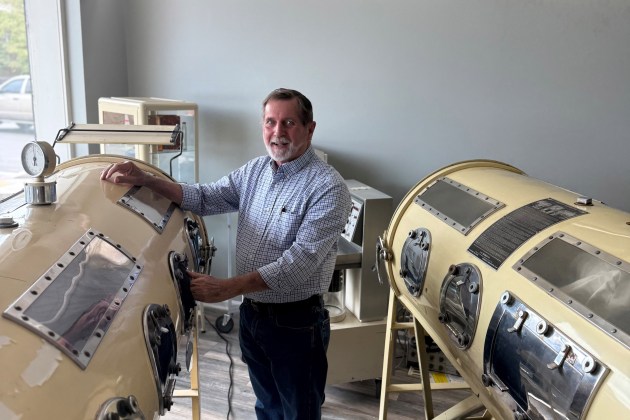
Iron lungs, the precursor to today’s mechanical ventilators, were developed to treat polio patients suffering from respiratory paralysis. These two iron lungs for adults, built by the J.H. Emerson Co. in the 1930s, are part of a collection owned by Gene Gantt, a Tennessee respiratory care consultant.(Donna Gantt)
Gantt, the respiratory care consultant, said that fewer than half of state Medicaid programs provide adequate reimbursement rates for ventilator patients. He said most state Medicaid payment formulas do not measure outcomes or reward nursing homes financially if they provide better care, such as weaning a patient off the ventilator or preventing infections. He said he has seen nursing homes accept patients with trach tubes even when nurses lack proper training, or when the facility doesn’t employ respiratory therapists.
“For the large part, these patients are stuck in bed,” Gantt said. “We should try to get them the best quality of life.”
David Gifford, the chief medical officer for the American Health Care Association, a nursing home trade group, said equipping a nursing home with ventilators and getting state approval is expensive, and outside of urban areas, many markets lack enough local patients who need ventilators to make it financially worthwhile.
“It’s not as simple as saying we’re going to pay more and have more respiratory therapists,” Gifford said. “This is a group that needs highly specialized care. You’re not going to have it everywhere.”
Flagging Breaths
Derek McManus’ weakening right hand and occasional twitching was the first sign something was wrong. In October 2023, doctors diagnosed Derek, a corporate executive who lives in Painted Post, New York, with ALS.
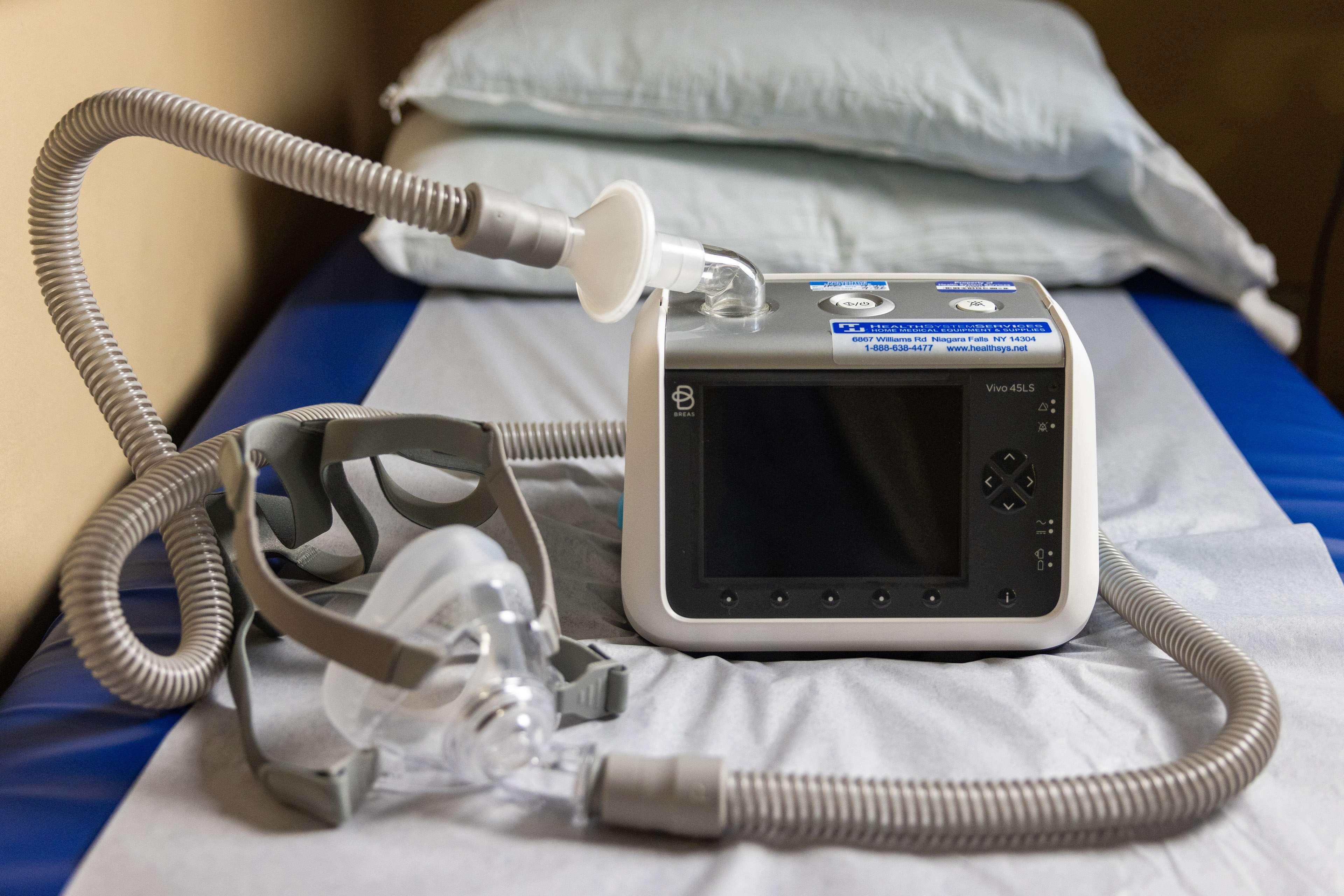
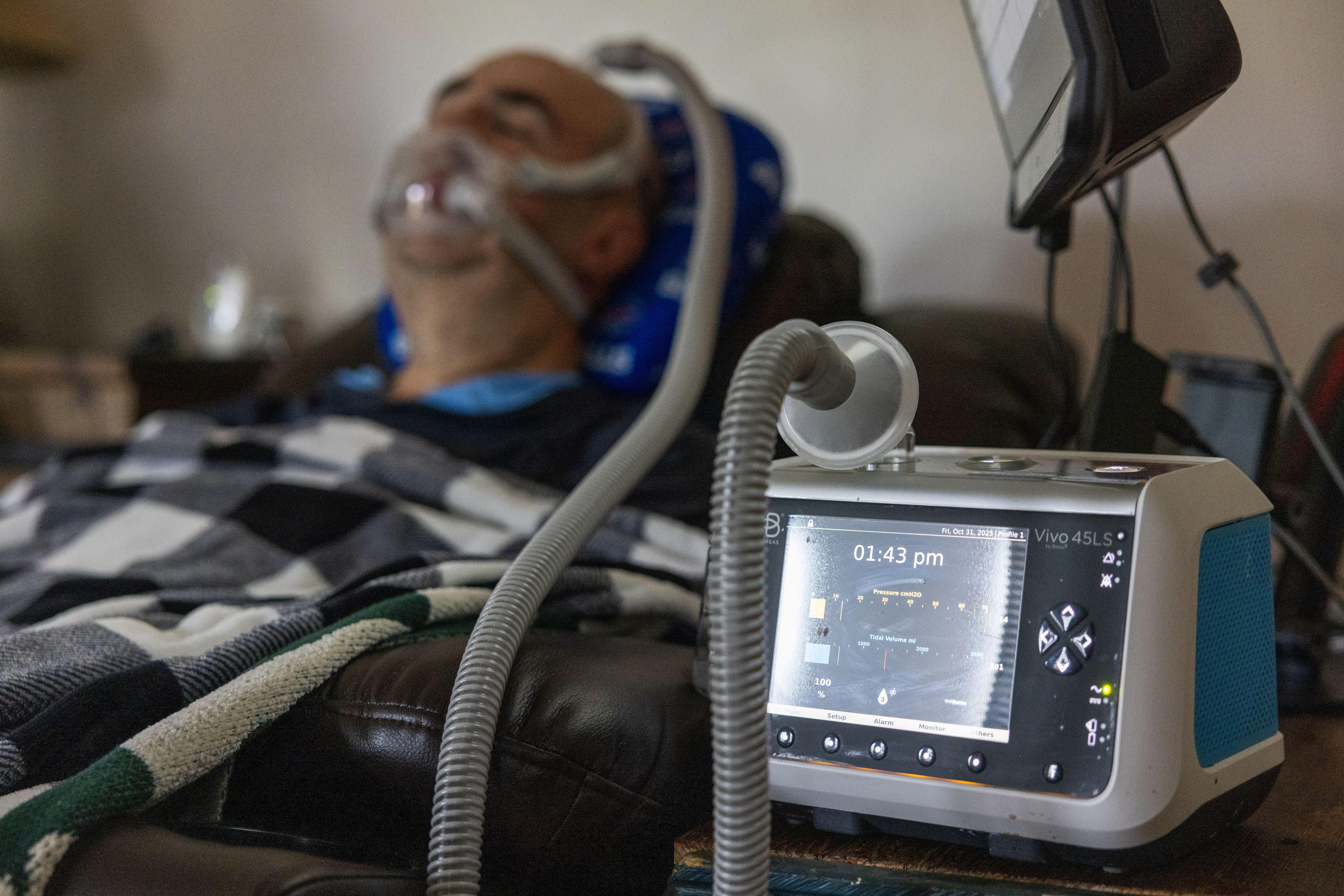
By August 2024, Derek’s lungs were operating at 78% of capacity, his medical records show. Because ALS progresses so quickly, doctors often prescribe advanced home mechanical ventilators. These machines deliver high-pressure air through a mask (called non-invasive) or a tube down the airway or via a tracheostomy (called invasive). They can calibrate themselves based on a patient’s breathing and have alarms that detect leaks, airway blockages, and device malfunctions. They can run on portable power sources and backup batteries in case of a power failure. The machines can allow people to talk or eat.
Derek McManus’ insurer refused to provide an advanced medical ventilator. Each machine can cost insurers more than $10,000. An independent appeals reviewer ordered the insurer to provide one.(Lauren Petracca for KFF Health News)
But some insurers have what physicians call “fail first” policies that won’t pay for ventilators unless the patient has already tried a respiratory assist device without success (as defined by the company). These simpler machines, the kind sleep apnea patients use, are not as effective in removing carbon dioxide as ventilators and lack safety features. Commonly known by the acronyms BiPAP or CPAP, they can cost $1,000 or more and need to be plugged into an electrical socket.
“It seems to be an expectation of insurance companies they should live the rest of their life attached to a wall outlet,” said Rehbein, the University of Rochester neurologist.
In November 2024, Derek’s insurer denied his physician’s request for a ventilator, writing that “you have not failed treatment” with the simpler device, according to the insurer’s letter, provided by his wife, Lesley McManus. By April, Derek’s breathing capacity had dropped to 60% of normal. Lesley said she worried he would suffocate overnight if his basic device stopped working, since it had no safety alert. “He couldn’t take the mask off, because he can’t move his hands,” she said.
The insurer denied a second request for a ventilator, reiterating that Derek had not shown the simpler machine hadn’t worked, according to another insurance letter. Derek, who is 56, appealed to an independent medical reviewer, who overturned the insurer’s decision and ordered it to provide a ventilator, according to a copy of the ruling. The doctor wrote that the machine’s alarm system and capacity to automatically clear away airway secretion by simulating a cough were “vital for patient safety” and would help protect Derek from developing pneumonia.
“This multi-faceted approach to respiratory care is essential for improving gas exchange, reducing the work of breathing, and ultimately enhancing the patient’s quality of life and extending survival,” the decision said.
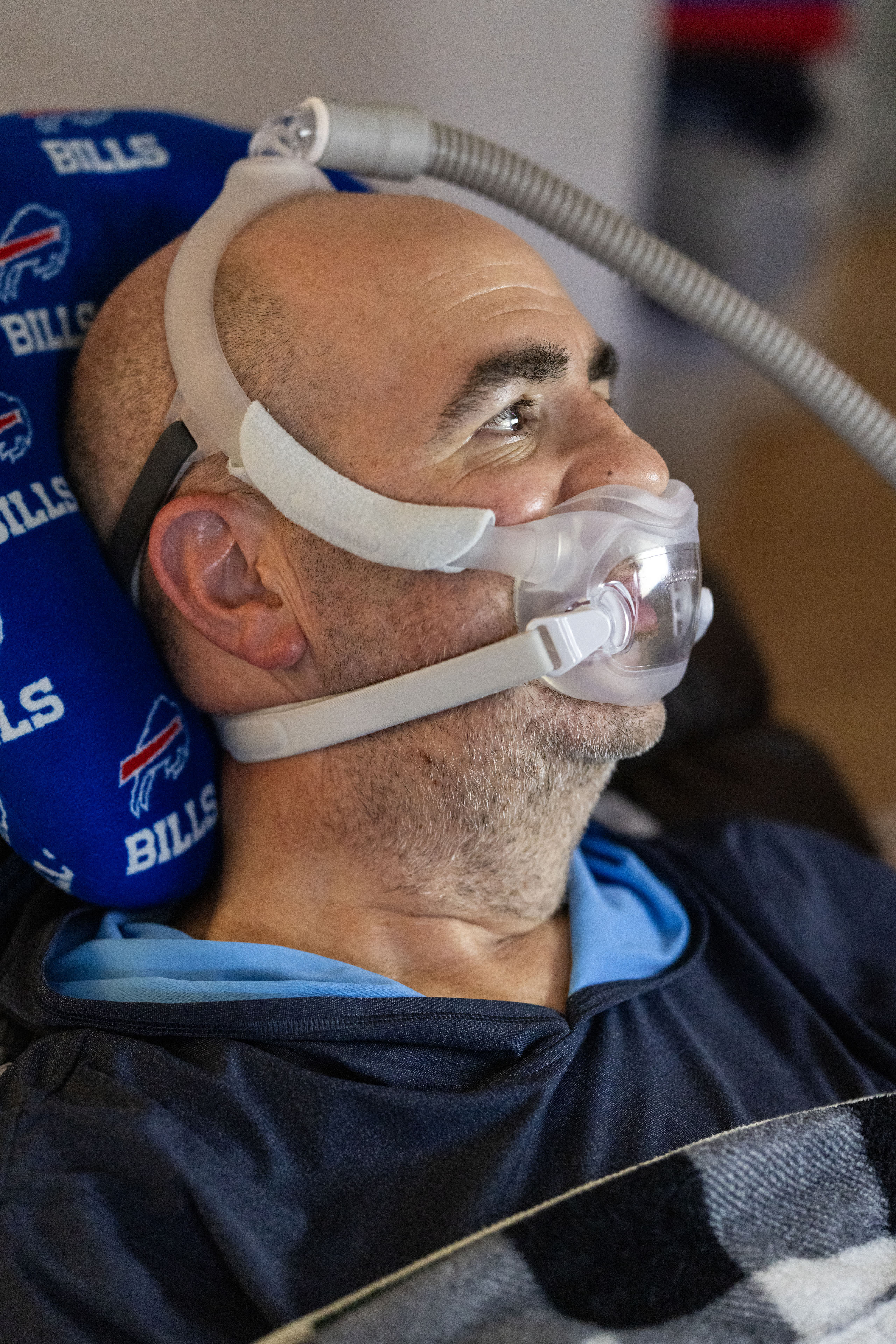
Derek said that since he got the new machine, he’s breathing easier, literally and emotionally. “If I’m not breathing right, it will give it an alert, and it will let us know if I don’t have the mask on properly,” he said.
The McManus family requested KFF Health News not publish their insurer’s name, out of fear of repercussions.
Derek McManus says his new ventilator has made things easier for him physically and emotionally.(Lauren Petracca for KFF Health News)
Insurance Rules
John Hansen-Flaschen, a pulmonologist who founded Penn Medicine’s program for home assisted ventilation, said some patients give up when an insurer denies their requests and don’t file appeals. “These are some of the most vulnerable people there are, and they don’t have energy to do this,” he said.
Doctors who treat patients with neuromuscular disorders said the most resistance to providing ventilators comes from some private Medicare Advantage plans, but they said it also has been an issue with some commercial policies.
Insurers dispute that they refuse ventilators for patients who need them. The written policy of Excellus BlueCross BlueShield, which Rehbein said was one of the companies that covers his patients, requires simpler breathing machines to have failed before patients can get the more sophisticated ventilator. After a KFF Health News inquiry, Excellus clarified its policy with a footnote saying it does consider mechanical ventilators as first-line therapy for certain situations, such as ALS, on a case-by-case basis.
UnitedHealthcare confirmed that some of its policies require that a less complex device be tried initially and found ineffective before a ventilator can be authorized. Aetna’s policy doesn’t mandate a stepped process and says it considers mechanical ventilators based on the severity of the condition and “where interruption or failure of respiratory support would lead to death,” with other patients eligible only for the simpler devices. Humana and Cigna did not respond to requests to provide their policies.
Chris Bond, a spokesperson for AHIP, the health insurance industry’s trade organization, said, “Health plans work to connect patients with safe, clinically appropriate care and welcome opportunities to work with policymakers and stakeholders across the health care system to continually improve access and precisely address any coverage-related issues.”
Melanie Lendnal, senior vice president for policy and advocacy at the ALS Association, said, “I haven’t met one person yet living with ALS, or a family member, who has not had to fight — really fight — to get a non-invasive ventilator.”
A Model in Massachusetts
In 2019, David Marion, a 36-year-old plumber, was hanging out with friends in Lowell, Massachusetts, when he tripped on the sidewalk and fractured his neck. The injury rendered him quadriplegic and paralyzed his abdominal and diaphragm muscles, requiring him to use a ventilator. Surgeons performed a tracheotomy, and over the next year and a half, Marion lived in two long-term acute care hospitals. “I didn’t get out of bed” at the second hospital, Marion, now 43, said in an interview.
His mother, Denise Valliere, who lives in New Hampshire, said she grew desperate trying to find a permanent home for him that was close enough that she could visit. “Some of those nursing homes are pretty sad places,” she said.
At the end of 2020, Marion’s luck turned. He was accepted by the Leonard Florence Center for Living in Chelsea, Massachusetts, which has created an alternative to the institutional life most nursing homes can offer people on ventilators. The center follows the Green House philosophy, with small residences each serving 10 people, with private bedrooms, a common living room, and outdoor space. Residents set their own schedules, including when and what to eat. The center has 10 residences in its building; six are dedicated to people dependent on ventilators, including those with ALS or MS.
The center’s respiratory therapists helped Marion get to the point where he didn’t need a feeding tube and didn’t require his ventilator for portions of the day. The center provided a portable ventilator attached to his wheelchair and a computer tablet that Marion operates with his mouth. It allows him to summon the elevator, open doors, go outside, and adjust his bed, window shades, temperature, and television settings. Other residents who can’t use their hands or mouths can operate the devices through a camera that captures eye movement.
“This gives back independence to people who never thought they’d have independence again,” said Barry Berman, the chief executive officer of Chelsea Jewish Lifecare, the nonprofit that owns the Leonard Florence Center. “There are alternatives. It doesn’t have to be the way that it is.”
Residents at the Leonard Florence Center for Living in Chelsea, Massachusetts, are given computer tablets they can operate with their mouths or eye movements to open doors, call elevators, and adjust the lights, shades, temperature, and TV in their rooms. This is a screen they see to select options. (Steve Saling)
Most of the residents’ stays are paid for by Medicaid, which together with Medicare provides the bulk of the center’s revenue. Its finances are bolstered by the nonprofit’s endowment, something most nursing homes lack. Berman said that since the center opened in 2010, he has hosted dozens of visitors interested in replicating its model elsewhere in the country, but no one has.
Some states have licensed facilities that aren’t nursing homes to care for people on ventilators. In California, some people on ventilators live in “congregate living health facilities,” which are residential houses that provide 24-hour skilled nursing for the terminally ill, people who are catastrophically or severely disabled, or people who are mentally alert but physically disabled.
Patients often must pay privately because Medicaid managed care programs don’t include these facilities as a benefit, said Mariam Voskanyan, who is president of the state association representing congregate living facilities and owns one in Los Angeles. California’s Medi-Cal program is authorized to pay these kinds of facilities through its Home and Community-Based Alternatives waiver, but the program is at capacity and there is a waitlist of more than 5,000 people.
Valliere, Marion’s mother, said she was baffled that there were not more places like Leonard Florence. “How can we be so behind in that kind of care and those kinds of facilities if we’re the best country in the world,” she asked. “Why is this?”